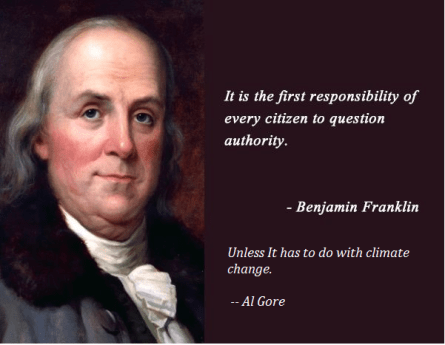
Question Authority

I’m making this a sticky post for the day. Its important.

Question Authority?AlGore
With seven state attorneys general and Al Gore sharing a New York City stage , there was no doubt about it: It was showtime for a whodunit. The crime being investigated? Dissent.

The March 29 news conference unveiled, according to New York Attorney General Eric T. Schneiderman, an “unprecedented” coalition to fight not only climate change but also allegedly deceptive speech about climate change. The group, which dubbed itself AGs United for Clean Power, promised to “use all the tools at our disposal” to battle for progress on “the most consequential issue of our time.”

Schneiderman was blunt about his goal of shutting down debate: “You have to tell the truth. You can’t make misrepresentations of the kinds we’ve seen here.”

This isn’t a law-and-order drama. It’s politics clothed in messianic garb, and its primary tools are censorship and intimidation.

The AGs are following a familiar script here: target an unpopular, deep-pocketed business, harass that business’s potential allies with overly broad investigations, run roughshod over the target’s First Amendment protections and settle once the politically weakened company tires of fighting the endless resources of the state.

ExxonMobil was singled out by name at the news conference, but the coalition appears to be following the script perfectly. Now it’s on to the fishing-expedition stage.

On April 7, our organization, the Competitive Enterprise Institute, was subpoenaed by coalition member and U.S. Virgin Islands Attorney General Claude Walker for all CEI material on climate change and energy policy, as well as information on our supporters, over 10 years beginning in 1997. The subpoena’s purported focus is on our contacts with ExxonMobil, a former CEI donor that publicly ended its support for us after 2005. Nonetheless, the subpoena calls for practically all of our material on climate change and energy policy, as well as information on any donors who directly or indirectly supported that work.

Read the rest

Earth Day 1970 Predictions

Earth day 1970 predictions didn’t come true.

1. Harvard biologist George Wald estimated that “civilization will end within 15 or 30 years unless immediate action is taken against problems facing mankind.”

2. “We are in an environmental crisis which threatens the survival of this nation, and of the world as a suitable place of human habitation,” wrote Washington University biologist Barry Commoner in the Earth Day issue of the scholarly journal Environment.

3. The day after the first Earth Day, the New York Times editorial page warned, “Man must stop pollution and conserve his resources, not merely to enhance existence but to save the race from intolerable deterioration and possible extinction.”

4. “Population will inevitably and completely outstrip whatever small increases in food supplies we make,” Paul Ehrlich confidently declared in the April 1970 Mademoiselle. “The death rate will increase until at least 100-200 million people per year will be starving to death during the next ten years.

5. “Most of the people who are going to die in the greatest cataclysm in the history of man have already been born,” wrote Paul Ehrlich in a 1969 essay titled “Eco-Catastrophe! “By…[1975] some experts feel that food shortages will have escalated the present level of world hunger and starvation into famines of unbelievable proportions. Other experts, more optimistic, think the ultimate food-population collision will not occur until the decade of the 1980s.

6. Ehrlich sketched out his most alarmist scenario for the 1970 Earth Day issue of The Progressive, assuring readers that between 1980 and 1989, some 4 billion people, including 65 million Americans, would perish in the “Great Die-Off.

7. “It is already too late to avoid mass starvation,” declared Denis Hayes, the chief organizer for Earth Day, in the Spring 1970 issue of The Living Wilderness.

8. Peter Gunter, a North Texas State University professor, wrote in 1970, “Demographers agree almost unanimously on the following grim timetable: by 1975 widespread famines will begin in India; these will spread by 1990 to include all of India, Pakistan, China and the Near East, Africa. By the year 2000, or conceivably sooner, South and Central America will exist under famine conditions….By the year 2000, thirty years from now, the entire world, with the exception of Western Europe, North America, and Australia, will be in famine.

9. In January 1970, Life reported, “Scientists have solid experimental and theoretical evidence to support…the following predictions: In a decade, urban dwellers will have to wear gas masks to survive air pollution…by 1985 air pollution will have reduced the amount of sunlight reaching earth by one half….

10. Ecologist Kenneth Watt told Time that, “At the present rate of nitrogen buildup, it’s only a matter of time before light will be filtered out of the atmosphere and none of our land will be usable.”

Study: No Difference Between 20th-century Rainfall Patterns and Those in the Pre-­Industrial Era

What a shocker. The climate cycles keep going up and down and so-called global warming” doesn’t change it

Predictions that a warmer ­climate will lead to more rain for some but longer droughts for others might be wrong, according to a study of 12 centuries worth of data.

The study, published today in science journal Nature, found there was no difference between 20th-century rainfall patterns and those in the pre-­industrial era. The findings are at odds with earlier studies suggesting climate­ change causes dry areas to become drier and wet areas to become wetter.

Fredrik Ljungqvist and colleagues at Stockholm University analysed previously published records of rain, drought, tree rings, marine sediment and ice cores, each spanning at least the past millennium across the northern hemisphere.

They found that the ninth to 11th and the 20th centuries were comparatively wet and the 12th to 19th centuries were drier, a finding that generally accords with earlier model simulations covering the years 850 to 2005.

However, their reconstruction “does not support the tendency in simulations of the 20th century for wet regions to get wetter and dry regions to get drier in a warmer climate”.

Our reconstruction reveals that prominent seesaw patterns of alternating moisture regimes observed in instrumental data across the Mediterranean, western USA and China have operated consistently over the past 12 centuries,” the paper says.

http://www.thegwpf.com/climate-model-predictions-on-rain-and-drought-wrong-study-finds/

Ontario Wood Pellets Would Have Produced Less Than Half Of The (net) CO2 as Norwegian Wood Pellets

Ontario is importing “advanced biomass” wood pellets from Norway. See the post here is you are coming in late.

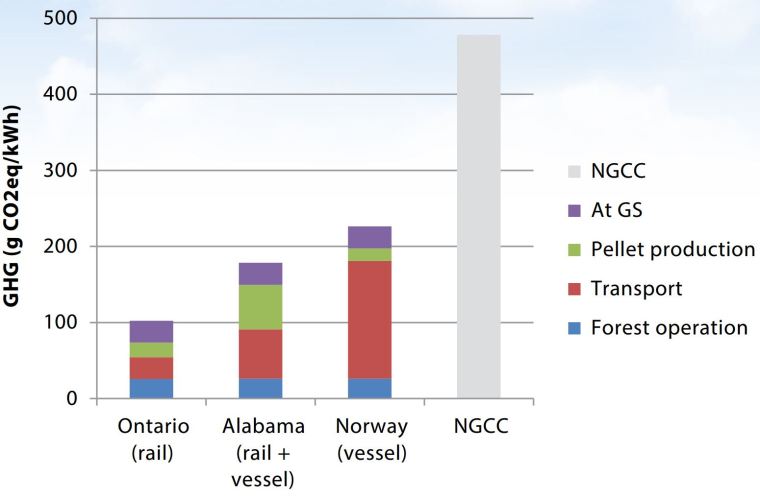
I was looking for total CO2 figures for the Atikokan plant. I haven’t found any yet. But I did find an OPG document showing CO2 production of 4 scenarios at Thunder Bay (which is also burning Norwegian Wood). One of those scenarios is a Natural Gas Combined Cycle power plant. It showed that plant producing a huge amount of CO2 compared to wood pellets. I know that isn’t true from this article.

Then I realized the the wood pellet CO2 numbers are based not on actual amount of CO2, but on the “net CO2” which is CO2 minus the fudge factor applied by the AGW cult to claims that since the trees are renewable most of the CO2 doesn’t really count. (page 10  and 11 here)

The key is where they use the term (net) as in “Green House Gas (GHG) Life Cycle Assessment (net)”

Anyway … back to comparing Ontario Wood Pellets to Norway Wood Pellets.

From this OPG document:

Capture_Norway_CO2

See all that CO2 produced by transporting all those pellets from Norway!


Ontario Spent 170 million to Convert a Coal Power Plant to burn Norwegian Wood Pellets

Ontario has shut down its coal power plants. One of those coal power plants was Atikokan. What OPG decided to do (because they needed dispatchable power) was to convert the plant to biomass. And that biomass was wood pellets. Not just any wood pellets. It was “Advanced Biomass”.

Advanced biomass has been treated to withstand exposure to rain, and has handling and storage properties similar to those of coal. It is still in the early stages of development, which is why OPG purchases advanced biomass fuel from Norway.

Before we get to CO2 and squandering hundreds of millions to change from one fuel you burn to anther fuel you burn …. you may ask yourself why you need to make wood pellets waterproof.

Wet biomass catches on fire. Or explodes.

Biomass fuel has a wide range of possible refuse items: pellets, chip logs, forestry, sewage sludge, methane, meat and bone, palm kernels, cereal, sawdust, bioenergy crops, or landfill gas. When a biomass fuel is stored in a pile, waiting for transport or use, the biomass can spontaneously heat through oxidation. In order for this to happen, three conditions must sync: rate of heat generation, air supply, and insulation properties of the immediate surroundings. With most biomass material, there is a high moisture content combined with air and/or bacterial fermentation – both of which can cause spontaneous combustion through oxidation.

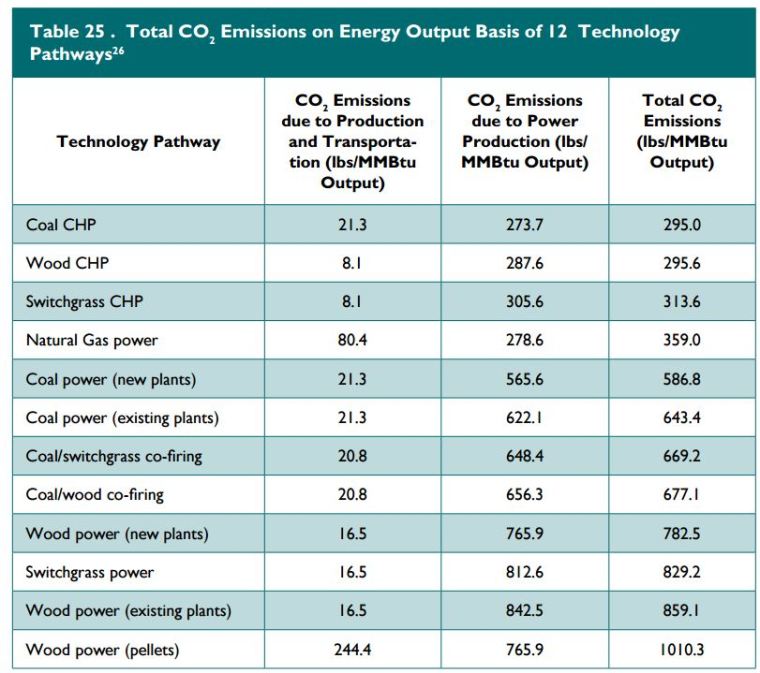
Back to CO2. The study I have referenced before told us that wood pellets (especially those transported long distances like USA to UK) produce way more CO2 than coal. So I would assume that if you buy wood pellets from Norway, your power plant is producing more CO2 than if you had not spent 170 million and were still burning coal.

CO2emissions


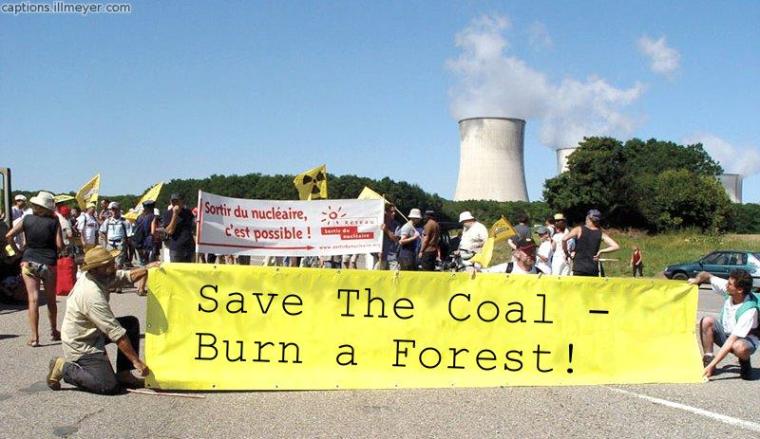
‘Green’ logic confuses me.Killing Norwegian forests and turning the wood into special waterproof pellets and then using a lot of fossil fuel to ship it to Ontario to burn in a closed down resurrected coal power plant seems crazy to me.


SaveTheCoal


Climate “Scientists” off by a factor of 5.

Another study proving the science isn’t settled and the previous assumptions about catastrophic climate change just aren’t true.

Until now, most scientists have thought that a warming planet would cause plants to release more carbon dioxide into the atmosphere, which in turn would cause more warming.

But in a study published Wednesday in Nature, scientists showed that plants were able to adapt their respiration to increases in temperature over long periods of time, releasing only 5 percent more carbon dioxide than they did under normal conditions. Based on measurements of short-term temperature responses in this study and others, the scientists expected that the plants would increase their respiration by nearly five times that much.


UK at Risk of Blackouts For Next Four Years

This is what “green” means. No more security of energy supply. Blackouts. 100s of thousands of jobs gone (transferred to China/India so they can use cheap energy from coal)

The former boss of one of Britain’s biggest energy suppliers has warned that the safety buffer separating Britain from power cuts will be uncomfortably slim for up to four years.

Experts had already warned this winter that Britain was at its highest risk of blackouts in more than a decade before the announcement of a succession of closures of coal-fired power stations.

Paul Massara, a former chief executive of npower, warned yesterday that the tight supply would last for up to four winters, in contrast with rosier forecasts from the regulator that the safety buffer between capacity and peak electricity

http://www.thetimes.co.uk/article/britain-on-the-brink-of-blackouts-for-four-winters-h55qpbv3z


Not Enough Fossil Fuels Left to Double CO2

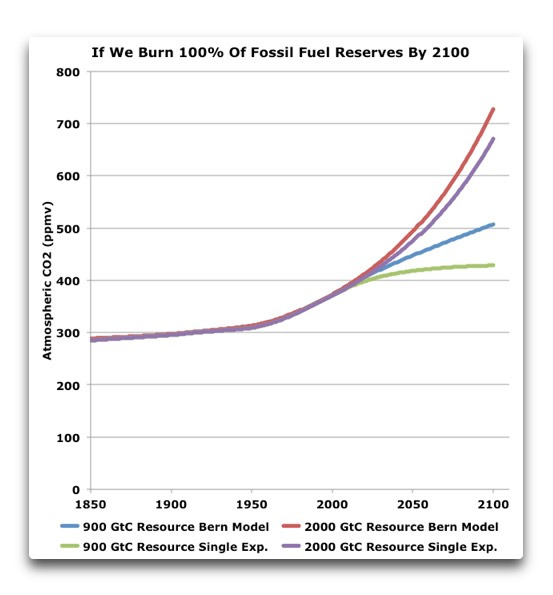
According to Willis Eschenbach there isn’t enough fossil fuels left in the ground to double CO2 in the atmosphere even if we burned it all by 2100.

if-we-burn-it-all-by-21002

Physics says the direct warming caused by a doubling of CO2 is only around 1.2C.

Then there are theories about feedbacks that have yet to be proven.


Word of the Day: Sewage Sludge

Ok. Technically Sewage Sludge is a phrase.

The other day I was talking about cofiring. And I discovered that one of the fuels they cofire alongside coal is sewage sludge.

What is sludge?

Up to 95 percent is water. But it starts as wastewater, which is a mix of food, paper, diapers, plant mater, feces, condoms, sanitary napkins, paints, pesticides, bacteria, pathogens, pharmaceuticals, sand, metal particles, road salt, insects and gases.

I think I would prefer 100% coal.