CO2 Greens The Western US

Another shocker. AGW predicts brown ….  and green happens.

A new study just gave people another reason to be skeptical of climate models relied upon by scientists to predict the future impacts of global warming.

Climate models have long predicted man-made global warming would cause the western U.S. to become more arid and brown, but that’s not what happened. A new study examining three decades worth of satellite data found the western U.S. — indeed, the world in general — is greening because of increased carbon dioxide emissions.

It’s another prediction failure from climate models, according to Chip Knappenberger, a scientist at the libertarian Cato Institute. Knappenberger pointed out on Twitter that climate models predicting “browning” in the western U.S. were dead wrong.

CO2: Wood versus Coal

How much CO2 does wood produce versus coal?

The results of our analysis shows that wood is generally about the same 
or slightly lower in CO2 emissions on a dry basis, 
but both wood and coal do not naturally have zero moisture content (MC).

The typical moisture content of coal is:
  • Anthracite Coal : 2.8% - 16.3% by weight
  • Bituminous Coal : 2.2% - 15.9% by weight
  • Lignite Coal : 39% or more by weight
It is the water that causes CO2 emissions to increase over the dry weight. 
The underlying cause that drives this is “the enthalpy of vaporization.” 
In simple terms, it takes energy to evaporate the water in wood or coal 
and convert it to vapor, and all of that energy is sent out the chimney 
and into the atmosphere in the form of water vapor, unless a condensing 
boiler is used which may claim part of the escaping energy. 
To get a million BTUs of useful energy from the fuel, 
a larger mass of wood or coal is necessary to compensate for the losses 
from vaporizing all that water. And more wood/coal burned means more CO2 produced. 

With coal, the higher water content grades also have lower carbon content 
and higher volatiles. The net effect of this is that, on average, CO2 
outputs are relatively consistent across grades (see Table 2). 

At 45 percent, the combustion of wood yields about 9.0 percent 
more CO2 per unit of useful energy than an average of the coal 
grades’ outputs. 

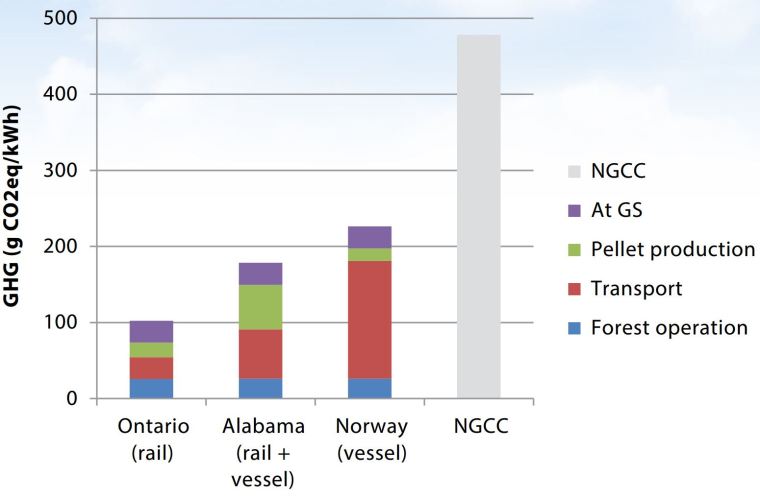
Ontario Wood Pellets Would Have Produced Less Than Half Of The (net) CO2 as Norwegian Wood Pellets

Ontario is importing “advanced biomass” wood pellets from Norway. See the post here is you are coming in late.

I was looking for total CO2 figures for the Atikokan plant. I haven’t found any yet. But I did find an OPG document showing CO2 production of 4 scenarios at Thunder Bay (which is also burning Norwegian Wood). One of those scenarios is a Natural Gas Combined Cycle power plant. It showed that plant producing a huge amount of CO2 compared to wood pellets. I know that isn’t true from this article.

Then I realized the the wood pellet CO2 numbers are based not on actual amount of CO2, but on the “net CO2” which is CO2 minus the fudge factor applied by the AGW cult to claims that since the trees are renewable most of the CO2 doesn’t really count. (page 10  and 11 here)

The key is where they use the term (net) as in “Green House Gas (GHG) Life Cycle Assessment (net)”

Anyway … back to comparing Ontario Wood Pellets to Norway Wood Pellets.

From this OPG document:

Capture_Norway_CO2

See all that CO2 produced by transporting all those pellets from Norway!


CO2 is a Benefit

CO2 is a huge benefit to agriculture and nature.

It’s an undeniable fact that increasing CO2 increases plant growth. CO2 increases since 1985 have led to increased rainforest and crop growth, satellites show a 14 per cent increase in global greenery – fantastic news for nature and food security. Despite climate pessimists, global food prices remain low, with record yields achieved last year. Food prices would be even lower if the US ceased growing subsidised, inefficient “green” bioethanol crops. Extra production from rising “CO2 fertilisation” is equivalent to an extra 15 per cent land globally. This equals 35 times UK arable area, enough to feed the entire world their daily bread, worth over £100 billion yearly, plus the environmental benefit of increased growth in natural ecosystems. All down to a supposed “villain”.

Dr Keith P Dawson is vice President at the Scottish Society of Crop Research

Read more: The Scotsman


Ontario Spent 170 million to Convert a Coal Power Plant to burn Norwegian Wood Pellets

Ontario has shut down its coal power plants. One of those coal power plants was Atikokan. What OPG decided to do (because they needed dispatchable power) was to convert the plant to biomass. And that biomass was wood pellets. Not just any wood pellets. It was “Advanced Biomass”.

Advanced biomass has been treated to withstand exposure to rain, and has handling and storage properties similar to those of coal. It is still in the early stages of development, which is why OPG purchases advanced biomass fuel from Norway.

Before we get to CO2 and squandering hundreds of millions to change from one fuel you burn to anther fuel you burn …. you may ask yourself why you need to make wood pellets waterproof.

Wet biomass catches on fire. Or explodes.

Biomass fuel has a wide range of possible refuse items: pellets, chip logs, forestry, sewage sludge, methane, meat and bone, palm kernels, cereal, sawdust, bioenergy crops, or landfill gas. When a biomass fuel is stored in a pile, waiting for transport or use, the biomass can spontaneously heat through oxidation. In order for this to happen, three conditions must sync: rate of heat generation, air supply, and insulation properties of the immediate surroundings. With most biomass material, there is a high moisture content combined with air and/or bacterial fermentation – both of which can cause spontaneous combustion through oxidation.

Back to CO2. The study I have referenced before told us that wood pellets (especially those transported long distances like USA to UK) produce way more CO2 than coal. So I would assume that if you buy wood pellets from Norway, your power plant is producing more CO2 than if you had not spent 170 million and were still burning coal.

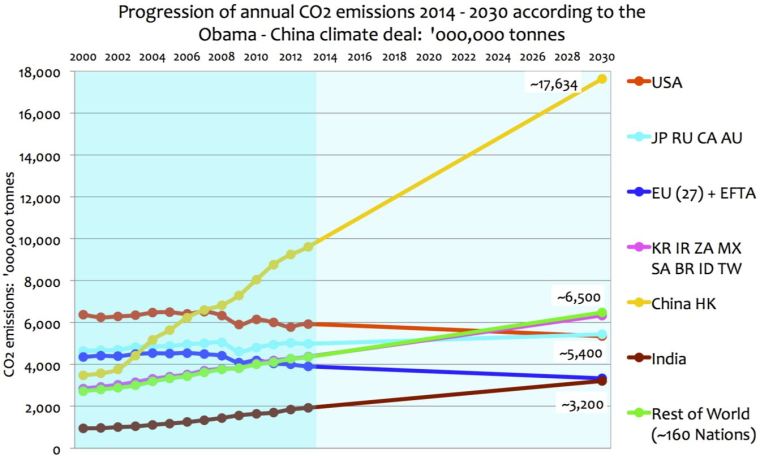
CO2emissions


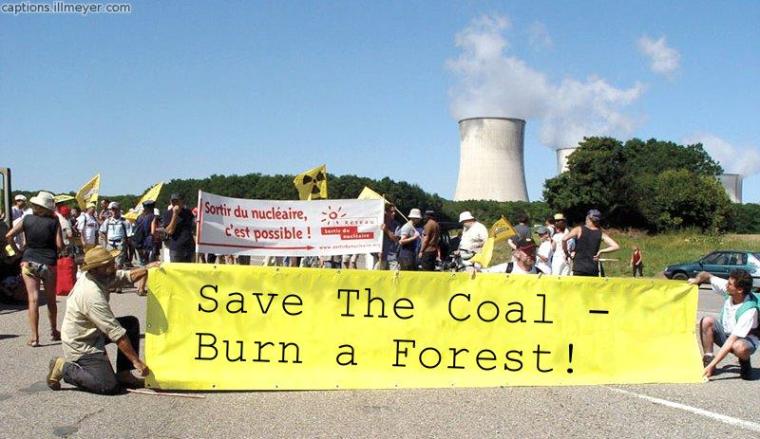
‘Green’ logic confuses me.Killing Norwegian forests and turning the wood into special waterproof pellets and then using a lot of fossil fuel to ship it to Ontario to burn in a closed down resurrected coal power plant seems crazy to me.


SaveTheCoal


Not Enough Fossil Fuels Left to Double CO2

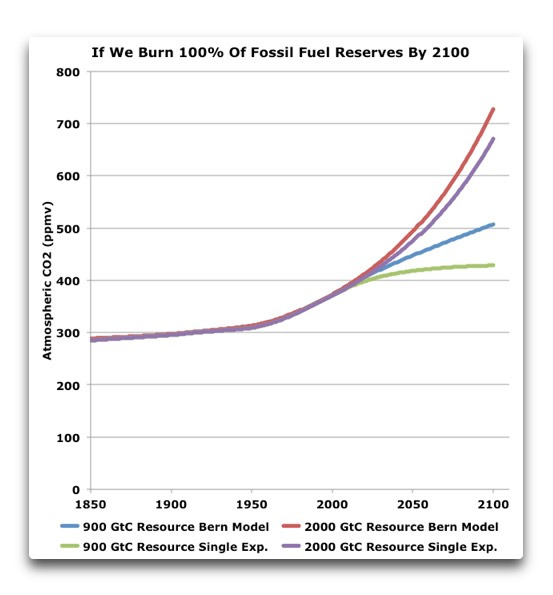
According to Willis Eschenbach there isn’t enough fossil fuels left in the ground to double CO2 in the atmosphere even if we burned it all by 2100.

if-we-burn-it-all-by-21002

Physics says the direct warming caused by a doubling of CO2 is only around 1.2C.

Then there are theories about feedbacks that have yet to be proven.


Word of the Day: Sewage Sludge

Ok. Technically Sewage Sludge is a phrase.

The other day I was talking about cofiring. And I discovered that one of the fuels they cofire alongside coal is sewage sludge.

What is sludge?

Up to 95 percent is water. But it starts as wastewater, which is a mix of food, paper, diapers, plant mater, feces, condoms, sanitary napkins, paints, pesticides, bacteria, pathogens, pharmaceuticals, sand, metal particles, road salt, insects and gases.

I think I would prefer 100% coal.


Word of the Day: Cofiring and more CO2

Cofiring: the combustion of two different types of materials at the same time.

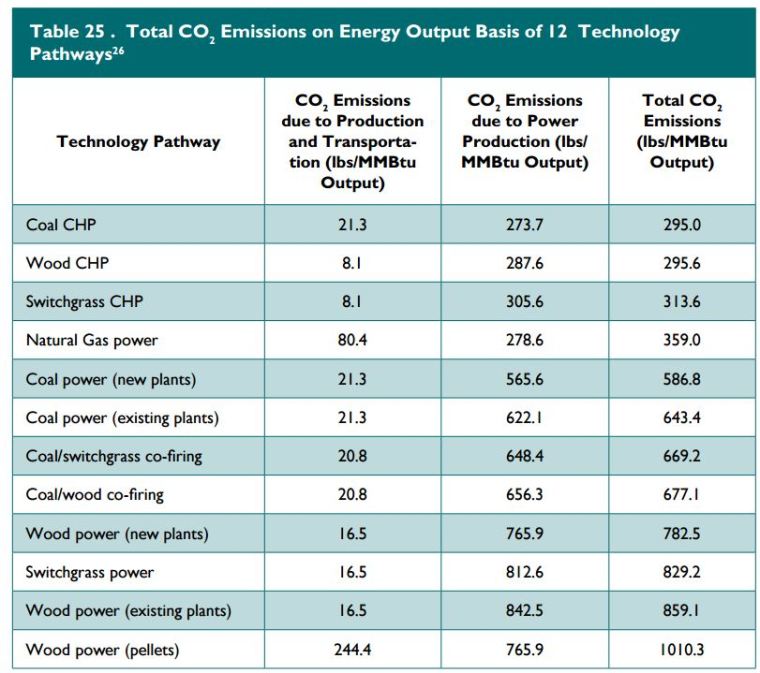
This word may not be new to many of you (or some of you) but it was to me. Or course I have mocked the idea of replacing coal with wood since burning wood from the USA creates more CO2 than coal. The DRAX post from the other day points out that even DRAX’s own study showed more CO2 from wood pellets than from coal.

And destroying forests to produce more CO2 in the atmosphere seems to me to be amazingly stupid.

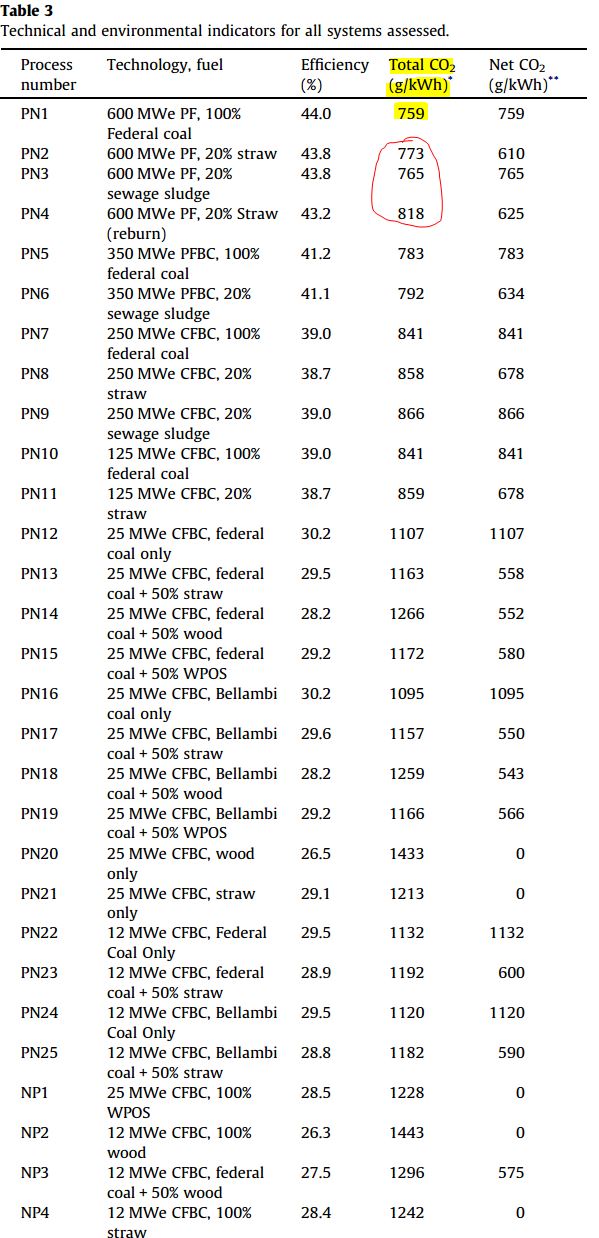
So I’ve been investigating to see what kind of cofiring goes on and how much CO2 is produced. The really important terms are Total CO2 and Net CO2 and CO2 neutral.

Total CO2 refers to the gross emissions of CO2 from this power plant.

Net CO2 refers to the emissions of CO2 from the fossil fuel used in this power plant, since biomass is assumed to be CO2 neutral. Gross CO2 and net CO2 will be the same where only fossil fuel is used.

In my opinion the concept of CO2 neutral is bogus. CO2 is CO2. If you generate 600MW of power and you care about CO2 then it shouldn’t matter whether you use coal or sewage sludge or any other biomass. It should be total CO2. (Not completely true because other things are produced from coal power plants like SO2 etc but today we talk CO2)

I came across this paper: A Techno-economic assessment of the reduction of carbon dioxide emissions through the use of biomass co-combustion

The paper claims:

Using sustainably-grown biomass as the sole fuel, or co-fired with coal, is an effective way of reducing the net CO2 emissions from a combustion power plant. There may be a reduction in efficiency from the use of biomass, mainly as a result of its relatively high moisture content, and the system economics may also be adversely affected.

Notice the term net CO2 is used. Their conclusions are based on the fallacy that the CO2 produced by burning the biomass is zero. But they were nice enough (honest enough?) to show the figures for total CO2.

The table shows the result of the experiments. The one I highlighted has 4 sections:

PN1: a 600MW power plant burning 100% coal. CO2 = 759 g/kWh
PN2: a 600MW power plant burning 80% coal and 20% straw. 773 g/kWh
PN3: a 600MW power plant burning 80% coal and 20% sewage sludge. 765 g/kWh
PN4: a 600MW power plant burning 80% coal and 20% straw (reburn). 818 g/kWh

In all cases biomass+coal cofiring produces more CO2. And the CO2 numbers don’t take into account transportation of coal or biomass. So locally sourced biomass isn’t a disaster. But wood pellets from the USA produce a lot of CO2 just in transport costs.
Capture


Germany Will Need 3,000 Wind Turbines To Replace One Nuke Plant

Insane: Germany Will Need 3,000 Wind Turbines To Replace This Workhorse Nuke Plant

“Germany’s Grohnde nuclear power plant in Lower Saxony has just become the single most productive power plant in history. It just passed its 350 billion kWh production milestone, the most of any nuclear plant, and the most of any plant of its size in the world.”

“Unfortunately, Grohnde is scheduled to close in 2021, decades ahead of its useful life, like all of Germany’s nuclear plants, and the positive and negative affects of that policy are still being debated.

In 2001, Gerhard Schröder’s government decided to get rid of nuclear power from the country as fast as possible. In 2010, Merkel actually decided to extend the lives of nuclear power plants another ten years beyond Schröder’s limit. But the Fukushima disaster in 2011 forced her politically to revert back to the original plan, closing eight nuclear plants immediately and planning to close the rest in the following 10 years.”

http://www.forbes.com/sites/jamesconca/2016/03/21/the-little-reactor-that-could-germanys-grohnde-nuclear-plant/

German power companies have been forced to set aside 39 billion Euros for the nuke decommissioning.

And most likely Germany will still be burning huge amounts of brown coal long after the last nuke is shutdown.