US Senate Considering Albedo Modification Geoengineering Proposal

The US Senate is considering an “Albedo Modification Geoengineering Proposal”.

Budgetmakers in the U.S. Senate want the Department of Energy (DOE) to study the possibility of making Earth reflect more sunlight into space to fight global warming. Earth’s reflectivity is known as its albedo, and the request to study “albedo modification” comes in the details of a proposed spending bill passed by the Senate appropriations committee to fund DOE, the Army Corps of Engineers, and related agencies for fiscal year 2017, which begins 1 October. The bill does not specify how much money should be spent on the research.

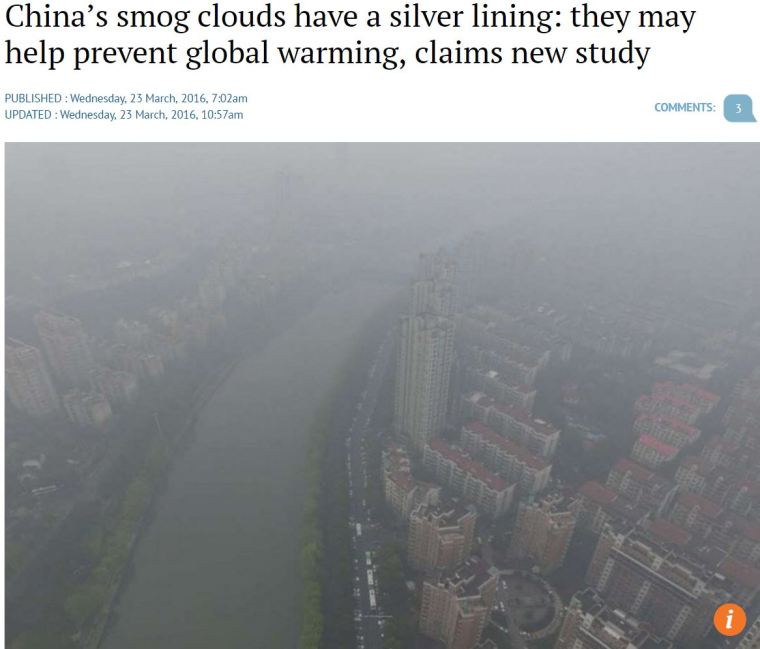
In a surprise move, 200 companies in China decided to bid on the contract. Most of their plans involved reopening all the coal power plants President Obama has shut down.

china smog


Irony in Antarctica

Students set sail to save the world!

… university students, techies, researchers, executives and greens with a common cause to save earth from ill-effects of greenhouse emissions, rapid urbanisation, excess consumption of natural resources and changing lifestyle.

Irony!

Setting off in ‘Ocean Endeavour’, the luxury ship navigated by 50 crew members,

Luxury!

The ship offers a superb guest experience with a nautical lounge, two restaurants, sundeck, and ample deck space for observation of polar landscapes. The ship’s interiors have a contemporary aesthetic that provides a bright and spacious feel to the cabins and common spaces.

Ocean Endeavour has a focus on health and wellness with newly-built saunas, pool, gym, hot tub and the Wellness Café and Juice Bar. The ship will offer guests onboard services and amenities that that will enhance their Polar expedition experience. There is also a Polar Boutique, where guests can buy gifts and/or any gear they might need for the voyage.


40_745_420_quark_ocean_endeavour_exterior_crp

Opinion: Fukushima 5 years on – ‘The Germans are crazy’

There are still eight nuclear power plants on the German energy grid; once there were almost twenty. In six years the last eight will also have been shut down. No more controversies in parliament, no more public debates. It is easy to overlook the fact that a special commission is discussing just how much it will cost to dismantle what is left of Germany’s nuclear energy program, and who will have to pay for it. The energy companies? Or will taxpayers get stuck with the bill in the end? It is a debate for insiders.

Read more: http://www.dw.com/en/opinion-fukushima-5-years-on-the-germans-are-crazy/a-19109743

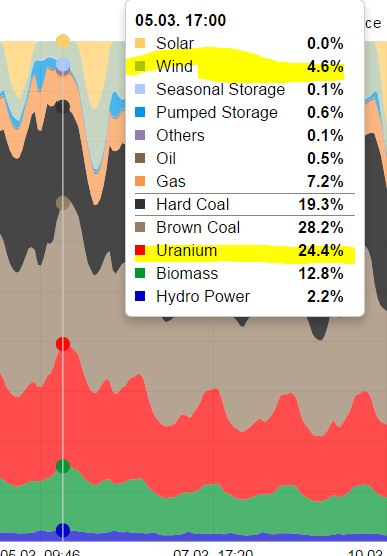
Just remember March 7 2016 (not that unusual) when wind dropped to essentially zero.

Or March 5th when uranium supplied 24.4% and wind 4.6%.

Capture


Word of the Day: Sewage Sludge

Ok. Technically Sewage Sludge is a phrase.

The other day I was talking about cofiring. And I discovered that one of the fuels they cofire alongside coal is sewage sludge.

What is sludge?

Up to 95 percent is water. But it starts as wastewater, which is a mix of food, paper, diapers, plant mater, feces, condoms, sanitary napkins, paints, pesticides, bacteria, pathogens, pharmaceuticals, sand, metal particles, road salt, insects and gases.

I think I would prefer 100% coal.


Word of the Day: Cofiring and more CO2

Cofiring: the combustion of two different types of materials at the same time.

This word may not be new to many of you (or some of you) but it was to me. Or course I have mocked the idea of replacing coal with wood since burning wood from the USA creates more CO2 than coal. The DRAX post from the other day points out that even DRAX’s own study showed more CO2 from wood pellets than from coal.

And destroying forests to produce more CO2 in the atmosphere seems to me to be amazingly stupid.

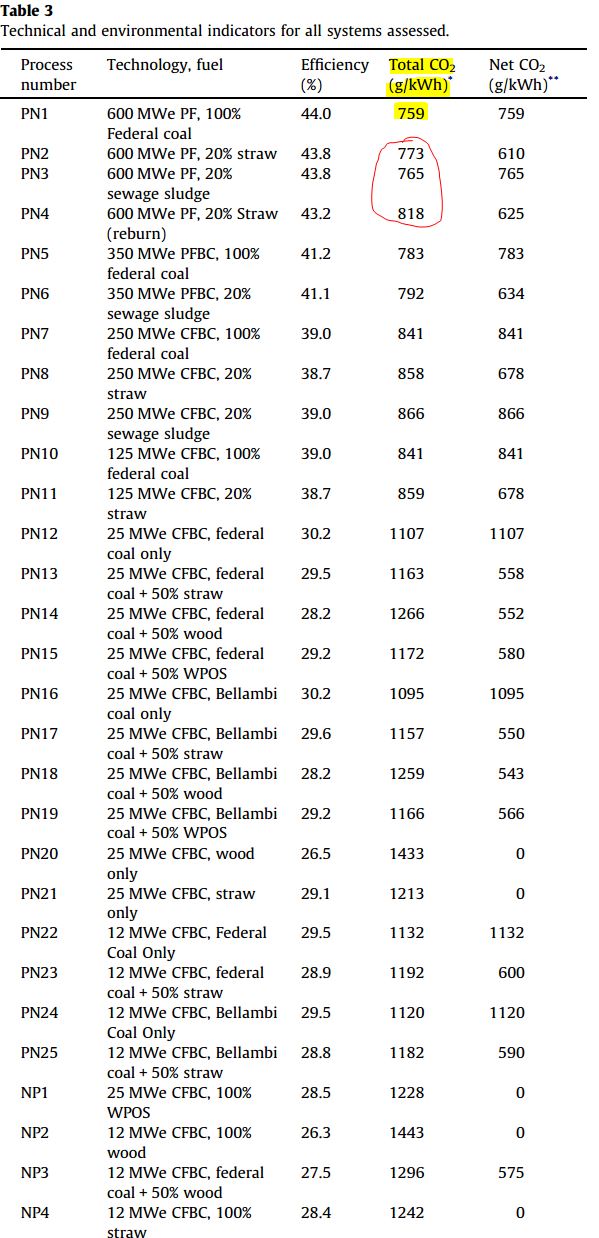
So I’ve been investigating to see what kind of cofiring goes on and how much CO2 is produced. The really important terms are Total CO2 and Net CO2 and CO2 neutral.

Total CO2 refers to the gross emissions of CO2 from this power plant.

Net CO2 refers to the emissions of CO2 from the fossil fuel used in this power plant, since biomass is assumed to be CO2 neutral. Gross CO2 and net CO2 will be the same where only fossil fuel is used.

In my opinion the concept of CO2 neutral is bogus. CO2 is CO2. If you generate 600MW of power and you care about CO2 then it shouldn’t matter whether you use coal or sewage sludge or any other biomass. It should be total CO2. (Not completely true because other things are produced from coal power plants like SO2 etc but today we talk CO2)

I came across this paper: A Techno-economic assessment of the reduction of carbon dioxide emissions through the use of biomass co-combustion

The paper claims:

Using sustainably-grown biomass as the sole fuel, or co-fired with coal, is an effective way of reducing the net CO2 emissions from a combustion power plant. There may be a reduction in efficiency from the use of biomass, mainly as a result of its relatively high moisture content, and the system economics may also be adversely affected.

Notice the term net CO2 is used. Their conclusions are based on the fallacy that the CO2 produced by burning the biomass is zero. But they were nice enough (honest enough?) to show the figures for total CO2.

The table shows the result of the experiments. The one I highlighted has 4 sections:

PN1: a 600MW power plant burning 100% coal. CO2 = 759 g/kWh
PN2: a 600MW power plant burning 80% coal and 20% straw. 773 g/kWh
PN3: a 600MW power plant burning 80% coal and 20% sewage sludge. 765 g/kWh
PN4: a 600MW power plant burning 80% coal and 20% straw (reburn). 818 g/kWh

In all cases biomass+coal cofiring produces more CO2. And the CO2 numbers don’t take into account transportation of coal or biomass. So locally sourced biomass isn’t a disaster. But wood pellets from the USA produce a lot of CO2 just in transport costs.

Capture


Greenpeace May Be In Trouble in Canada

I’m sure the shredders will work overtime, but Greenpeace could be in trouble.

Any day now a Canadian court could force the radical environmental group Greenpeace to open up its records world-wide to scrutiny from attorneys for Resolute Forest Products. The progressive green bullies may have picked on the wrong business.

Standard operating procedure for many companies faced with a protest campaign is to write a check and hope it goes away. But not at Montreal-based Resolute. CEO Richard Garneau tells us, “If you believe you’re on firm ground, you stand firm.”

In 2012 Greenpeace claimed that Resolute was violating forestry practices that the company had agreed to follow. Resolute threatened legal action and so Greenpeace retracted its claims. But Resolute says that even after the retraction the environmental outfit kept publishing and broadcasting the same false claims, along with some new ones. According to the company, one Greenpeace tactic is to show video footage of trees damaged by an insect outbreak hundreds of miles away but pretend it is the forest harvested by Resolute. Greenpeace denies this.

In 2013 Resolute sued Greenpeace for “defamation, malicious falsehood and intentional interference with economic relations” and sought $7 million Canadian in damages. The company has clearly been harmed by Greenpeace’s fact-challenged denunciations of logging in Canada’s vast boreal forest. As a result of the green media campaign, Resolute says it has lost U.S. customers including Best Buy. Greenpeace says in its court filings that its publications on Resolute “present fair comment based on true facts” and that the company is “engaged in destructive forest operations.”

But Greenpeace may be forced to defend those comments. In January 2015 an Ontario court refused to consider an appeal of its motion to dismiss the lawsuit. Then last June Superior Court Justice F. B. Fitzpatrick rejected Greenpeace’s motion to strike part of the Resolute complaint that details the environmental group’s activities around the world.

It’s a greatest hits collection of green distortions. One paragraph reads: “In 2006, Greenpeace USA mistakenly issued a press release stating ‘In the twenty years since the Chernobyl tragedy, the world’s worst nuclear accident, there have been nearly [FILL IN ALARMIST AND ARMAGEDDONIST FACTOID HERE]’.”

[…] Greenpeace has tried to contain the Resolute case and ensure it only affects its Canadian operations, but Justice Fitzpatrick wisely understood that it is one global organization. Now the Divisional Court in Ontario is considering the issue and if Greenpeace loses again, the outfit could soon be coughing up the internal documents behind its various campaigns of fear and intimidation world-wide.”

http://www.thegwpf.com/pushing-back-against-green-bullies/

Plastic Water Bottle Bans Cause Diabetes

The City of Montreal wants to ban plastic water bottles because they hate water … or something … and want to save the world.

The University of Vermont banned selling water bottles in 2013 after a student-led campaign to reduce waste on campus. Seems like a good idea, right?

Two years after the bottle ban went into effect, the results are in, and they are … not great.

NPR reports that a study by UVM professor Rachel Johnson found that banning bottled water actually made the total number of bottles on campus increase. “When we compared the spring of 2012 to the spring of 2013,” Johnson told Vermont Public Radio’s Tyler Dobbs, “the number of bottles shipped per capita or per person to the UVM campus actually went up by 6 percent.”

That’s right — less access to bottled water meant more bottles wasted. The university replaced bottled water with filtered water stations, but apparently students skipped right past those and went for other bottled drinks like sodas and juices instead. Turns out, it’s not so easy to get college students to make the healthiest choices, especially when you forgot your Nalgene at home and the vending machine is right there.

So we took away the healthiest beverage.

Plastic water bottle ban leads to unexpected results

Plastic water bottle bans cause diabetes.


Wood Pellets are 3x to 4x More Expensive Than Coal And Produce More CO2.

UPDATE: See 1.5 year old numbers for coal versus wood in USA at bottom

I’m not a big fan of coal. But I do oppose stupidity. Switching from coal (which produces CO2 and particulate matter when burned) with wood pellets (which produces CO2 and particulate matter when burned) that kill forests seems kind of dumb.

How much CO2 and particulate matter is hard to find out. This post suggests wood pellets produce more CO2 than coal when you account for all of the transportation costs.

This article suggests wood pellets costs 150 to 200 a ton when coal is going for 51$ a ton.

“Wood pellets are much more expensive, about $150 to $210 a ton, compared to about $51 for coal in Newcastle, Australia, the global benchmark. Lyra wouldn’t provide a price for sugar-cane pellets, though he said they’re “competitive” with wood.

These products don’t compete on price,” said Lyra. “Companies that are looking to use renewables as a replacement have assets fueled by coal that has a deadline to disappear.”

It would make sense ( in the green stupidity way) to replace coal with trees and then pay 4x the cost and still produce lots of CO2.

As for CO2, the above referenced article says:

“Bagasse pellets emit about one-16th the carbon dioxide of coal, when burned in Brazil

That is the key. If you transport the pellets (whether wood or sugar cane) it produces a lot more CO2.

This article is interesting.

“Burning wood pellets releases as much or even more carbon dioxide per unit of energy as burning coal, so in order for burning pellets to be carbon-neutral the carbon emitted into the atmosphere has to be recaptured in regenerated forests, Abt says. Residual wood, such as tree thinnings and unused tree parts left over at timber mills, is the best material for wood pellets, says Abt. But he and others say that not enough of such waste wood exists to feed the growing demand for wood pellets.

So the industry has turned to whole trees.”

Ouch!

“The accounting now used for assessing compliance with carbon limits in the Kyoto Protocol and in climate legislation contains a far-reaching but fixable flaw that will severely undermine greenhouse gas reduction goals (1). It does not count CO2 emitted from tailpipes and smokestacks when bioenergy is being used, but it also does not count changes in emissions from land use when biomass for energy is harvested or grown. This accounting erroneously treats all bioenergy as carbon neutral regardless of the source of the biomass, which may cause large differences in net emissions. For example, the clearing of long-established forests to burn wood or to grow energy crops is counted as a 100% reduction in energy emissions despite causing large releases of carbon.”

http://science.sciencemag.org/content/326/5952/527.summary

UPDATE:

“The cost of a unit of electricity consumed within the U.S. ranged between $171 and $175.40 per MWh, depending upon the pine rotation age. The cost of pulpwood procurement (stumpage, logging, and pulpwood transportation) was about 26 percent of the overall cost across rotation ages. Manufacturing of wood pellets and generation of electricity at the power plant contributed about 30 and 40 percent, respectively, toward the overall cost of a unit of electricity across rotation ages. The average unit cost was $173 per MWh, which was 73 percent and 157 percent higher than the average obtained from coal, at $100 per MWh, and natural gas, at $67 per MWh, respectively.

This cost differential is the main reason U.S. electric utilities show little interest in utilizing wood pellets. Therefore, special policy incentives will be needed to promote wood pellets as a potential feedstock, instead of coal and natural gas.”

http://biomassmagazine.com/articles/10903/how-pellets-compare-to-fossil-fuels-in-carbon-intensity-and-cost



Scientists Lie … and They Admit It

“Australian academics say they are being forced to exaggerate or embellish the potential impacts of their research when trying to secure limited funding for projects.

Key points:

  • Study based on 50 interviews of unnamed academics in Australia and UK
  • Australian academics said they struggled to be “fully frank and honest”
  • Australian Research Council funds more than $700 million worth of projects each year
  • The council rejects claims scientists have to lie to get funding

But the head of the Australian Research Council has rejected the claim scientists have to lie to get a project funded, saying there is a difference between speculating and lying.

The revelations are included in a study of a relatively new system where academics forecast the impact of their research when applying for funding.

The study is based on 50 interviews of unnamed academics in Australia and Britain.

The 25 Australian academics said it was difficult to give an accurate answer when a grant application asked them to predict the impact of their project.

“It’s virtually impossible to write one of these grants and be fully frank and honest in what it is you’re writing about,” one unnamed academic said.

“I don’t know what you’re supposed to say. Something like, ‘I’m Columbus, I’m going to discover the West Indies’,” a second unnamed academic said.

The proposals are reviewed by experts who do have a really good and sharp sense of what’s plausible and what’s implausible, and what’s fictitious and what’s not.

Professor Aidan Byrne, Australian Research Council

It’s really virtually impossible to write an Australian Research Council grant without lying, and this is the kind of issue they should be looking at,” a third unnamed academic said.”


http://www.abc.net.au/news/2016-03-11/academics-dramatise-expected-study-outcomes-for-funding-study/7238694

Screenshot.

Capture