Joe Bastardi: Arctic sea ice anomaly in the summer is forecast to be near or above normal

Big story:

There is a huge event being forecasted this year by the CFSV2, and I don’t know if anyone else is mentioning this. For the first time in over a decade, the Arctic sea ice anomaly in the summer is forecast to be near or above normal.”

Read here:

Major Arctic Sea Ice Story Lurking, But Is Anyone Watching?


(h/t NorthwestPassage)


Sweden: Coal To Play Important Role In Future

Thanks to anti-fracking activities in Europe by environmentalists, the only plentiful fuel available cheap enough to use against Putin’s control is Coal.

I’ve mentioned Poland and Germany and Japan. Now it is Sweden’s turn.

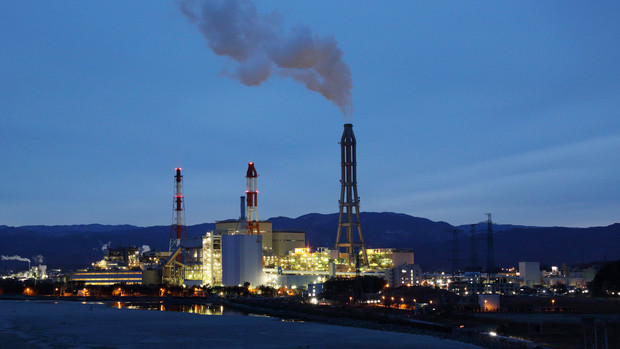
“In the wake of the Ukraine crisis and Germany’s nuclear shutdown, Swedish-state-owned Vattenfall is supplying even more energy from coal. Vattenfal’s chief executive officer told Swedish public television that coal power will have an important role to play in the future.

The state-owned power company, which runs Sweden’s hydro and nuclear plants, had its annual general meeting on Monday. Despite getting badly burned by buying the now-devalued Dutch company Nuon, Vattenfall has plans to buy up even more foreign coal companies.

The Swedish state is the owner of Vattenfall. The government’s representative at the meeting says that, despite setting a goal of reducing carbon emissions, the government has no objection to Vattenfall investing in coal, and leaves such decisions to the company board.”

http://www.thegwpf.org/sweden-coal-to-play-important-role-in-future/

If Europe had jumped into fracking as soon as possible, the natural gas would have been coming on stream by now and they could be replacing coal with cleaner, lower CO2 gas. But Europe bet the farm on wind and solar. Idiots.

Embed from Getty Images
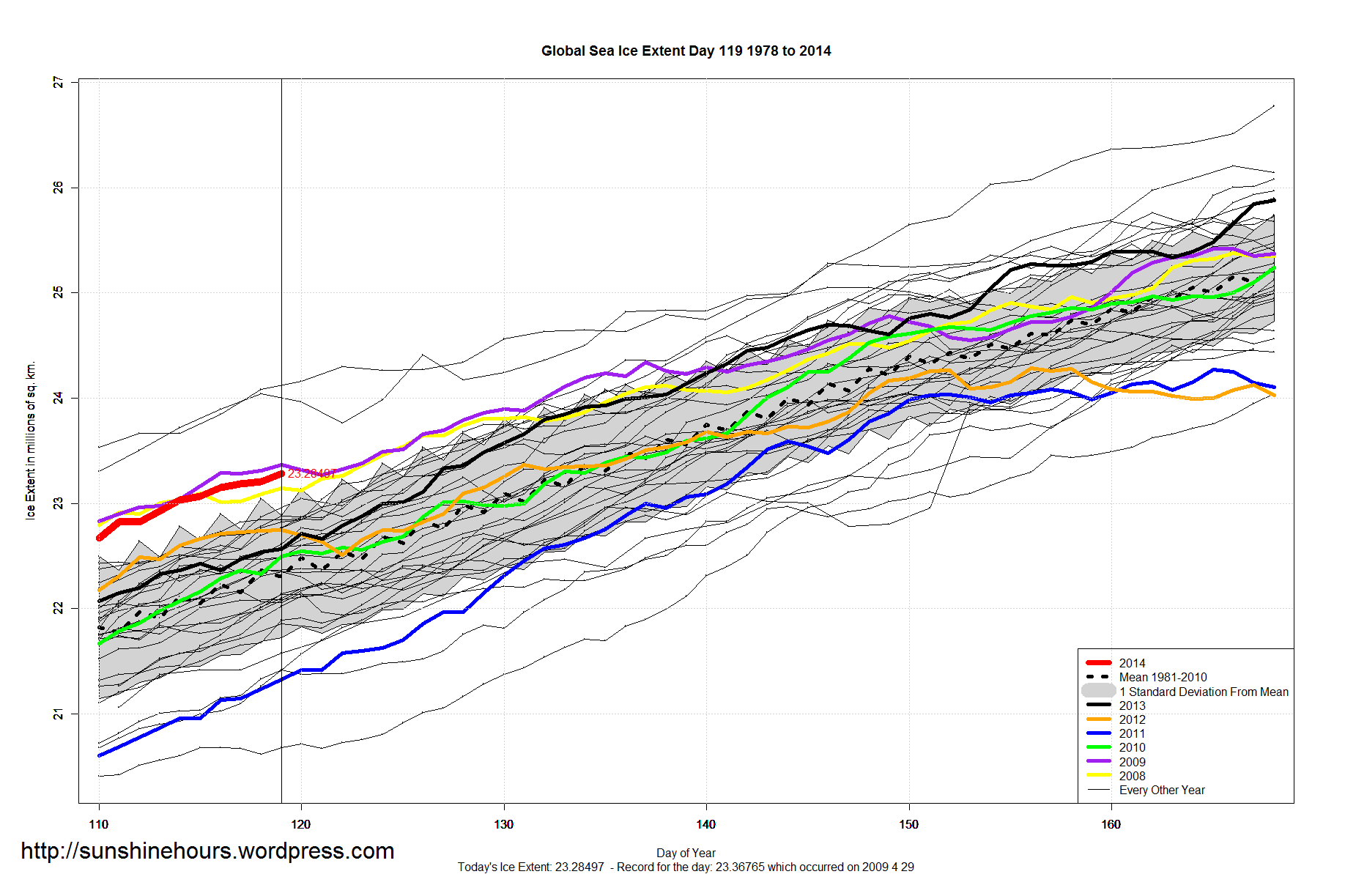
Sea Ice Update April 30 2014 – Antarctic Sea Ice 52nd daily record – Global Sea Ice 980,000 sq km Above Normal

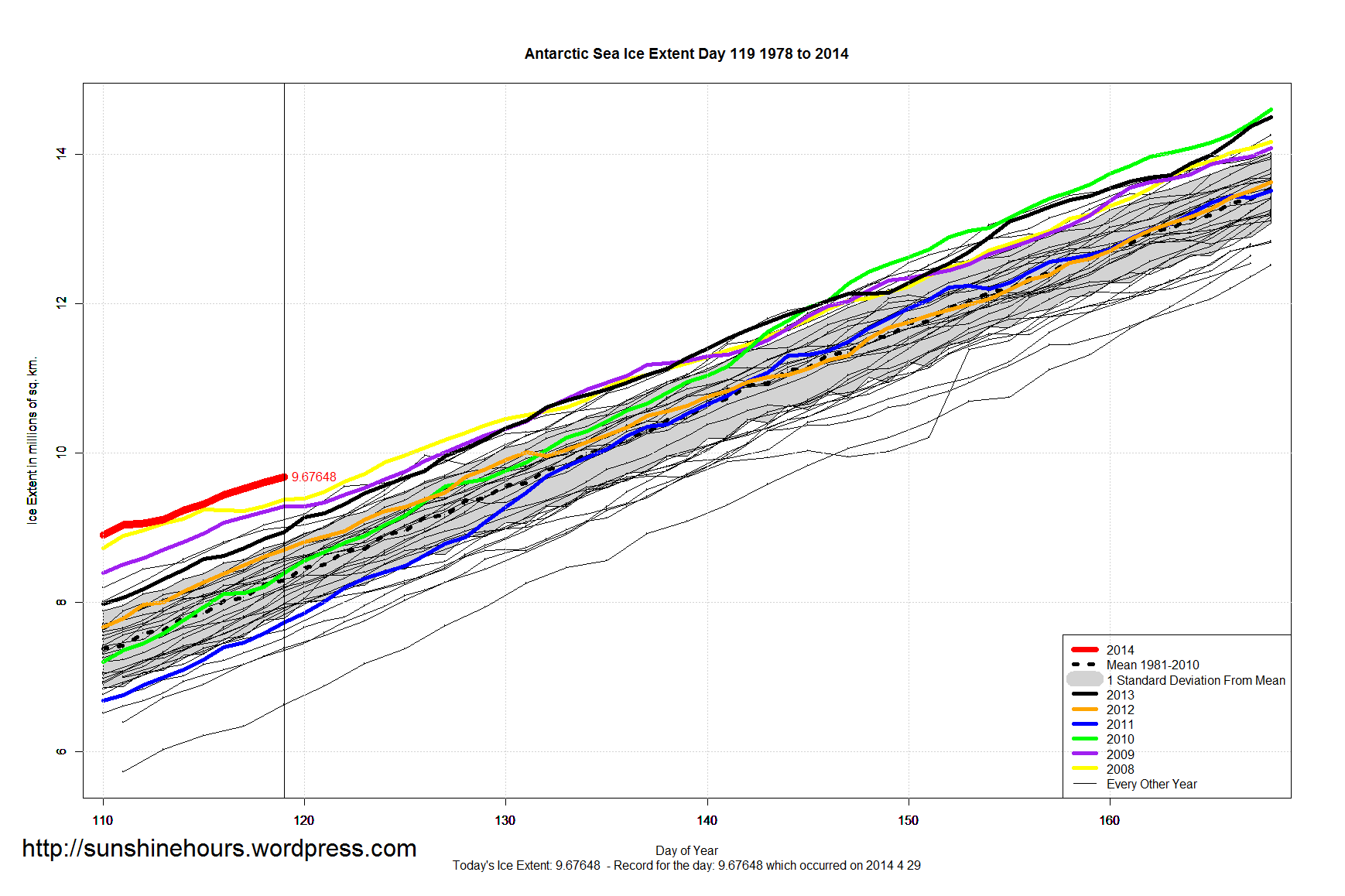
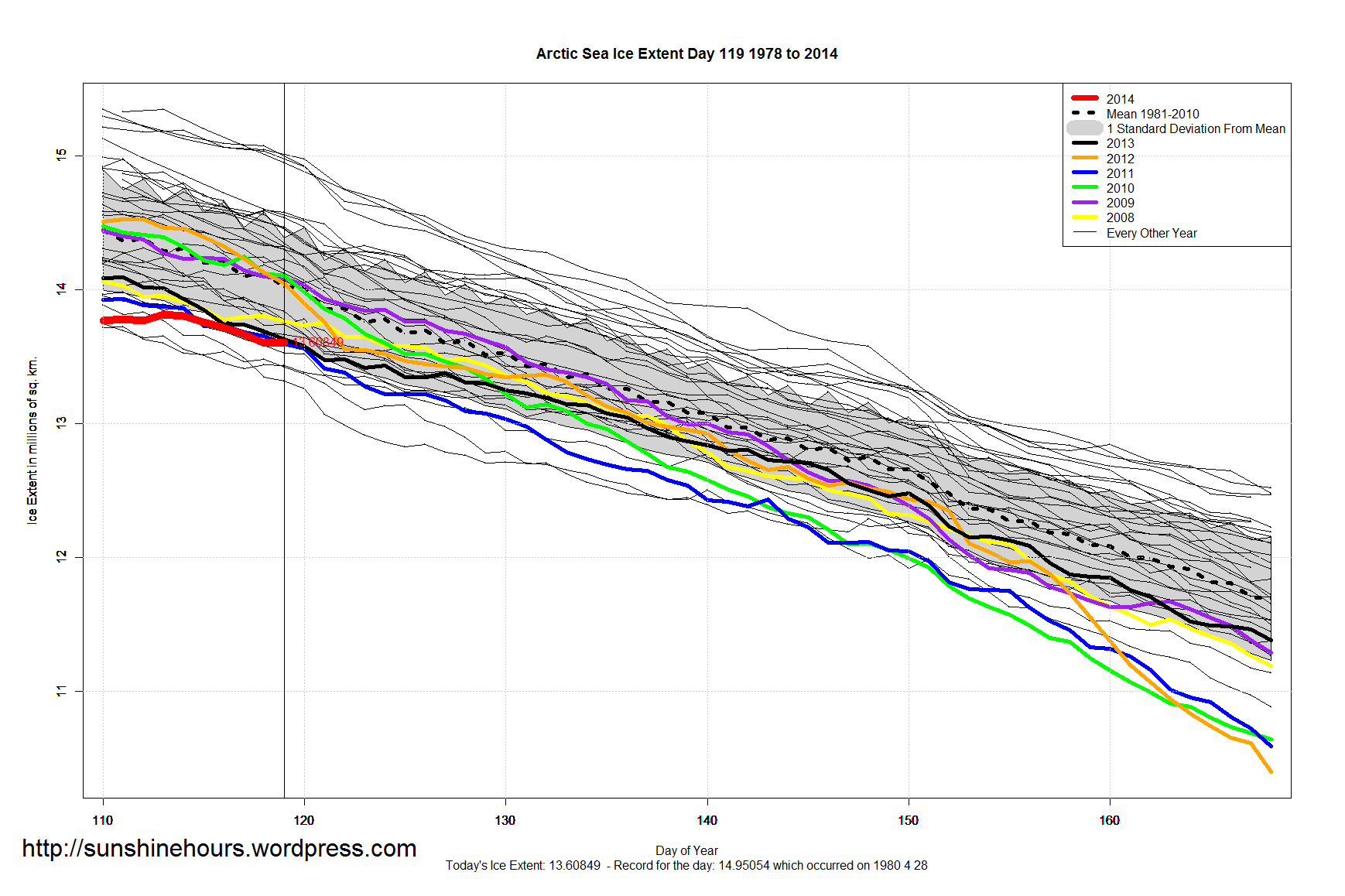
A quick update for sea ice extent for day 119 of 2014:

  • Global Sea Ice Extent is 981,000 sq km above the 1981-2010 mean.
  • Antarctic Sea Ice Extent is 1,388,000 sq km above the 1981-2010 mean. That’s the 52nd daily record for 2014.
  • Arctic Sea Ice Extent is -407,000 sq km below the 1981-2010 mean.  Only 190,000 sq km melted in the last 11 days. Last year 600,000 sq km melted in same 11 days.

NOAA Data here and here here. Graphs below. Click for bigger.

Global_Sea_Ice_Extent_Zoomed_2014_Day_119_1981-2010 Antarctic_Sea_Ice_Extent_Zoomed_2014_Day_119_1981-2010 Arctic_Sea_Ice_Extent_Zoomed_2014_Day_119_1981-2010

The Streak – 1933/1934 and 2011/2012

The Hockey Schtick blog brought a recent paper to my attention.

The abstract says:

A recent observation in NOAA’s National Climatic Data Center’s monthly assessment of the state of the climate was that contiguous US average monthly temperatures were in the top third of monthly ranked historical temperatures for thirteen straight months from June 2011 — June 2012. The chance of such a streak occurring randomly was quoted as (1/3)13, or about one in 1.6 million.”

I’m not going to discuss the “chances”. But I am going to simply note the following.

The NOAA ranks months temperature and precipitation based on the number of months from 1895. So 2012 was the 118th year. If a month is ranked 118 (as of 2012) then it was the warmest month from 1895 to 2012.

Using the same 12 month June to June time frame and using data from October 2012 ( before NOAA’s recent update) it took me about 10 minutes to find out a similar streak.

From June 1933 to to June 1934 8 months were ranked 100 and above. 2 of them were ranked 118.

From June 2011 to June 2012 8 months were ranked 100 and above. 1 of them was ranked 118.


year Month Rank
1933 6 118
1933 7 104
1933 9 116
1933 12 115
1934 1 114
1934 4 107
1934 5 118
1934 6 108


year Month Rank
2011 7 114
2011 8 117
2012 1 115
2012 2 104
2012 3 118
2012 4 116
2012 5 117
2012 6 107

What are the odds of that occurring 80 years apart!


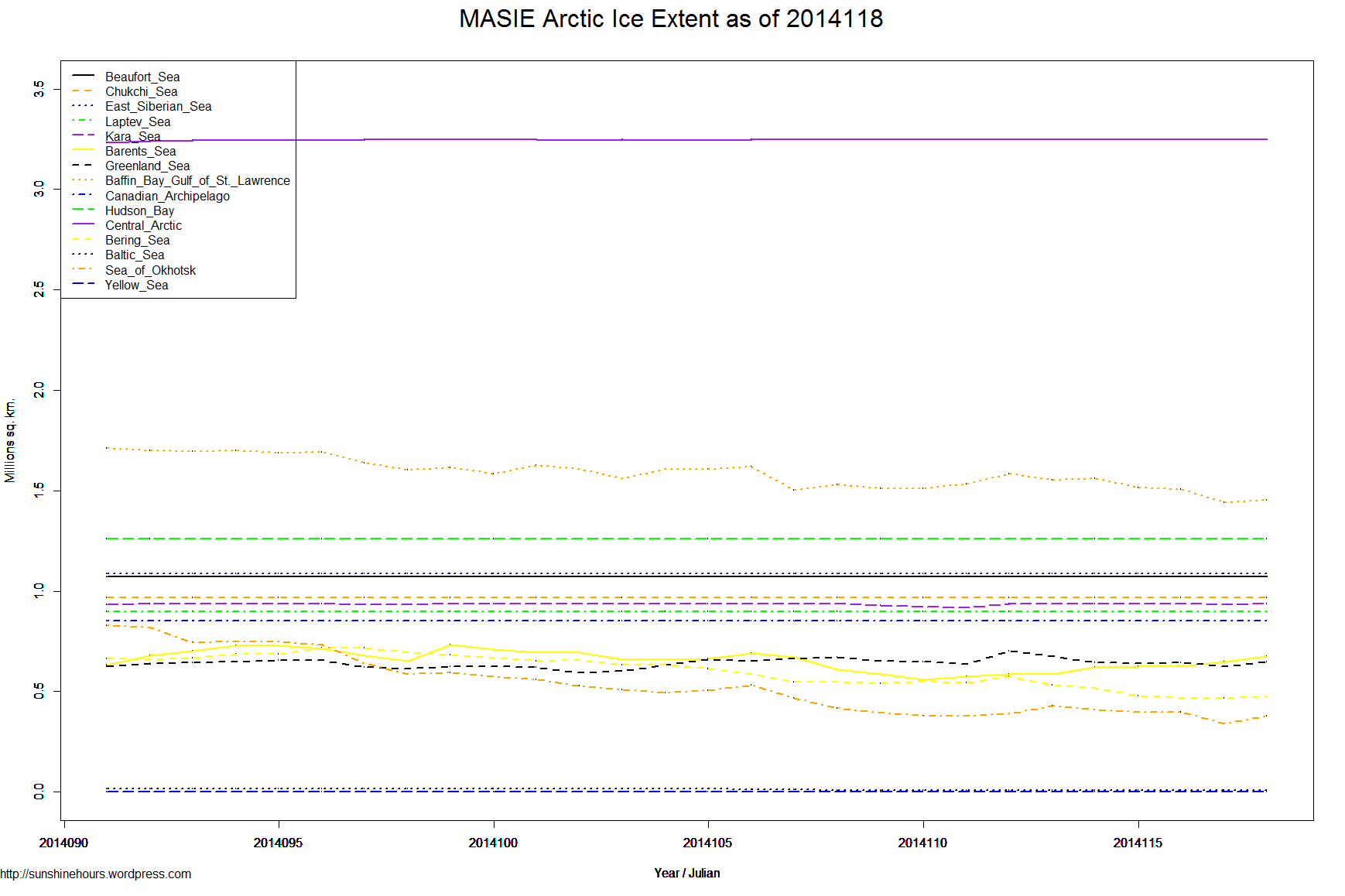
MASIE April 29 2014 – Arctic Ice Extent By Region As of Day 118

April 29 2014  MASIE Update (This Arctic Sea Ice dataset frm MASIE only has 28 days of data.

This is the gain/loss from day 91 to day 118. Negative = loss. Sorted with biggest loser in last 7 days at top. Northern Hemisphere is the grand total.

Notice that even though the NH shows a 404,000 melt in the last 14 days, only 16,782 melted in last 7 days.

The bottom 5 have all gained in last 7 days. Including 102,200 in the Barents Sea.

Region Start End Last 28 Last 14 Last 7 Days
Northern Hemisphere 14,789,245 13,959,969 -829,276 -404,018 -16,782
Baffin Bay Gulf of St. Lawrence 1,711,230 1,454,513 -256,717 -151,655 -79,359
Bering Sea 664,041 474,076 -189,965 -160,060 -70,680
Baltic Sea 15,337 8,725 -6,612 -7,013 -653
Beaufort Sea 1,070,445 1,070,445 0 0 0
Chukchi Sea 966,006 966,006 0 0 0
East Siberian Sea 1,087,137 1,087,137 0 0 0
Laptev Sea 897,845 897,845 0 0 0
Canadian Archipelago 853,214 853,214 0 0 0
Hudson Bay 1,260,903 1,260,903 0 0 0
Yellow Sea 0 0 0 0 0
Sea of Okhotsk 829,717 376,689 -453,028 -118,565 223
Central Arctic 3,231,886 3,248,013 16,127 4,581 1,482
Greenland Sea 624,163 649,651 25,488 15,511 13,156
Kara Sea 932,891 935,023 2,132 0 16,849
Barents Sea 634,409 675,523 41,114 15,469 102,200


Here is the MASIE graph. The flat lines at the bottom are regions that have melted and are now  ice free. The completely flat lines elsewhere indicate no melting at all yet. The changing lines indicate melting regions.

Click for bigger.

MASIE Arctic Ice Extent as of 2014118


Japan Chooses Coal Over Renewable Energy

Japan isn’t as dumb as Environmentalists hoped. After working hard to shutdown Japans nuclear power because of the earthquake/tidal wave, Japan is choosing coal instead of renewables.

“Prime Minister Shinzo Abe is pushing Japan’s coal industry to expand sales at home and abroad, undermining hopes among environmentalists that he’d use the Fukushima nuclear accident to switch the nation to renewables.

A new energy plan approved by Japan’s cabinet on April 11 designates coal an important long-term electricity source while falling short of setting specific targets for cleaner energy from wind, solar and geothermal. The policy also gives nuclear power the same prominence as coal in Japan’s energy strategy.”

“Before the accident, Japan got 62 percent of its electricity from fossil fuels, and nuclear made up about a third, according to government figures. Since then, utilities reverted to fossil fuels such as liquefied natural gas and coal to replace nuclear capacity taken offline. Those thermal power sources generated about 90 percent of Japan’s electricity in fiscal 2012, according to figures in the energy plan.”

http://www.bloomberg.com/news/2014-04-13/post-fukushima-japan-chooses-coal-over-renewable-energy.html

japan_nuclear

Japan Will Encourage Coal Use In Eastern Europe

Thanks to anti-fracking activities in Europe by environmentalists, the only plentiful fuel available cheap enough to use against Putin’s control is Coal.

“The government plans to support Ukraine and other Eastern European nations in the construction of next-generation coal-fired power plants that can generate power with less fuel, according to informed sources.

Under the initiative, Japan would stand behind the nations’ efforts to use coal—abundant in Eastern Europe—instead of natural gas, the supply of which makes them dependent on Russia. The government is expected to announce the initiative at the meeting of energy ministers from Japan and other Group of Seven industrialized nations to be held in Rome from May 5.

Japan’s support will involve the construction of coal-fired power plants using technologies known as supercritical steam pressure and ultra supercritical pressure to spin the turbines, enabling these nations to obtain electricity while using less fuel and emitting less carbon dioxide.”

http://the-japan-news.com/news/article/0001241034

Embed from Getty Images

Sea Ice Update April 28 2014 – Antarctic Sea Ice 50% higher than 1980! – Global Sea Ice 1.02 million sq km Above Normal

A quick update for sea ice extent for day 117 of 2014:

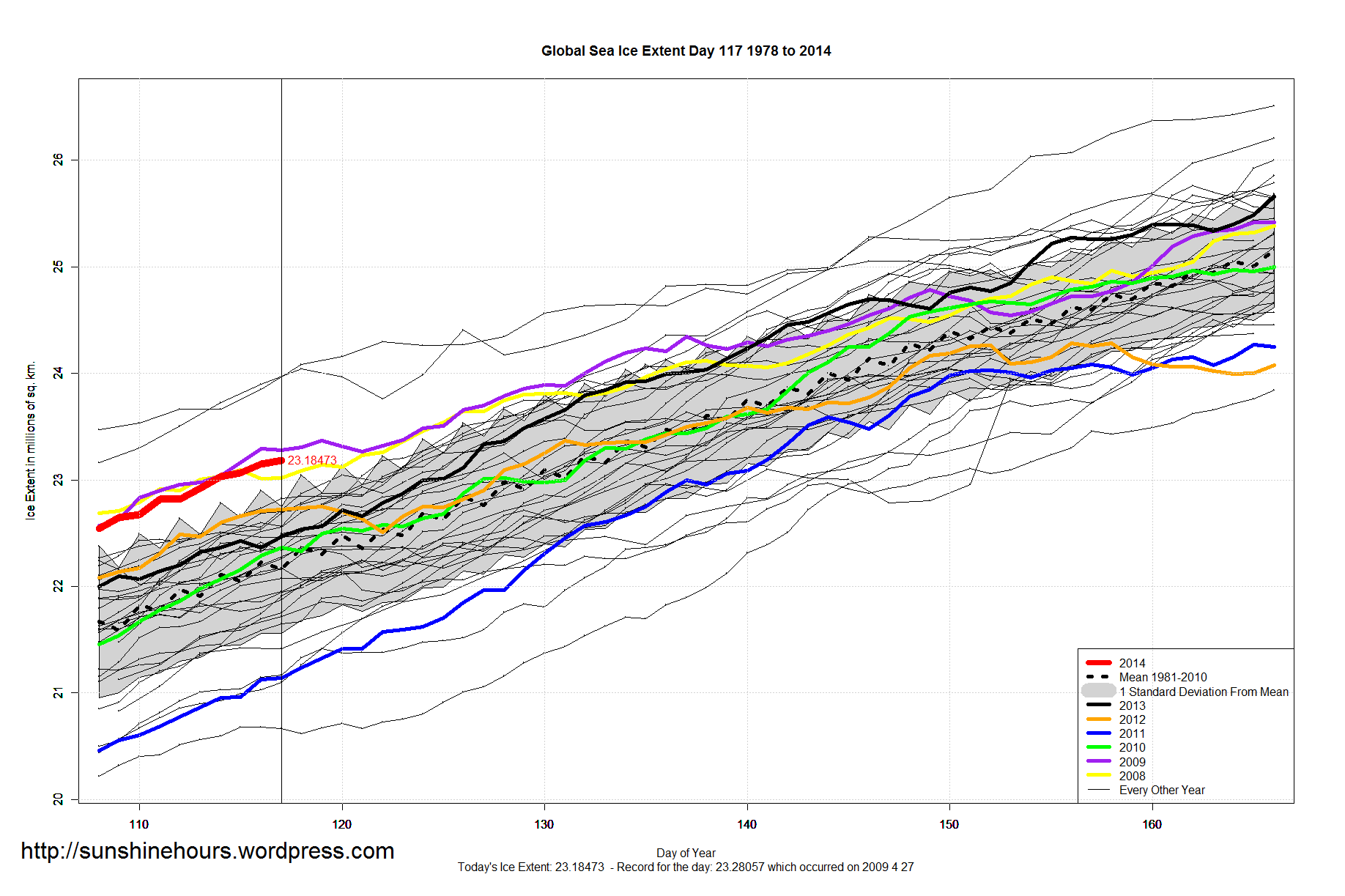
  • Global Sea Ice Extent is 1,027,000 sq km above the 1981-2010 mean.
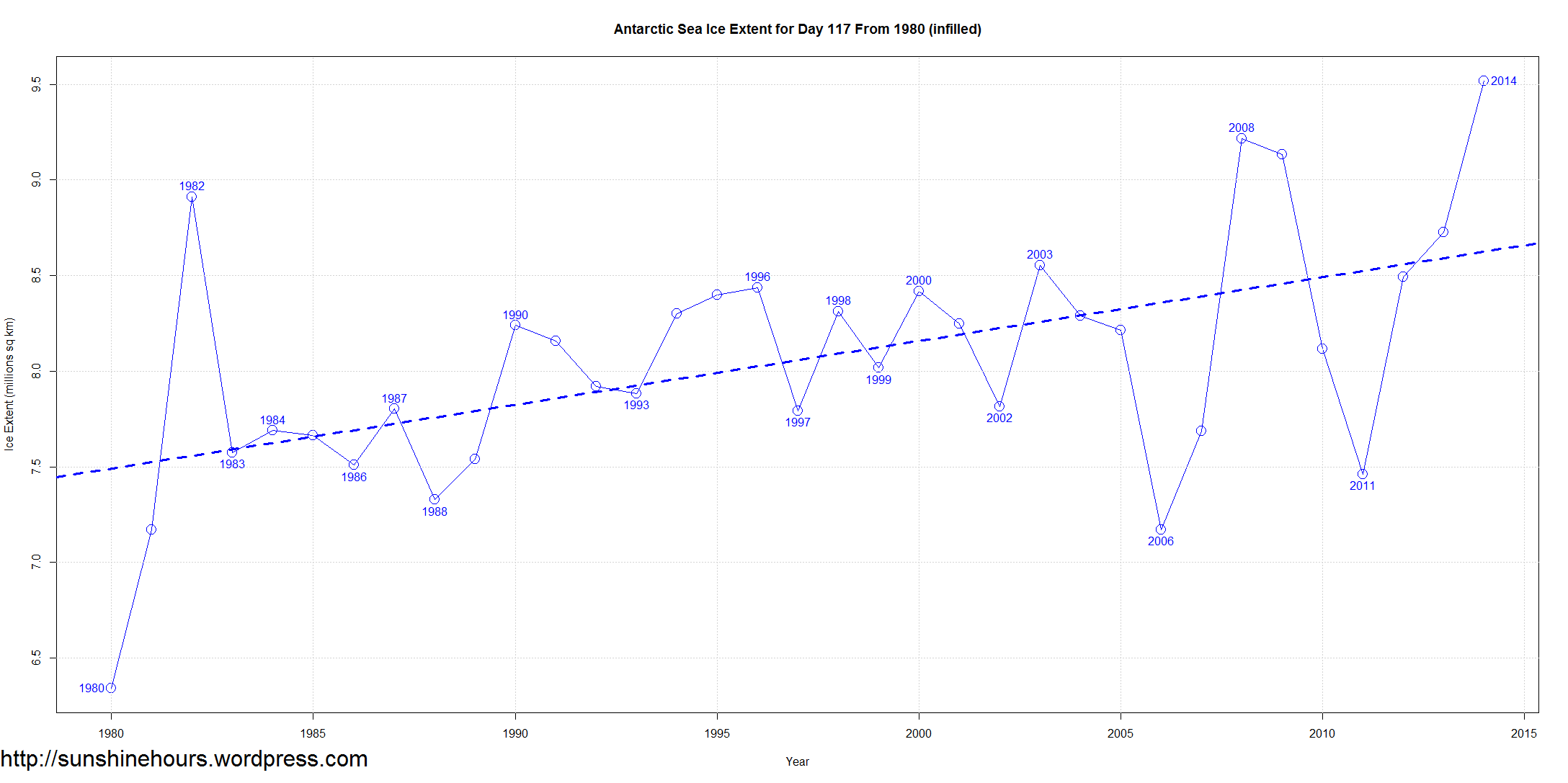
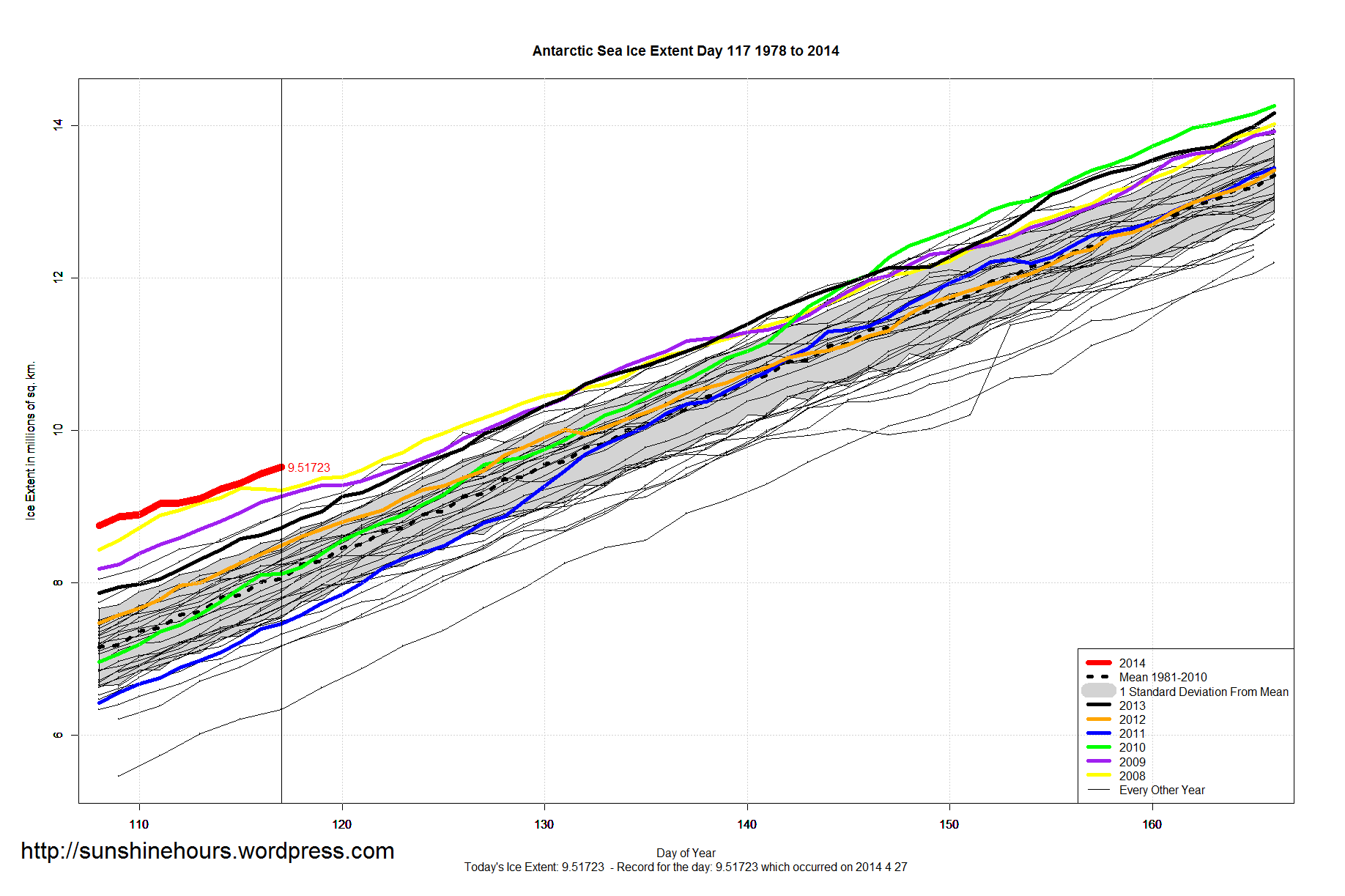
  • Antarctic Sea Ice Extent is 1,461,000 sq km above the 1981-2010 mean. That is the 50th daily record of 2014. For day 117, 2014 Antarctic Sea Ice Extent is is 50% higher than 1980!
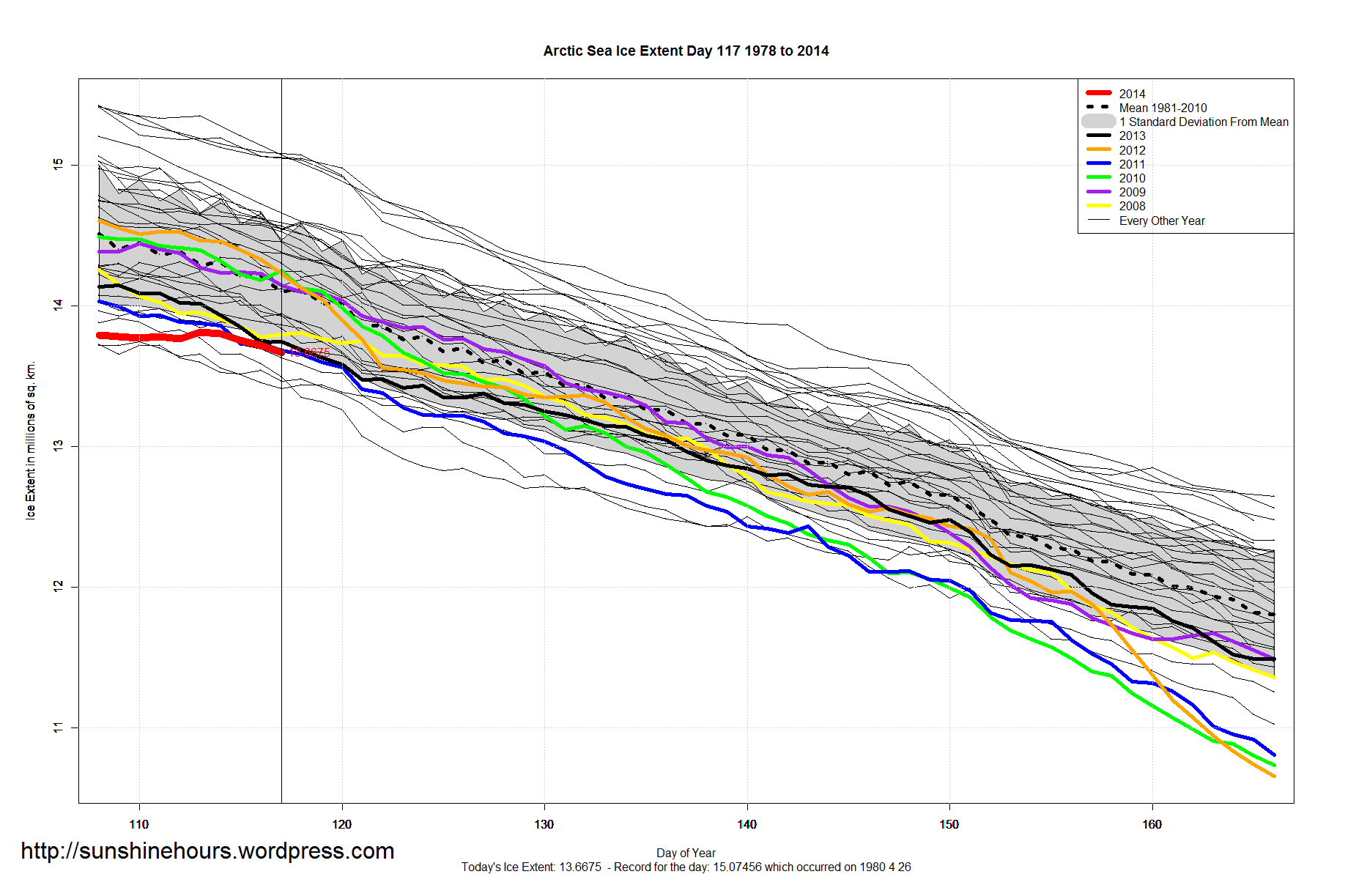
  • Arctic Sea Ice Extent is -434,000 sq km below the 1981-2010 mean.

NOAA Data here and here here. Graphs below. Click for bigger.

Antarctic Sea Ice Extent for Day 117 From 1980 (infilled) Global_Sea_Ice_Extent_Zoomed_2014_Day_117_1981-2010 Antarctic_Sea_Ice_Extent_Zoomed_2014_Day_117_1981-2010 Arctic_Sea_Ice_Extent_Zoomed_2014_Day_117_1981-2010

Coal Vengeance on Drax

Hurrah!

“Britain’s biggest power station is suing the Government for losing a lucrative contract after a Mail on Sunday investigation revealed that it burns wood from precious US forests as a ‘green’ alternative to coal.

Drax is committed to switching from coal to ‘biomass’, or wood pellets.

In December, Energy and Climate Change Secretary Ed Davey promised the North Yorkshire plant two lucrative ‘contracts for difference’ – which would see it earn £105 for every megawatt hour it generates, rather than the normal price of £50.

But this paper revealed that much of its biomass is shipped in from historic wetland hardwood forests – 3,000 miles away in North Carolina.

“Environmentalists” say this is destroying endangered species’ habitats, and increasing greenhouse gases in the atmosphere.”


http://www.dailymail.co.uk/news/article-2614104/Power-station-sues-government-axeing-contract-MoS-exposed-switch-coal-wood-precious-U-S-forests.html


However, keep in mind it was “Environmentalists” who have worked hard to stop fracking. Natural gas has half the CO2 per mega-joule of energy compared to coal. And it is much, much cleaner than coal or wood.


Embed from Getty Images

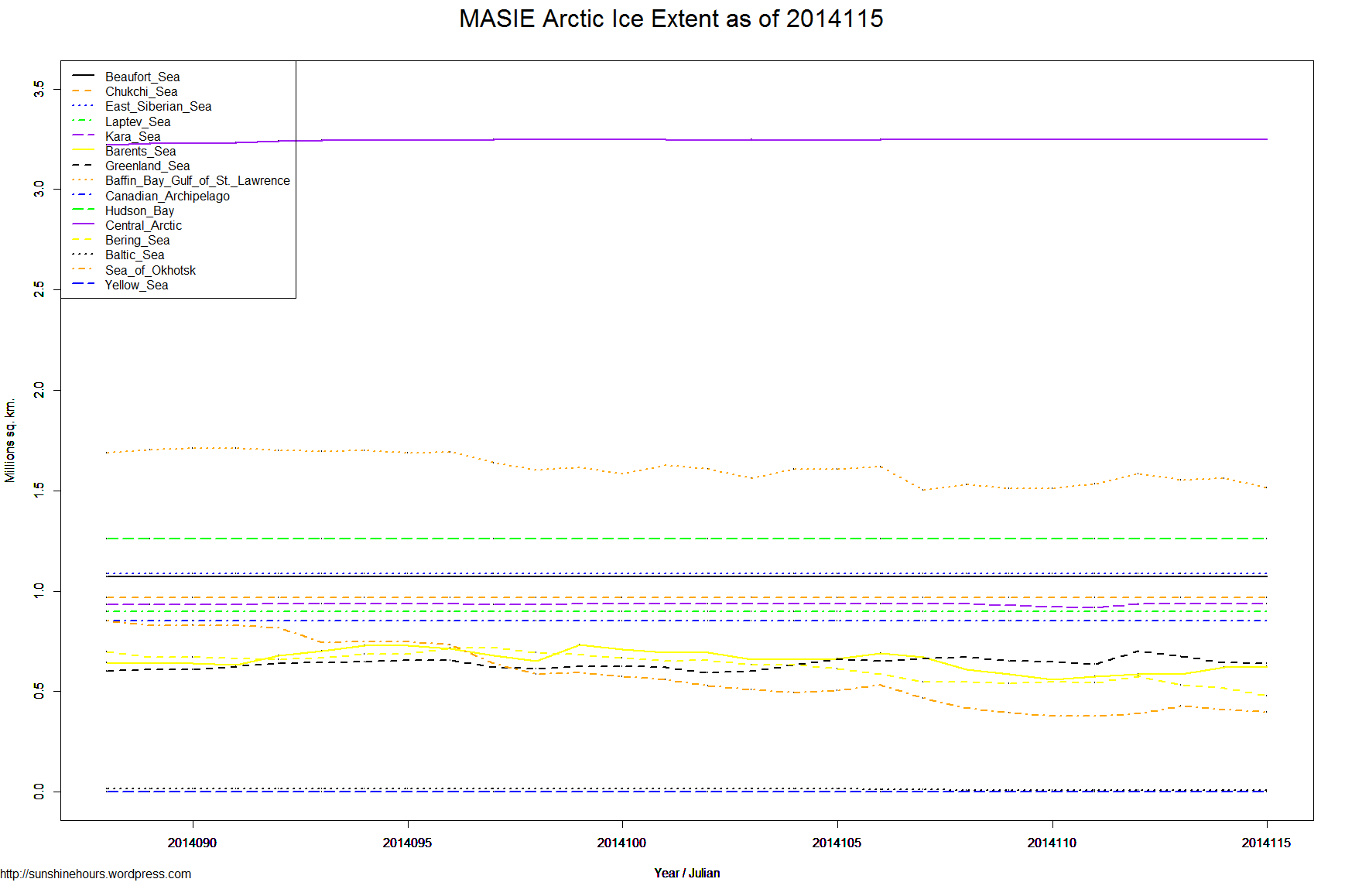
MASIE April 26 2014 – Arctic Ice Extent By Region As of Day 115

This Arctic Sea Ice dataset frm MASIE only has 28 days of data. I leave out the NH total otherwise the all of the other lines would look kind of flat.

Earlier today I posted my sea ice update and noted that ice loss in the Arctic had been almost flat for a week (compared to last year).

MASIE totals are not identical to NSIDC totals. Its the trend that is worth looking at.

This is the gain/loss from day 88 to day 115. Negative = loss. Sorted with biggest loser in last 7 days at top. Northern_Hemisphere is the grand total.

Region Start End Last 28 Days Last 14 Last 7
Northern_Hemisphere 14,805,115 13,984,885 -820,230 -509,465 -121,570
Bering_Sea 697,324 479,375 -217,949 -173,774 -68,905
Greenland_Sea 603,416 639,494 36,078 20,265 -32,575
Sea_of_Okhotsk 853,240 398,045 -455,195 -162,679 -18,897
Baffin_Bay_Gulf_of_St._Lawrence 1,688,530 1,515,185 -173,346 -112,258 -14,610
Baltic_Sea 15,337 8,172 -7,165 -7,566 -1,958
Beaufort_Sea 1,070,445 1,070,445 0 0 0
Chukchi_Sea 966,006 966,006 0 0 0
East_Siberian_Sea 1,087,137 1,087,137 0 0 0
Laptev_Sea 897,845 897,845 0 0 0
Kara_Sea 933,859 935,023 1,164 0 0
Canadian_Archipelago 853,214 853,214 0 0 0
Hudson_Bay 1,260,903 1,260,903 0 0 0
Central_Arctic 3,221,921 3,248,013 26,092 452 0
Yellow_Sea 0 0 0 0 0
Barents_Sea 645,917 623,822 -22,096 -71,839 15,375

The flat lines at the bottom are regions that have melted and are now  ice free. The completely flat lines elsewhere indicate no melting at all yet. The changing lines indicate melting regions.

The purple line near the top is the “Central Arctic “.  You can barely notice it rose from 3221921 on day 88 to 3248013 on day 115.

(I wish I had historical MASIE data) Click for bigger.

MASIE Arctic Ice Extent as of 2014115