Hail Mary Pass Attempt By Warmists to Claim Antarctica Sea Ice is Not Increasing

David Appell was kind enough to alert me to a paper written by I. Eisenman, W. N. Meier, and J. R. Norris.

They titled their paper “A spurious jump in the satellite record: is Antarctic sea ice really expanding?”

I don’t plan to demean myself by spending a lot of time on this silly hail mary pass attempt. But I will post the evidence from the papers own supplemental materials.

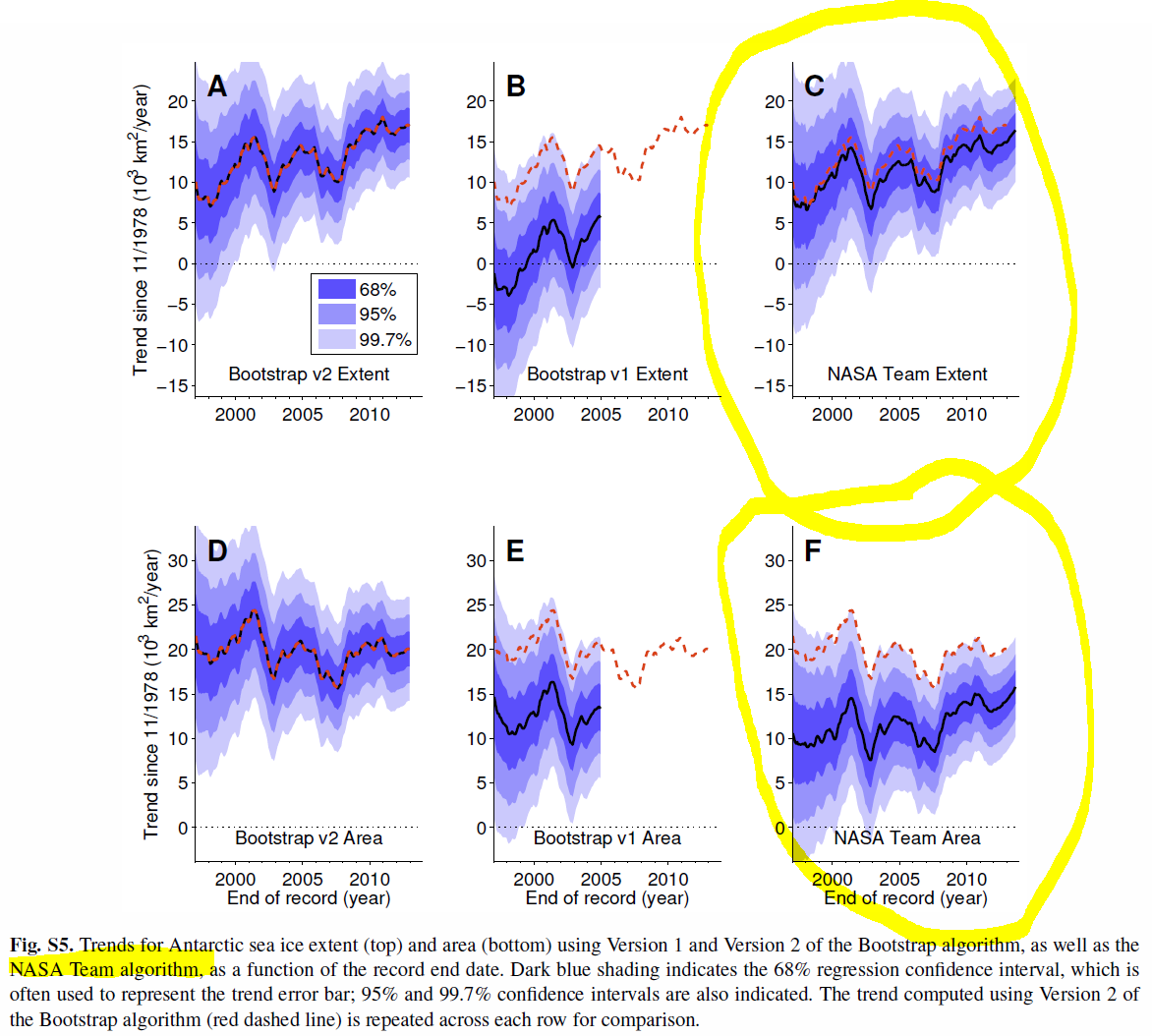
That evidence was pointed out by P.R. Holland in an interactive comment here.

“This paper contains solid and important science and I congratulate the authors on their
vigilance. It is certainly important to know that the uncertainties in the ice area/extent
timeseries might be larger than thought (depending upon how this finding is addressed
by the author of the timeseries in question).

However, doesn’t Figure S5 in the supplementary material show that whatever the
source of the Bootstrap issue, there is no doubt that Antarctic sea ice is increasing in
both area and extent? The trends appear significant whichever of the three time series
one chooses. Even if one discards Bootstrap altogether on the basis of this paper, the
NASA Team series clearly shows significant increases. These two facts imply that the
title of this paper is misleading, and so is much of the discussion and abstract. The
clearly significant increases in all 3 datasets are not accurately reflected by the paper
text, abstract, or title.

With the eyes of the climate change lobbies (on both sides) watching this debate, it
is very important that papers’ titles, abstract, and conclusions accurately convey the
facts. Very few journalists will check the content of the paper before reporting its title,
and no-one should be expected to examine the supplementary figures of a paper.”

Figure S5 from supplement here. The yellow circled items are the NASA team data that is not using the bootstrap algorithm.
Cryosphere S5

Sea Ice Update February 2 2014

A quick update for sea ice extent:

Global Sea Ice is 192,000 sq km above normal.
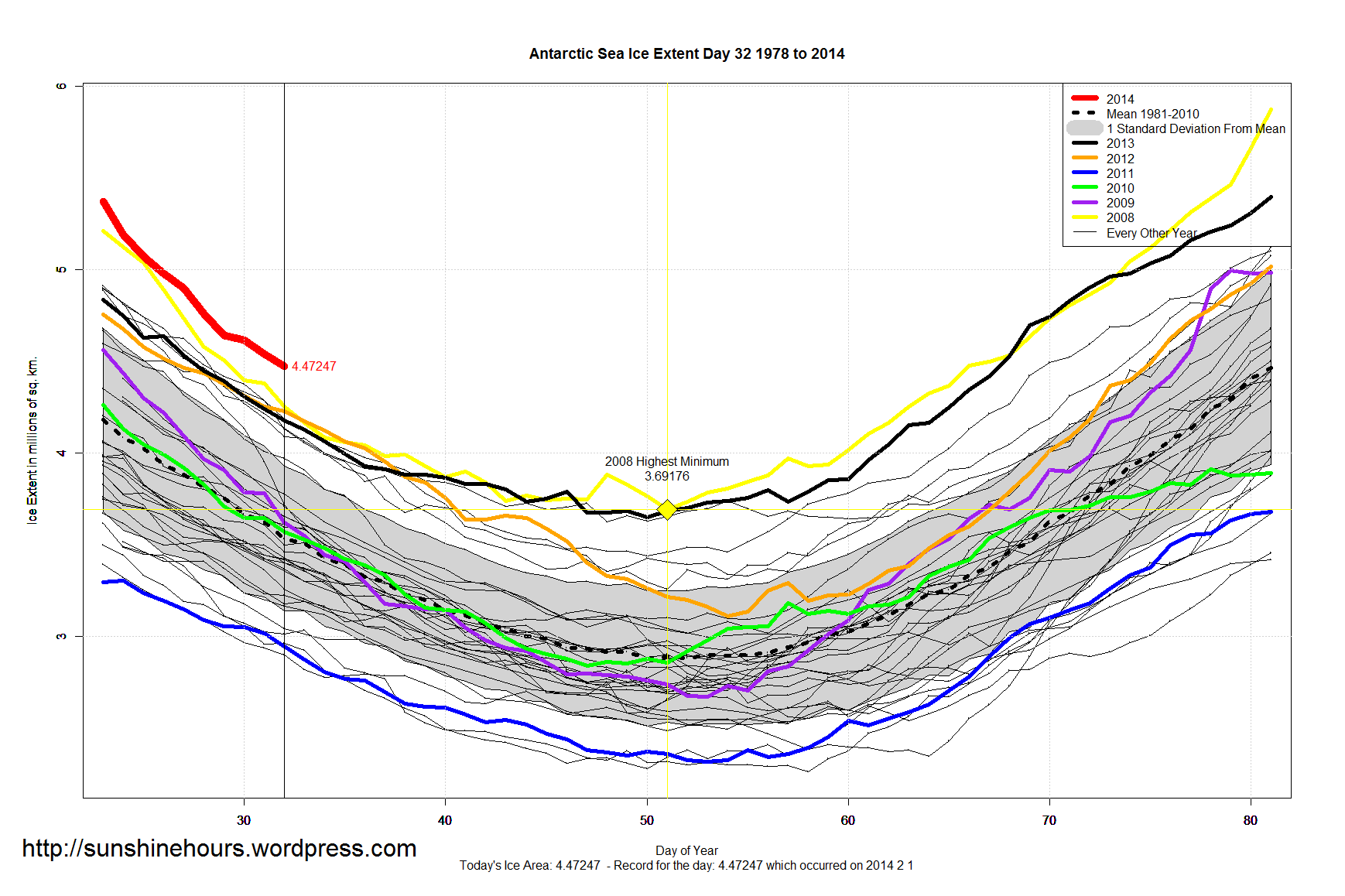
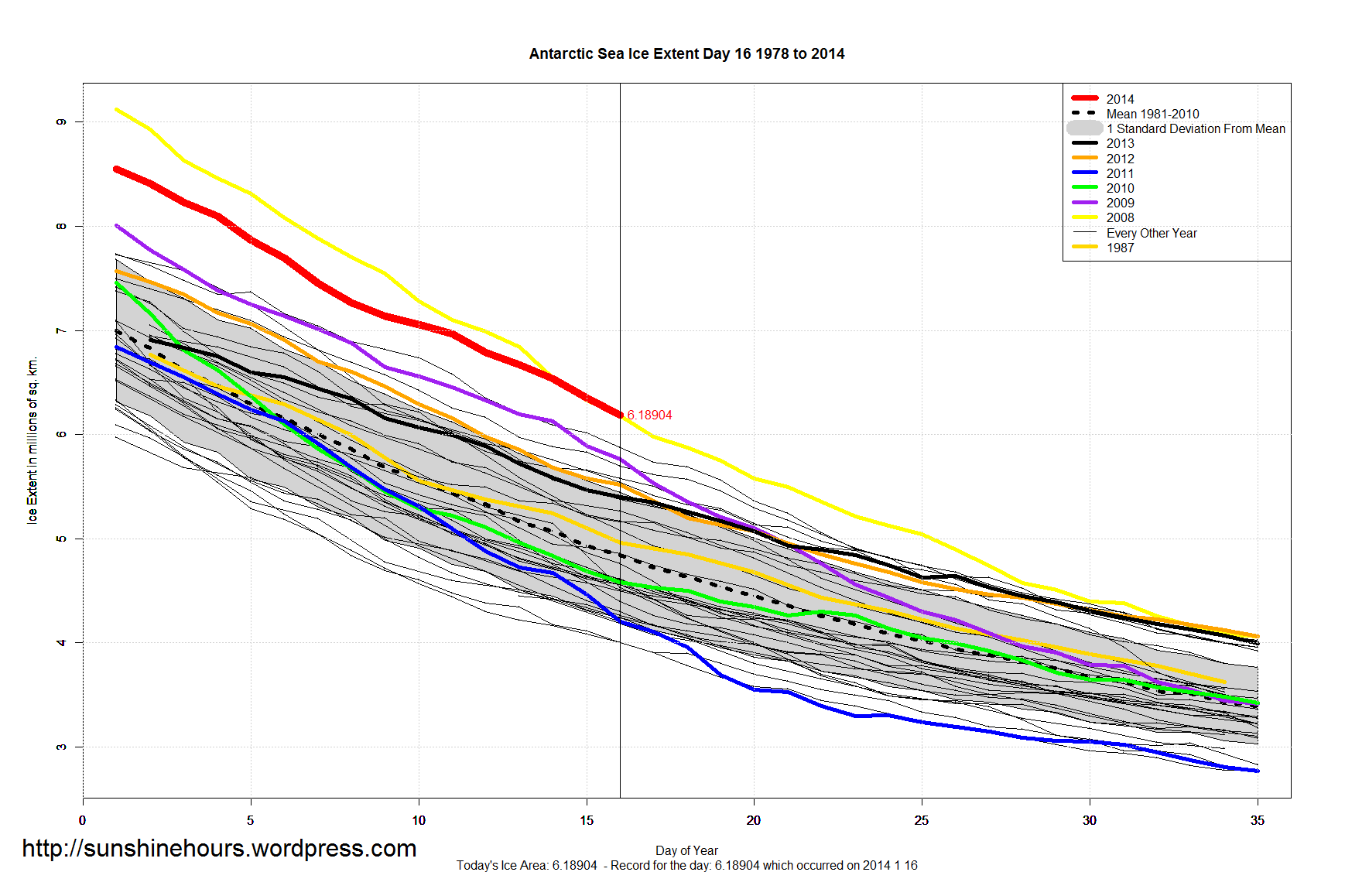
Antarctic Sea Ice is at record levels for this day and is 219,000 sq km above 2008 and 940,000 sq km above the 1981-2010 mean and on track to break the record for highest minimum.
Arctic Sea Ice is 746,000 sq km below the 1981-2010 mean.

Graphs below. Click for bigger.

Global_Sea_Ice_Extent_Zoomed_2014_Day_32_1981-2010 Antarctic_Sea_Ice_Extent_Zoomed_2014_Day_32_1981-2010 Arctic_Sea_Ice_Extent_Zoomed_2014_Day_32_1981-2010

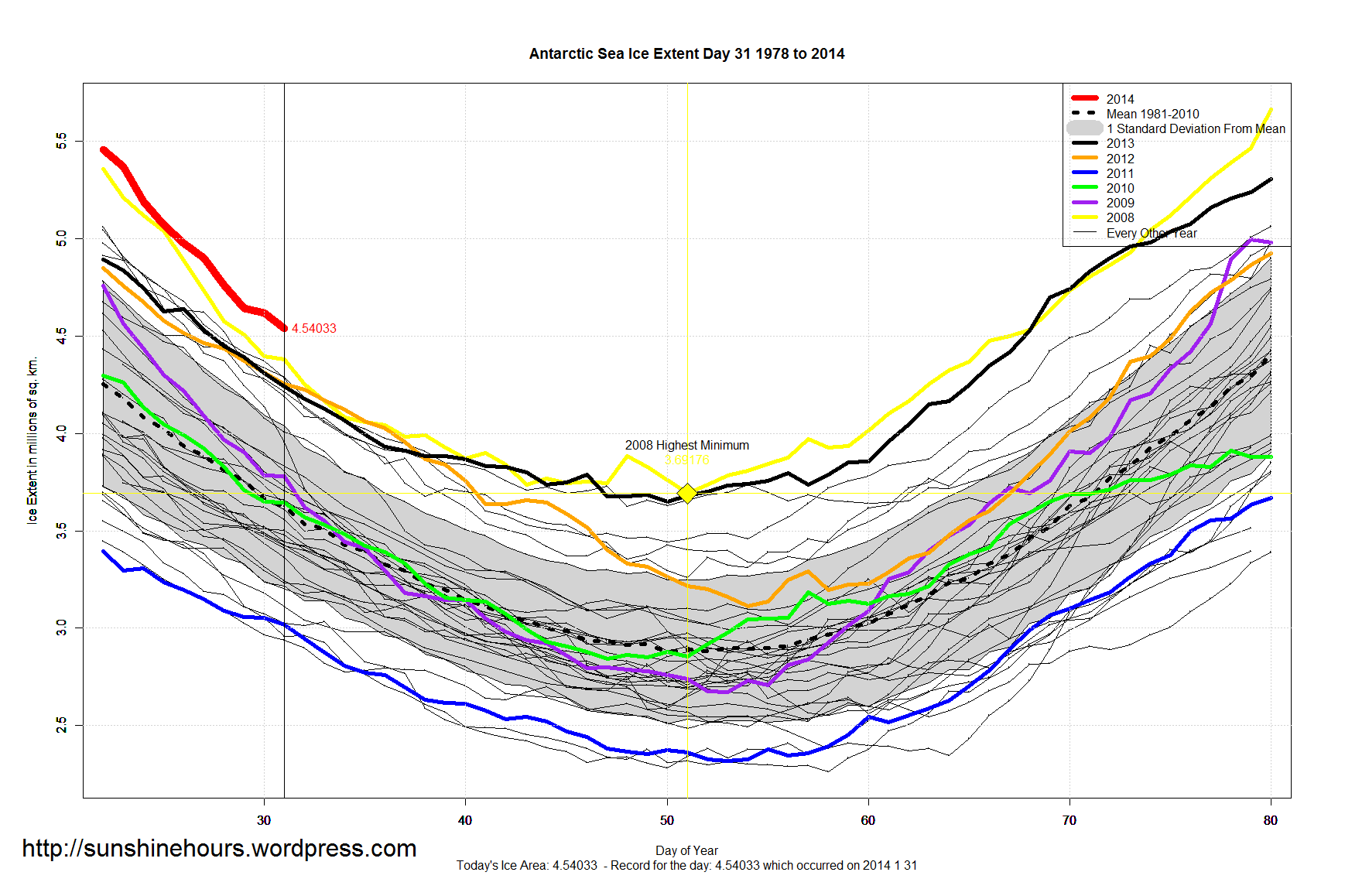
Antarctic Sea Ice – 14th Daily Record of 2014 – 10th In A Row – Day 31

The 14th daily record for Antarctic Sea Ice Extent in 2014 was set yesterday on Jan 31 (Day 31). The old record was from 2008.

The old record was broken by 159,750 sq km. Sea Ice is 913,000 sq km above the 1981-2010 mean.

I’ve added the 2008 Highest Minimum point to this graph Data is here. Click for bigger.

Antarctic_Sea_Ice_Extent_Zoomed_2014_Day_31_1981-2010


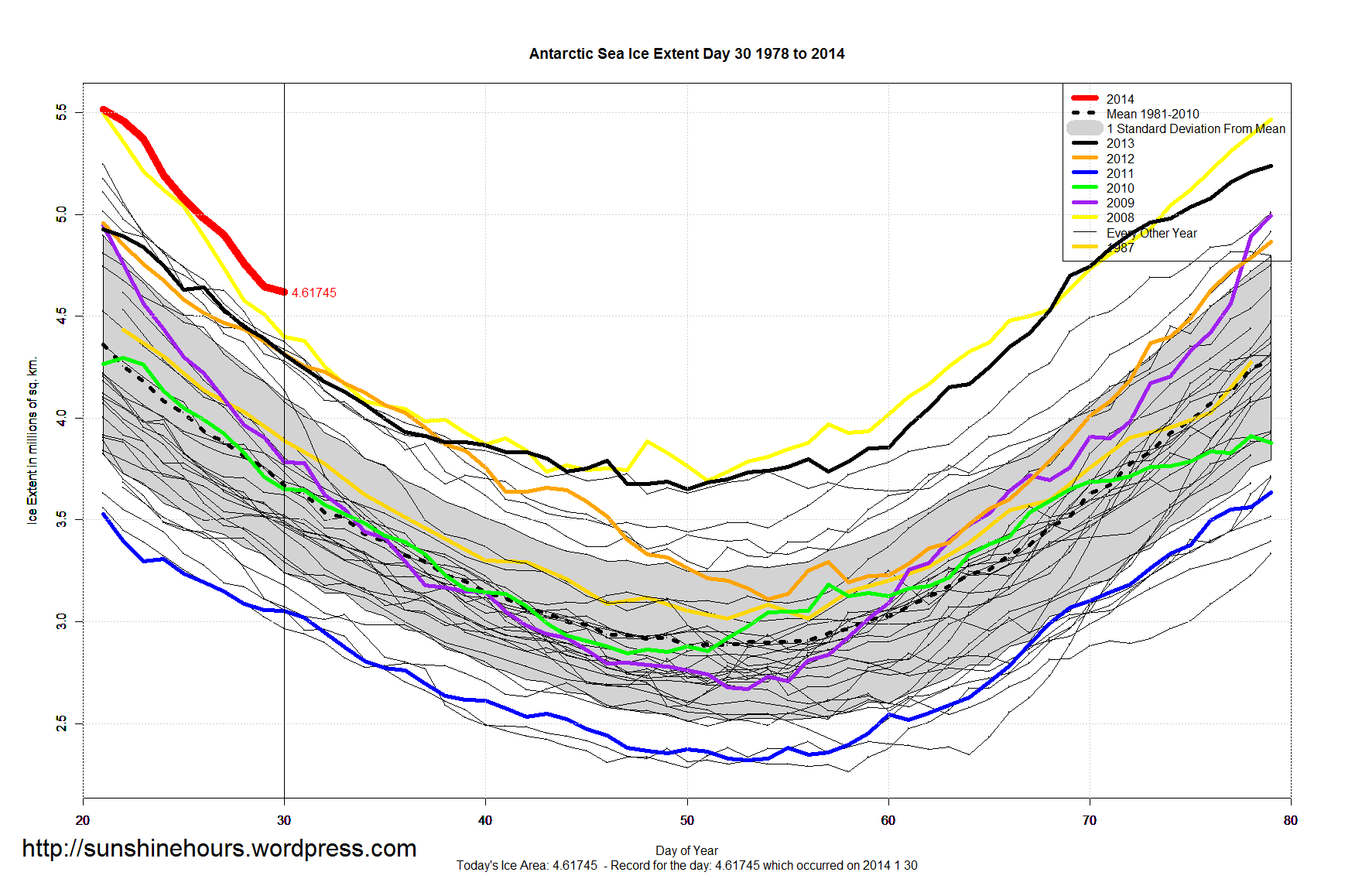
Antarctic Sea Ice Extent is 26% above normal as of Jan 30 2014

Antarctic Sea Ice Extent  is even more on track to have the highest minimum in the modern satellite era.

Antarctic Sea Ice Extent as of Jan 30 2014 was 950,000 sq km above the 1981-2010 mean and 220,000 sq km above 2008.

950,000 sq km above normal is 26% above normal. Day 30 was the 13th daily record of the year.

Click for bigger.

Antarctic_Sea_Ice_Extent_Zoomed_2014_Day_30_1981-2010


XKCD and Global Warming and St Louis

XKCD is a funny geeky comic that I read quite regularly. The blog Inconvenient Skeptic has a good post about being annoyed with a recent XKCD strip that mocks people for using the recent cold days to “disprove” global warming.

Go ahead, read the blog posting (if you are still interested) and comic and then return here.

I was ticked at XKCD for the obvious reason. The mainstream media always loves to blame global warming for any warm spell but never uses cold spells to mock the concept of global warming. I guess when XKCD followed along I was disappointed.

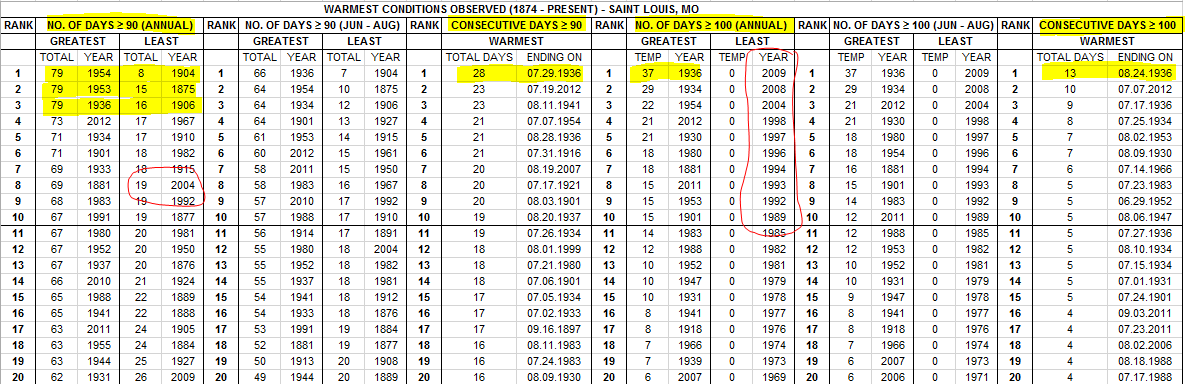
However, beyond that point I was interested in the St Louis data linked by the blog post here. I was immediately interested in the heatwave data in this Excel spreadsheet. I’ll just show the top twenty rows.

Notice 2012 didn’t make the top of any highlighted lists. It came close.  But 1954, 1963 and 1936 had more days greater than 90F. 1936 topped consecutive days above 90F.

And 1936, 1934 and 1954 topped the list of days over 100F. And 1936 was the year with most consecutive days above 100F.

And the red circled years are the Least number of days above 90F and 100F. Notice there are recent years without any 100F days at all.

And while I didn’t highlight it, notice that in 1954 22 days were above 100F. Only 18 were in Jun/Jul/Aug. The other 4 were int the spring or fall. Now thats hot.

So much for recent “warming”. St Louis had more extreme heat in the past. Even 2012 did not set new records.

StLouis_Heatwave


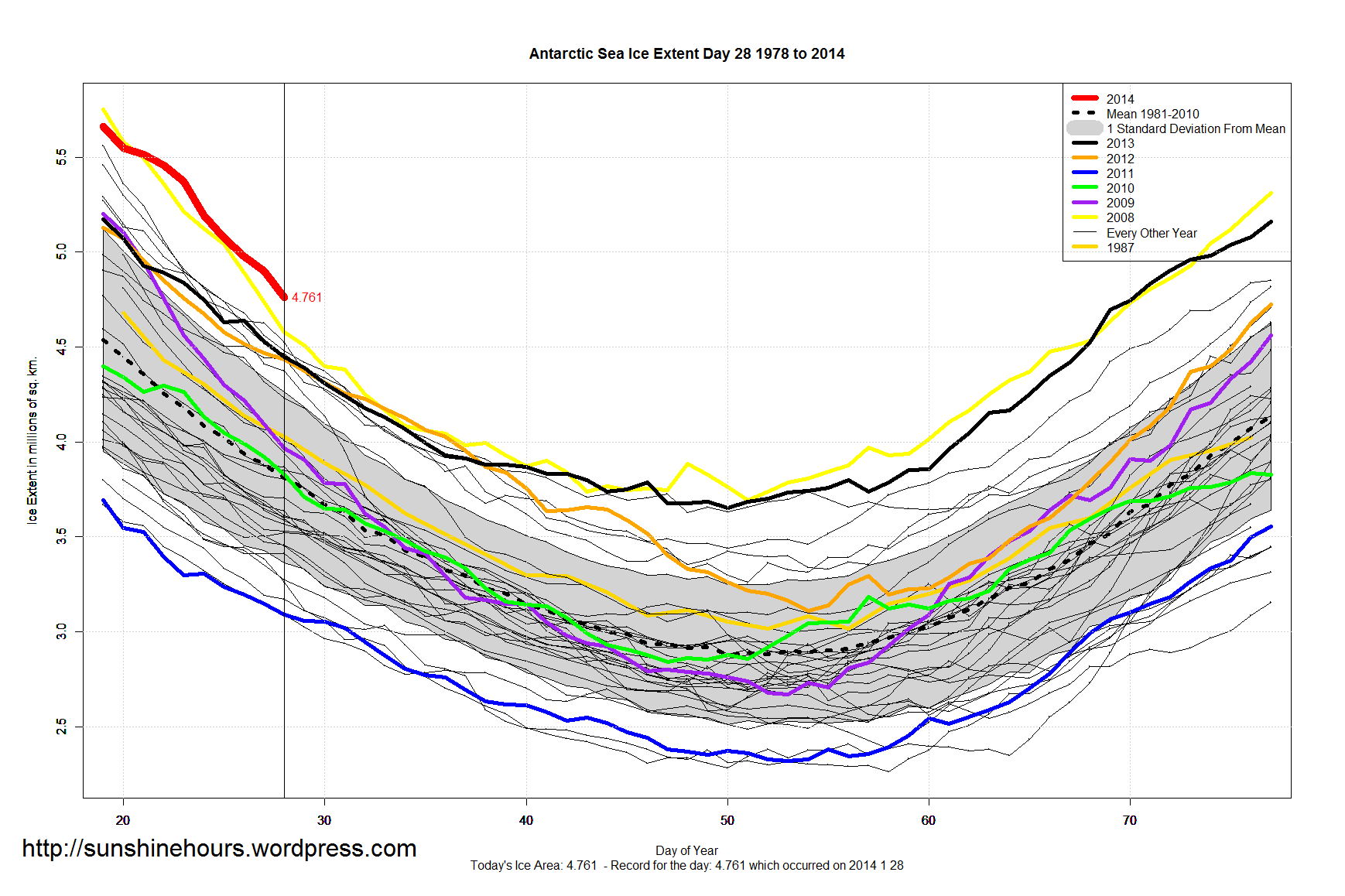
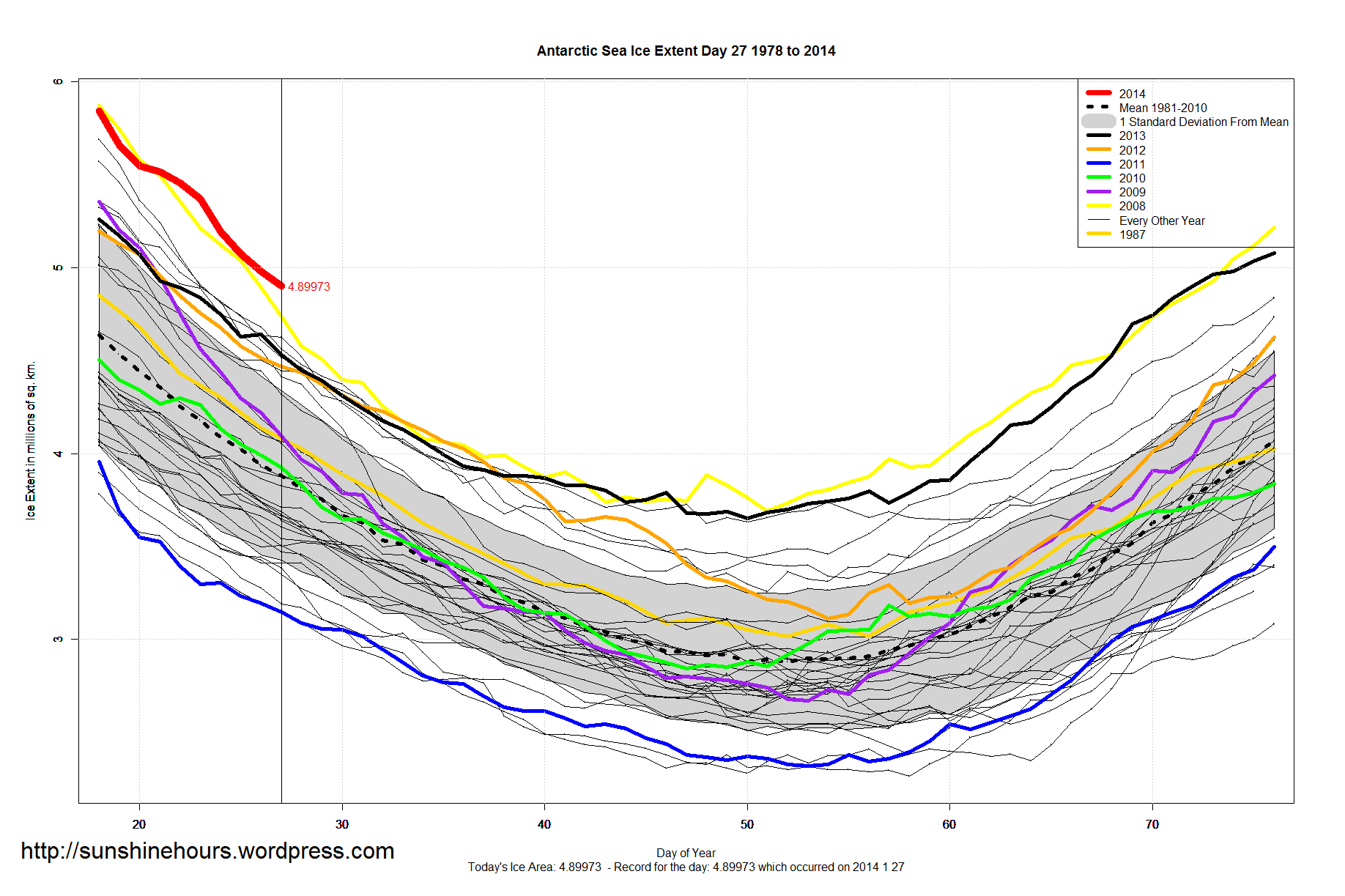
Antarctic Sea Ice Extent On Track For Record High Minimum – Jan 28 2014

Antarctic Sea Ice Extent  is very much on track to have the highest minimum in the modern satellite era.

The highest minimum was in 2008 at 3.69176 million sq km on day 51, The 2nd highest was in 2013 at 3.65040 million sq km on day 50.

The earliest minimum was day 43 in 1994. And the latest minimum was day 65 in 1986.

Antarctic Sea Ice Extent as of Jan 27 2014 was 1 million sq km above the 1981-2010 mean and 160,000 sq km above 2008.

Day 27 was the 10th daily record of the year.

Antarctic_Sea_Ice_Extent_Zoomed_2014_Day_27_1981-2010

Sea Ice Update January 27 2014

A quick update for sea ice extent:

Global Sea Ice is 560,000 sq km above normal.
Antarctic Sea Ice is at record levels for this day and on track to possibly break the record for highest minimum.
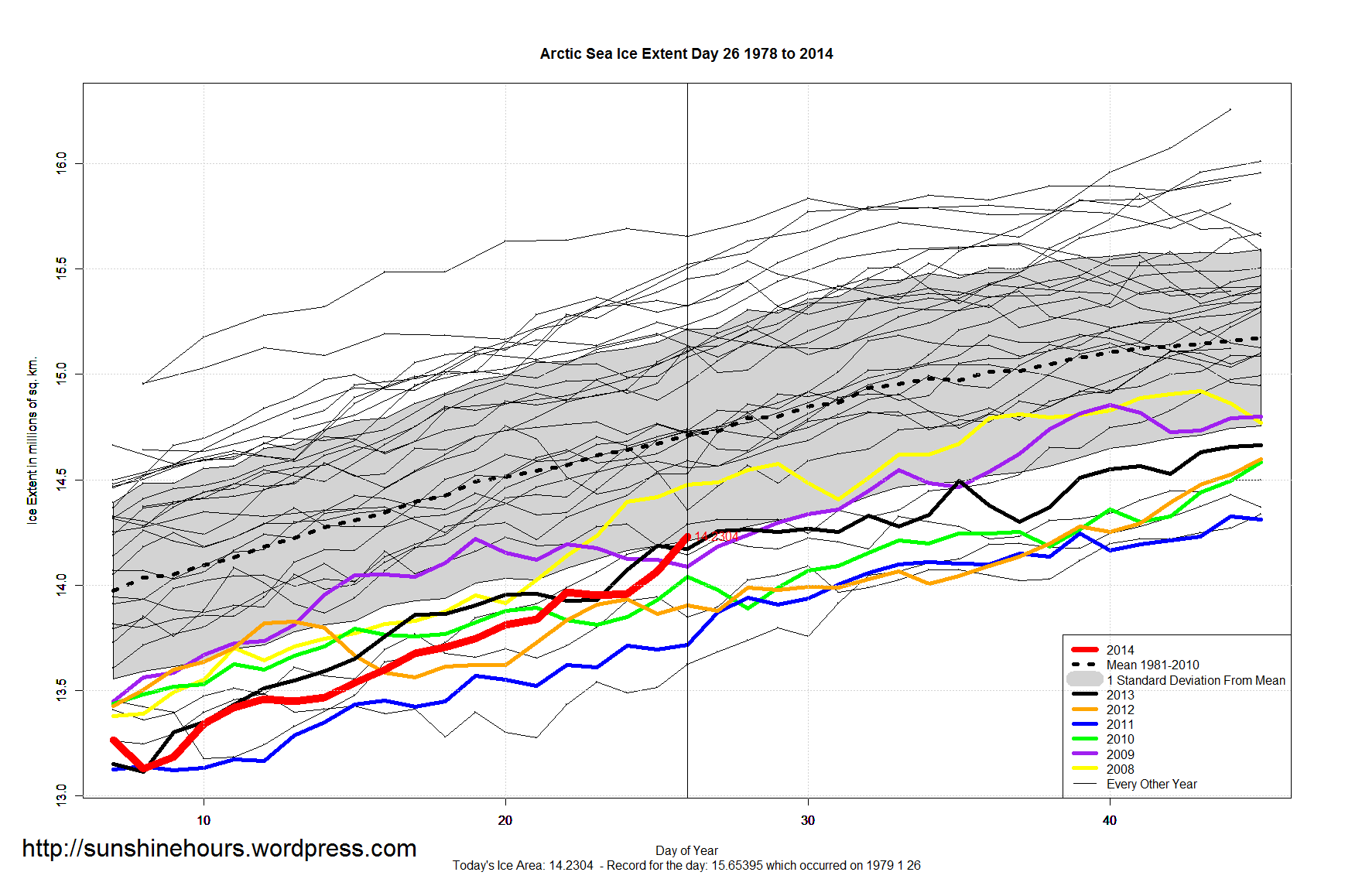
Arctic Sea Ice has just crossed the one standard deviation line for the first time this year.

Graphs below. Click for bigger.

Global_Sea_Ice_Extent_Zoomed_2014_Day_26_1981-2010 Antarctic_Sea_Ice_Extent_Zoomed_2014_Day_26_1981-2010 Arctic_Sea_Ice_Extent_Zoomed_2014_Day_26_1981-2010