2012 Highest September Average Antarctic Sea Ice of All Time!

Antarctic Sea Ice Extent for September 2012 averaged 19.1702 million sq km.

That is the highest September average of ALL TIME!!!! (during the satellite era).

Year Average for September (million sq km)
2012 19.1702
2006 19.0932
2009 18.9596
2004 18.9184
1998 18.9027
2000 18.8872
2007 18.8599
1980 18.817
2005 18.8036
2010 18.7979
1985 18.7061
1999 18.6957
2011 18.6937
1996 18.6308
1994 18.6144
1981 18.5972
1997 18.5955
1983 18.5864
1993 18.5438
1995 18.4147
1982 18.3555
1991 18.3121
1988 18.3064
2003 18.299
1987 18.2454
1979 18.1968
1990 18.1924
2001 18.1742
1984 18.166
1992 18.1474
2008 18.1443
1989 18.1194
2002 17.8866
1986 17.6925

Antarctic Sea Ice Extent Still Another Daily Record – 23rd for 2012

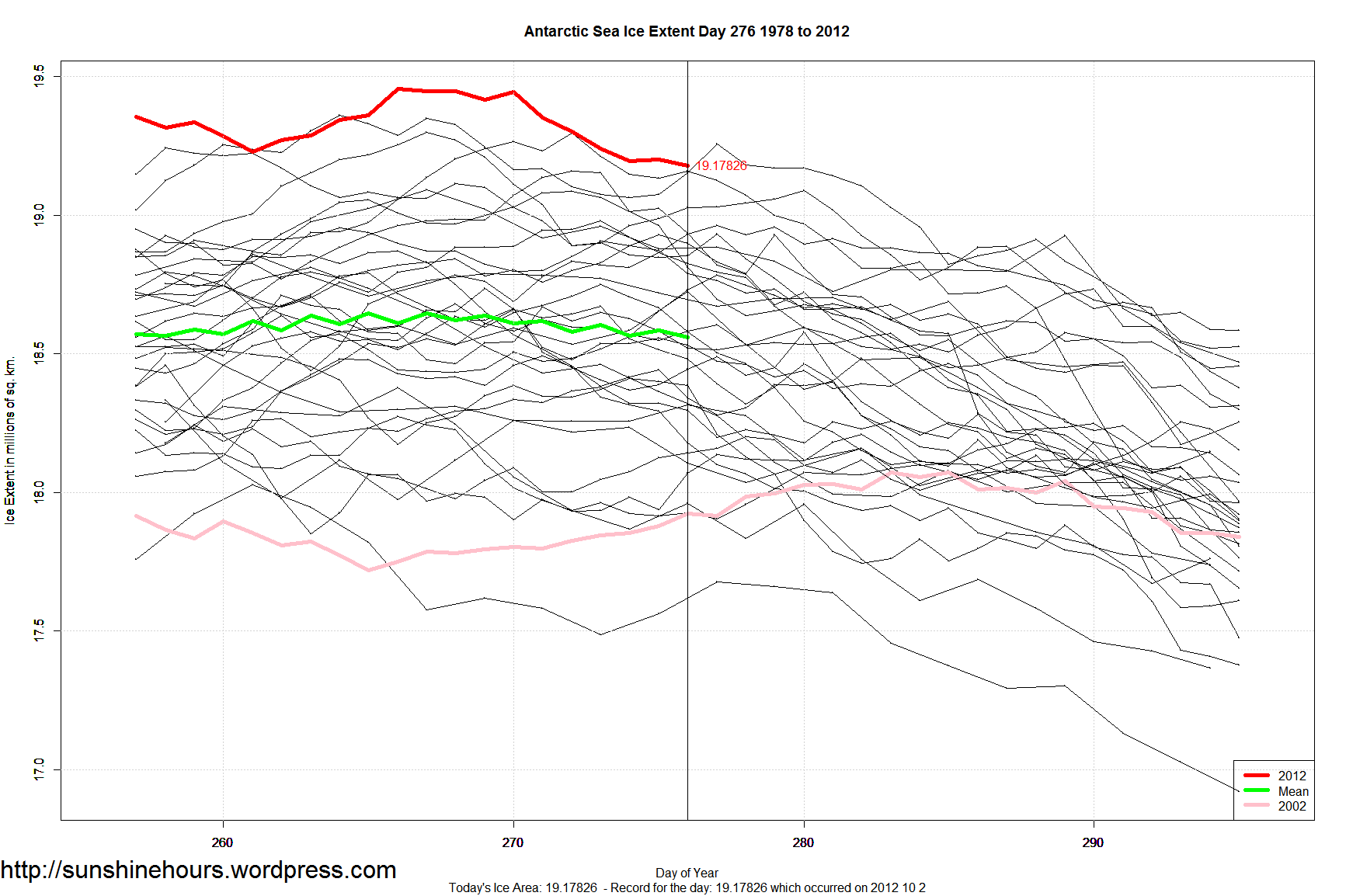
Antarctic Sea Ice Extent set another daily record yesterday (day 276 – 2012 Oct 2.). Sea ice extent was 19.17826 million sq km.

The previous day 276 record was 19.15764 million sq km and occurred on 2005 Oct 3.

This is the 23rd daily record and 12th day in a row that is a record for the day.


NY Times Dishonestly Shills for NSIDC Antarctic Deniers

A few days I asked the question about the record Antarctic Sea Ice Extent in 2012 “Anyone wonder why NOAA isn’t making a fuss about this?”

One caveat is that I should have said NSIDC instead of NOAA (NOAA does partially fund NSIDC).

Today Justin Gillis took a cheap shot at bloggers (h/t Tom Nelson) and said:

“The National Snow and Ice Data Center uses a five-day moving average to track such matters, and always waits a few days before announcing a minimum or maximum in sea ice at either pole. That is to make sure the low or high point for the year has really been reached, given that sea ice can change abruptly in response to winds and other factors. The five-day averaging also helps smooth out small errors in the satellite tracking data.

.

This longstanding practice has been explained publicly many times, but that has not stopped climate-change contrarians from asserting that the snow and ice center had been trying to hide this year’s record in Antarctica by supposedly failing to make any announcement.”

I checked. The Arctic record was broken on the August 24th and NSIDC waited 3 days to call a news conference for the media on the 27th,

The Antarctic Extent record was broken on September 24th.  I wrote about the Antarctic Ice Area coming close to the record on  September 24th, but  I was 5 days late writing about the Antarctic Ice Extent breaking the record (NSIDC uses Extent and I had not come across the NSIDC data)  and did not post until September 29th.

So of course NSIDC held a news conference on September 27th to announce the new record … didn’t they?

No. No news conference.

Obviously there was a media advisory on the 27th.  Nope.

If you go the press page for NSIDC you will see that Antarctic Ice Extent record is not mentioned until October 2nd, 2012.

Justin Gillis and the NY Times owes a lot of bloggers an apology.

Record Antarctic Sea Ice – NSIDC references debunked Steig et al., 2009

NSIDC has attempted to explain why there was record breaking Antarctic Sea Ice by claiming:

First, climate is warming over much of the Antarctic continent, as shown in several recent studies (e.g., Steig et al., 2009)

Those of us who pay attention to climate know that Steig et al, 2009 was refuted by O’Donnell et al 2010.  A very good explanation can be read at Climate Audit.

“Steig’s West Antarctic warming results from a spreading of warming in the Peninsula to the West Antarctic through choices made in their principal components. Different choices – ones more plausible in the circumstances – lead to opposite results.”

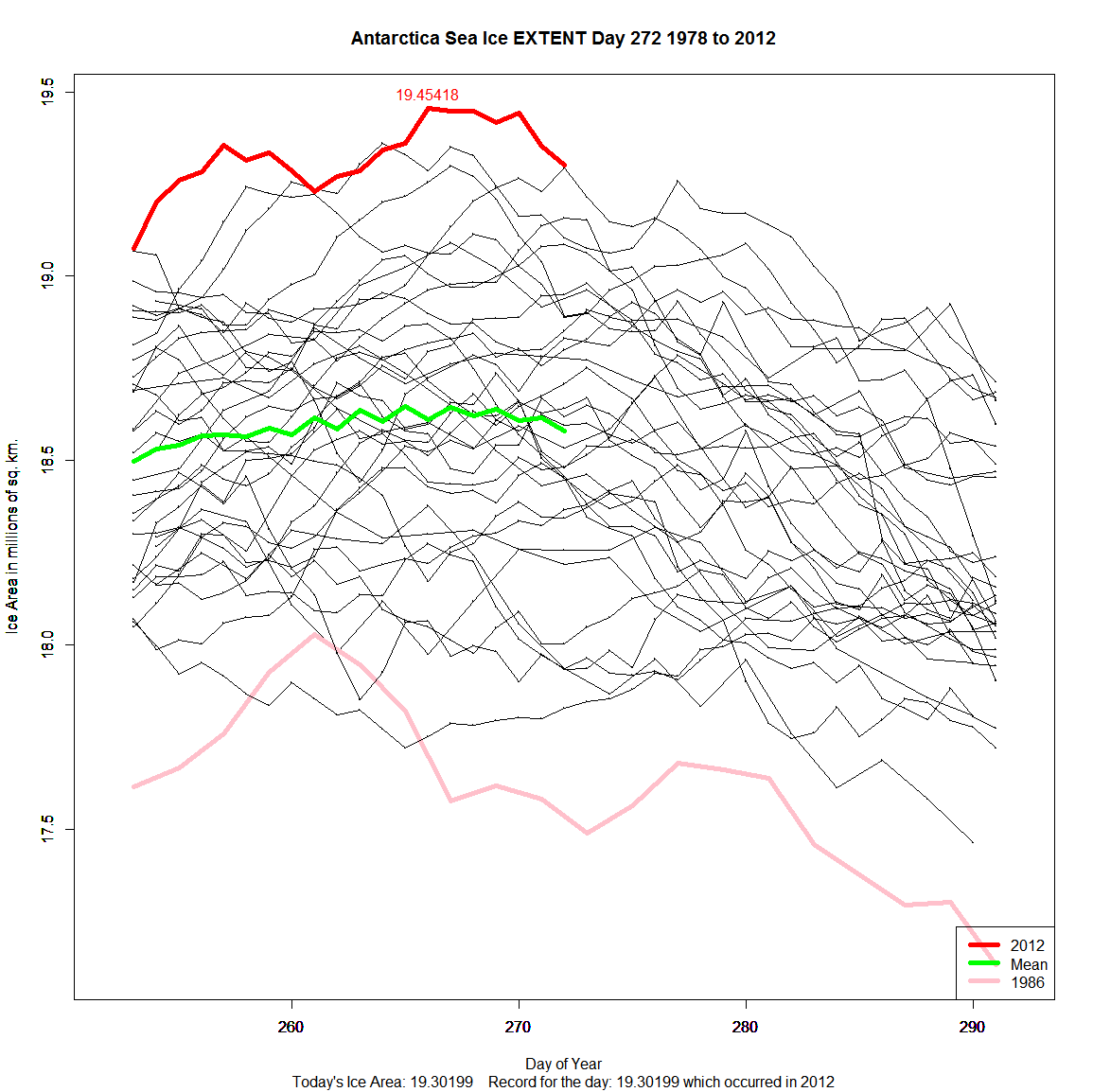
Antarctic Sea Ice Extent – 21 Daily Records Too

So far this year, Antarctic Sea Ice Extent has been a record for the day on 21 days.

19 of the last 22 days have been a record for the day, including day 265 which broke the all time record and day 266 which broke the record again.

The list below is the Day and the record amount of sea ice extent for the day.

Day million sq km 
-----------------
 33 4.17789 
 34 4.10773 
253 19.07485 
254 19.20215 
255 19.26022 
256 19.28323 
257 19.35567 
258 19.31503 
259 19.33522 
260 19.28461 
262 19.27106 
265 19.36135 
266 19.45418 
267 19.44631 
268 19.4478 
269 19.41601 
270 19.4433 
271 19.35207 
272 19.30199 
273 19.2408 
274 19.1961

Amazing Graph of AMO vs Arctic Sea Ice vs Antarctic Sea Ice

Update: In an earlier version the legend on the graph had blue labeled as Antarctic even though it was Arctic. The body of the post had it right (thanks Tom,Hugh,Tom,Anthony,Mike and Sundance for noticing ).

I decided to graph the AMO vs Arctic Sea Ice Extent vs Antarctic Sea Ice Extent. AMO data comes from NOAA, Sea Ice data comes from NSIDC.

The green is the AMO – Atlantic Multidecadal Oscillation. The red is Antarctic Sea Ice Extent. The blue is the Arctic Sea Ice Extent.

The dashed lines are the liner trends for each.

There are three amazing things:

1) The AMO trend is identical to the Antarctic trend even though the AMO is the sea surface trend of the North Atlantic Ocean! The trend are so close it is hard to see the AMO and Antarctic trends as separate items.

2) The Arctic trend is almost a mirror image of the Antarctic trend.

3) The cross over point is around 1997 which is when the AMO went officially positive (it sometimes goes opposite to the main trend for a few months)

The AMO is cyclic and will return to negative soon enough and this graph implies that sea ice trends will just reverse in a few years.

Click on the graph for a larger size.

Impact of more Antarctic Sea Ice

What is the impact of more Antarctic Sea Ice? Many warmists claim that less Arctic Sea Ice will have a more dramatic effect on earth’s albedo than increasing Antarctic Sea Ice.

Poster RACookPE1978 at WUWT disagrees and I hope he does not mind me reblogging  his comment here.

“The Antarctic Sea Ice at its 16.5 million km^2 maximum near the equinox in mid-September is a near crown-shape: A circular ring whose edge is between 62 south and 60 south latitude. During its mid-winter GROWTH range – that period BEFORE its maximum extent when its will reflect the most solar energy – it will have about 50% of its area between 66.5 south (the Antarctic Circle) and 60 south latitude.

Now, at that latitude, EVEN AT MID NH SUMMER (darkest time of the year for the Antarctic continent in mid-winter) the Antarctic sea ice WILL be reflecting light energy … for the simple reason that the Antarctic sea ice is exposed to southern hemisphere sunlight every day – even at the shortest day if the winter at June 22.

BUT … Antarctic Sea Ice is NOT at its maximum at mid-winter (the darkest days), but rather, Antarctic Sea Ice is at its maximum at the equinox when there IS sunlight for 12 hours per every latitude on the planet. Further, Antarctic Sea Ice at its maximum IS exposed to strongly absorbed sunlight at solar incidence angle between 15 and 30 degrees for 10 of those 12 hours. Worse, from a cooling world standpoint, a DECREASE in Arctic Sea ice from its present “circular cap” up between 81 north latitude and the pole DOES NOT result in increased solar absorption into the exposed sea surface, but rather an increased LOSS of heat energy from the exposed water due to evaporation and radiation.

The difference? The angle of the incidence sunlight. In the Antarctic, the light is inbound on the newly freezing sea ice at 30 degrees angle: At 30-25 degrees incidence angle, open water absorbs 90-95% of the inbound energy, sea ice reflects about 98 percent of the incident energy.

in the Arctic, at 4-8 degrees incidence angle, open (rough) water reflects 95% of the solar energy. Ice reflects about 98% of the incoming solar energy. Open water loses another 117 watts/m^2 compared to ice-covered water.

Thus, “simple” physics and geography shows that an increase in Antarctic Sea by 1.5 million km^2 ABOVE its previous “average” of 15.0 million km^2 SIGNIFICANTLY increases heat loss from the planet. An (potential) loss even of the entire remaining sea ice of 3.4 million km^2 increases heat loss from the planet.

And NO IPCC report nor ANY climate model predicts ANY increase in Antarctic sea ice at the same time as a Arctic Sea Ice decline. They only predict sea ice declines due to “a warming world” and “prove” a warming world by that same sea ice decline.”
 

WOW!!!! Antarctic Sea Ice Extent All Time Records Set in 2012

Update: Take at look at the amazing AMO vs Arctic vs Antarctic graph here.

As you may know, I have been using Cryosphere’s Antarctic Sea Ice Area data to show the record levels of Antarctic Sea Ice.

But I just found another data set, NOAA’s Sea Ice Extent here. (thanks to commenter HaroldW at the Blackboard)

And it turns out day 265 set an all time record, and then day 266 broke that record. Days 265 through 270 are now the 6 highest Antarctic Sea Ice Extent’s of all time!!!!

11 of the top 15 are now 2012.

Anyone wonder why NOAA isn’t making a fuss about this?

Year Day of Year Ice Extent
2012 266 19.45418
2012 268 19.4478
2012 267 19.44631
2012 270 19.4433
2012 269 19.41601
2012 265 19.36135
2006 264 19.35934
2012 257 19.35567
2012 271 19.35207
2006 267 19.34999
2012 264 19.34204
2012 259 19.33522
2006 265 19.3289
2006 268 19.32669
2012 258 19.31503

HADSST2 Southern Hemisphere Aug 2012 – Cooling For 15 Years

Using data from the Climate Research Unit of the UEA , it appears sea surface temperatures may explain Antarctic Sea Ice at record levels.

SST in the southern hemisphere have a cooling trend of -0.068C / decade.over the last 15 years.