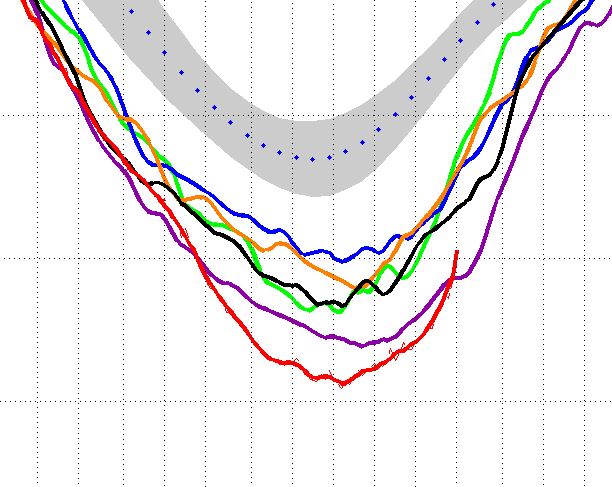
Arctic Ice Extent – Most New Ice In Any 30 Day Period – 2007 wins

Playing around with NSIDC data … Extent and Difference in millions of sq km.

Most New Arctic Extent in any 30 day period for each year:

Year Day1 Extent1 Day 30 Extent2 Difference Percent
2007 286 5.30839 316 9.66878 4.36039 82.14
2008 273 4.93508 303 9.077 4.14192 83.93
1995 277 6.14383 307 10.13683 3.993 64.99
2011 279 5.29842 309 9.12387 3.82545 72.2
1990 270 6.17527 300 9.80574 3.63047 58.79
2005 281 6.23356 311 9.82469 3.59113 57.61
1993 277 7.33222 307 10.55187 3.21965 43.91
2009 280 5.83093 310 9.00812 3.17719 54.49
2010 280 5.9077 310 9.00754 3.09984 52.47
1999 265 6.16758 295 9.26104 3.09346 50.16
2006 275 6.0512 305 9.12123 3.07003 50.73
1991 271 6.51511 301 9.53251 3.0174 46.31
2002 269 6.08789 299 9.04441 2.95652 48.56
2003 276 6.5633 306 9.46735 2.90405 44.25
1982 272 7.63864 302 10.51943 2.88079 37.71
1989 272 7.20673 302 9.99355 2.78682 38.67
2000 272 6.57732 302 9.33106 2.75374 41.87
1997 280 7.39169 310 10.1265 2.73481 37
1996 329 10.85434 359 13.57832 2.72398 25.1
1979 312 10.27106 342 12.98561 2.71455 26.43
2004 280 7.02369 310 9.72652 2.70283 38.48
1983 299 9.47507 329 12.16115 2.68608 28.35
1980 321 11.2121 351 13.89477 2.68267 23.93
1985 276 7.51509 306 10.19703 2.68194 35.69
2001 289 8.20044 319 10.87187 2.67143 32.58
1984 312 10.06132 342 12.7188 2.65748 26.41
2012 262 3.51352 292 6.16765 2.65413 75.54
1998 267 6.5224 297 9.17577 2.65337 40.68
1981 325 11.25234 355 13.90002 2.64768 23.53
1988 311 10.44499 341 13.08941 2.64442 25.32
1994 281 8.05619 311 10.64024 2.58405 32.08
1992 310 10.4128 340 12.98672 2.57392 24.72
1987 300 9.46603 330 12.01156 2.54553 26.89
1986 267 7.53248 297 9.98248 2.45 32.53

2012 is way down so far because it has only been 44 days since minimum.

Arctic Ice Extent – 8th Largest Refreeze Ever!

My previous post discussed the largest percentage increase in Arctic Sea Ice Extent Ever!

Some people called this bogus … since the low amount of ice made it “easy” for a large percentage increase.

However 31 days after minimum, 2012 is the 8th largest refreeze in sq km.

(Extent values in millions of sq km.)

Table Updated to fix percentages:

Year Minimum_Extent Extent Extent_Change Extent_Change_Pct
1990 6.0191 295 3.46791 57.6
2008 4.55469 293 3.33615 73.2
2005 5.31832 296 3.09221 58.1
2010 4.59918 293 2.88065 62.6
1989 6.88931 296 2.70935 39.3
1991 6.26027 290 2.69726 43.1
1999 5.68009 286 2.68723 47.3
2012 3.36855 291 2.62409 77.9
1979 6.89236 295 2.55691 37.1
2002 5.62456 287 2.41992 43
1982 7.15423 287 2.41499 33.8
2004 5.77608 294 2.37329 41.1
1998 6.29922 291 2.35169 37.3
2000 5.9442 286 2.32372 39.1
2003 5.97198 291 2.10126 35.2
1984 6.39916 291 2.08442 32.6
2001 6.56774 293 1.95252 29.7
1993 6.15699 280 1.85199 30.1
1986 7.12351 280 1.8491 26
1996 7.15283 285 1.77882 24.9
1988 7.04905 286 1.76783 25.1
2006 5.74877 288 1.72446 30
1981 6.88784 284 1.71672 24.9
1983 7.19145 282 1.70096 23.7
1992 7.16324 282 1.67903 23.4
1985 6.4799 281 1.50769 23.3
2009 5.05488 286 1.45951 28.9
2007 4.1607 288 1.39556 33.5
1987 6.89159 276 1.37713 20
2011 4.30207 282 1.35023 31.4
1994 6.92645 279 1.1014 15.9
1980 7.52476 280 0.95144 12.6
1997 6.61353 277 0.65032 9.8
1995 5.98945 283 0.51899 8.7

Fastest Arctic Ice Extent Refreeze Ever! (in 31 days)

Update: Another day another error to report. It appears that the percentage was calculated wrong. Instead of  43.8% it is 83.1%. Still the fastest ever. Corrected table below.

Year Minimum_Extent Extent Extent_Change Extent_Change_Pct
2012 3.36855 292 2.7991 83.1
2008 4.55469 294 3.4633 76
2010 4.59918 294 3.0069 65.4
2005 5.31832 297 3.23051 60.7
1990 6.0191 296 3.49865 58.1
1999 5.68009 287 2.80655 49.4
1991 6.26027 291 2.8399 45.4
2002 5.62456 288 2.49981 44.4
2004 5.77608 295 2.45647 42.5
1989 6.88931 297 2.7717 40.2
2000 5.9442 287 2.30344 38.8
2003 5.97198 292 2.28954 38.3
1979 6.89236 296 2.55691 37.1
1998 6.29922 292 2.32009 36.8
2007 4.1607 289 1.50469 36.2
2006 5.74877 289 1.95637 34
1982 7.15423 288 2.41499 33.8
1984 6.39916 292 2.08442 32.6
1993 6.15699 281 1.99632 32.4
2009 5.05488 287 1.59002 31.5
2011 4.30207 283 1.34784 31.3
2001 6.56774 294 1.98268 30.2
1988 7.04905 287 1.85327 26.3
1986 7.12351 281 1.8491 26
1996 7.15283 286 1.85602 25.9
1981 6.88784 285 1.71672 24.9
1992 7.16324 283 1.77142 24.7
1983 7.19145 283 1.70096 23.7
1985 6.4799 282 1.50769 23.3
1987 6.89159 277 1.55764 22.6
1994 6.92645 280 1.19137 17.2
1980 7.52476 281 0.95144 12.6
1997 6.61353 278 0.75388 11.4
1995 5.98945 284 0.59766 10

Today is day 291 in the Arctic. The minimum in 2012 was on day 260 – 31 days ago.

If you calculate the percentage of ice gained (the refreeze) 31 days after minimum, then 2012 is the fastest refreeze ever!

Arctic Sea Ice Extent has increased by 43.8% since the minimum was reached.

Extents are in millions of sq km.

(And note I am using NSIDC data here and their algorithm is making the refreeze appear slow compared to NORSEX)

Incorrect Table:

Year Minimum_Extent Extent Day Extent_Change Extent_Change_Pct
1979 6.89236 295 2.55691 27.1
1980 7.52476 280 0.95144 11.2
1981 6.88784 284 1.71672 20
1982 7.15423 287 2.41499 25.2
1983 7.19145 282 1.70096 19.1
1984 6.39916 291 2.08442 24.6
1985 6.4799 281 1.50769 18.9
1986 7.12351 280 1.8491 20.6
1987 6.89159 276 1.37713 16.7
1988 7.04905 286 1.76783 20.1
1989 6.88931 296 2.70935 28.2
1990 6.0191 295 3.46791 36.6
1991 6.26027 290 2.69726 30.1
1992 7.16324 282 1.67903 19
1993 6.15699 280 1.85199 23.1
1994 6.92645 279 1.1014 13.7
1995 5.98945 283 0.5189 8
1996 7.15283 285 1.77882 19.9
1997 6.61353 277 0.65032 9
1998 6.29922 291 2.35169 27.2
1999 5.68009 286 2.68723 32.1
2000 5.9442 286 2.32372 28.1
2001 6.56774 293 1.95252 22.9
2002 5.62456 287 2.41992 30.1
2003 5.97198 291 2.10126 26
2004 5.77608 294 2.37329 29.1
2005 5.31832 296 3.09221 36.8
2006 5.74877 288 1.72446 23.1
2007 4.1607 288 1.39556 25.1
2008 4.55469 293 3.33615 42.3
2009 5.05488 286 1.45951 22.4
2010 4.59918 293 2.88065 38.5
2011 4.30207 282 1.35023 23.9
2012 3.36855 291 2.62409 43.8

2012 Average Arctic Sea Ice Extent so far

Yesterday I did a post claiming average Arctic Sea Ice Extent was higher than 2007 up to day 290,

I had to issue a correction.

It turned out Arctic Sea Ice Extent was just slightly higher than 2011, but not higher than 2007.

On day 291, 2012’s lead over 2011 has shrunk from 4,633 sq km to 3393.

However, 2007’s  lead over 2012 of 1468 sq km has shrunk to 1104.

And to be clear, just because 2012 has slightly more sea ice than 2012 does not mean the end of the world happened in 2011.

The AGW cult is still quite sure we are now doomed because of the 2nd lowest amount of Arctic Sea Ice Extent (and a cyclone) occurred this year.

Updated/Corrected: Arctic Sea Ice Extent Average for 2012 is now higher than 2007 (NSIDC)

UPDATE: My apology. The original post was wrong.

What I did (in a hurry) was post the Extent for day 290, not the mean of the extent up to day 290.

Sorry.

The correct data is:

The mean for 2012 up to day 290 = 10.5267 million sq km
The mean for 2007 up to day 290 = 10.52817million sq km

2012 is still lower than 2007, but only by 1,468.4 sq km. A statistical tie.

If I had waited one more day and had done it right, the conclusion of my original post would have been right.

But it wasn’t.

However, the mean for 2011 up to day 290 is 10.522 million sq km.

Which means 2012 has now averaged 4,633.3 sq km more ice than 2011 thanks to normal extent earlier in the year.

Original Post Starts Here:

Using NSIDC data (to day 290):

The mean of Arctic Sea Ice Extent for 2012 = 5.78274 million sq km
The mean of Arctic Sea Ice Extent for 2007 = 5.74562 million sq km

The average Arctic Sea Ice Extent for 2012 is now 37,120 sq miles higher than 2007.

AGW Arctic Sea Ice Propaganda Ignores Area

AGW Arctic Sea Ice Propaganda in 4 Easy Steps with an added bonus.

The Yellow is the amount of ice where 2012 was higher than 2007.

The Pink is the amount of ice where 2007 was higher than 2012.

One of those areas is an indicator of the end of the world according to AGW. The other area is to be ignored.

Amazing Graph of AMO vs Arctic Sea Ice vs Antarctic Sea Ice

Update: In an earlier version the legend on the graph had blue labeled as Antarctic even though it was Arctic. The body of the post had it right (thanks Tom,Hugh,Tom,Anthony,Mike and Sundance for noticing ).

I decided to graph the AMO vs Arctic Sea Ice Extent vs Antarctic Sea Ice Extent. AMO data comes from NOAA, Sea Ice data comes from NSIDC.

The green is the AMO – Atlantic Multidecadal Oscillation. The red is Antarctic Sea Ice Extent. The blue is the Arctic Sea Ice Extent.

The dashed lines are the liner trends for each.

There are three amazing things:

1) The AMO trend is identical to the Antarctic trend even though the AMO is the sea surface trend of the North Atlantic Ocean! The trend are so close it is hard to see the AMO and Antarctic trends as separate items.

2) The Arctic trend is almost a mirror image of the Antarctic trend.

3) The cross over point is around 1997 which is when the AMO went officially positive (it sometimes goes opposite to the main trend for a few months)

The AMO is cyclic and will return to negative soon enough and this graph implies that sea ice trends will just reverse in a few years.

Click on the graph for a larger size.

Impact of more Antarctic Sea Ice

What is the impact of more Antarctic Sea Ice? Many warmists claim that less Arctic Sea Ice will have a more dramatic effect on earth’s albedo than increasing Antarctic Sea Ice.

Poster RACookPE1978 at WUWT disagrees and I hope he does not mind me reblogging  his comment here.

“The Antarctic Sea Ice at its 16.5 million km^2 maximum near the equinox in mid-September is a near crown-shape: A circular ring whose edge is between 62 south and 60 south latitude. During its mid-winter GROWTH range – that period BEFORE its maximum extent when its will reflect the most solar energy – it will have about 50% of its area between 66.5 south (the Antarctic Circle) and 60 south latitude.

Now, at that latitude, EVEN AT MID NH SUMMER (darkest time of the year for the Antarctic continent in mid-winter) the Antarctic sea ice WILL be reflecting light energy … for the simple reason that the Antarctic sea ice is exposed to southern hemisphere sunlight every day – even at the shortest day if the winter at June 22.

BUT … Antarctic Sea Ice is NOT at its maximum at mid-winter (the darkest days), but rather, Antarctic Sea Ice is at its maximum at the equinox when there IS sunlight for 12 hours per every latitude on the planet. Further, Antarctic Sea Ice at its maximum IS exposed to strongly absorbed sunlight at solar incidence angle between 15 and 30 degrees for 10 of those 12 hours. Worse, from a cooling world standpoint, a DECREASE in Arctic Sea ice from its present “circular cap” up between 81 north latitude and the pole DOES NOT result in increased solar absorption into the exposed sea surface, but rather an increased LOSS of heat energy from the exposed water due to evaporation and radiation.

The difference? The angle of the incidence sunlight. In the Antarctic, the light is inbound on the newly freezing sea ice at 30 degrees angle: At 30-25 degrees incidence angle, open water absorbs 90-95% of the inbound energy, sea ice reflects about 98 percent of the incident energy.

in the Arctic, at 4-8 degrees incidence angle, open (rough) water reflects 95% of the solar energy. Ice reflects about 98% of the incoming solar energy. Open water loses another 117 watts/m^2 compared to ice-covered water.

Thus, “simple” physics and geography shows that an increase in Antarctic Sea by 1.5 million km^2 ABOVE its previous “average” of 15.0 million km^2 SIGNIFICANTLY increases heat loss from the planet. An (potential) loss even of the entire remaining sea ice of 3.4 million km^2 increases heat loss from the planet.

And NO IPCC report nor ANY climate model predicts ANY increase in Antarctic sea ice at the same time as a Arctic Sea Ice decline. They only predict sea ice declines due to “a warming world” and “prove” a warming world by that same sea ice decline.”