Killing Sea Urchins To Make Money Carbon Trading

A pair of biologists have a plan to make hundreds of millions of dollar trading carbon credits in Europe.

“”An alluring idea,” they write, would be to sell the carbon indirectly sequestered by the sea otter protected kelp forest “as a way to pay for their reintroduction and management or to compensate losses to shell fisheries from sea otter predation.””

“They estimate that the CO2 removed from the atmosphere via the otter-kelp link could be worth between $205 million and $408 million on the European Carbon Exchange.”

How are they going to do this? By increasing the number of sea otters so the otters eat a lot more sea urchins and therefore the sea urchins won’t eat as much kelp. Sure, otters are cute. But why are the biologists taking sides?

To make a lot of money.

Notice the loaded language in the article:

ravenous sea urchins”

” sea urchins graze voraciously on living kelp” !!!

Living kelp? Does anyone ever attack cows for “grazing voraciously on living grass”?

You can see how climate change and carbon credits have corrupted the thinking of those poor biologists who are now choosing sides to make big money.
HADCRUT3 Gridded Data – NW Corner – Last 15 years

This post looks at the North West corner of the HADCRUT3 Gridded data for the last 15 years. It is a continuation of this post.

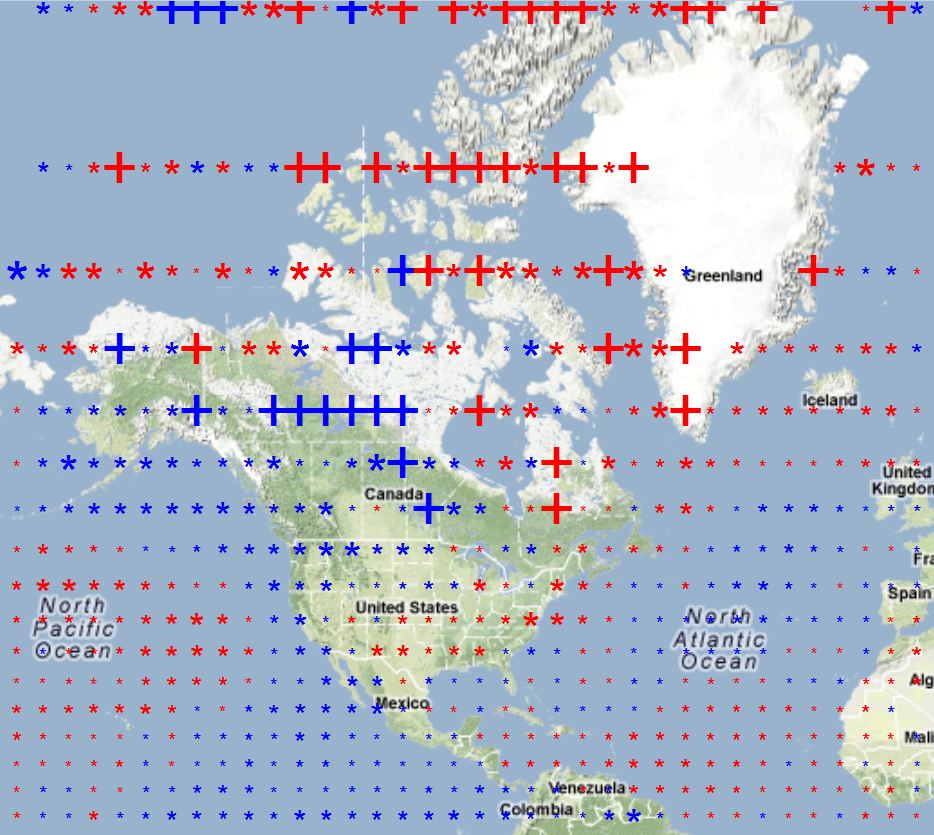
But Northwest I mean Latitude above 0, Longitude < 0. Roughly North America.

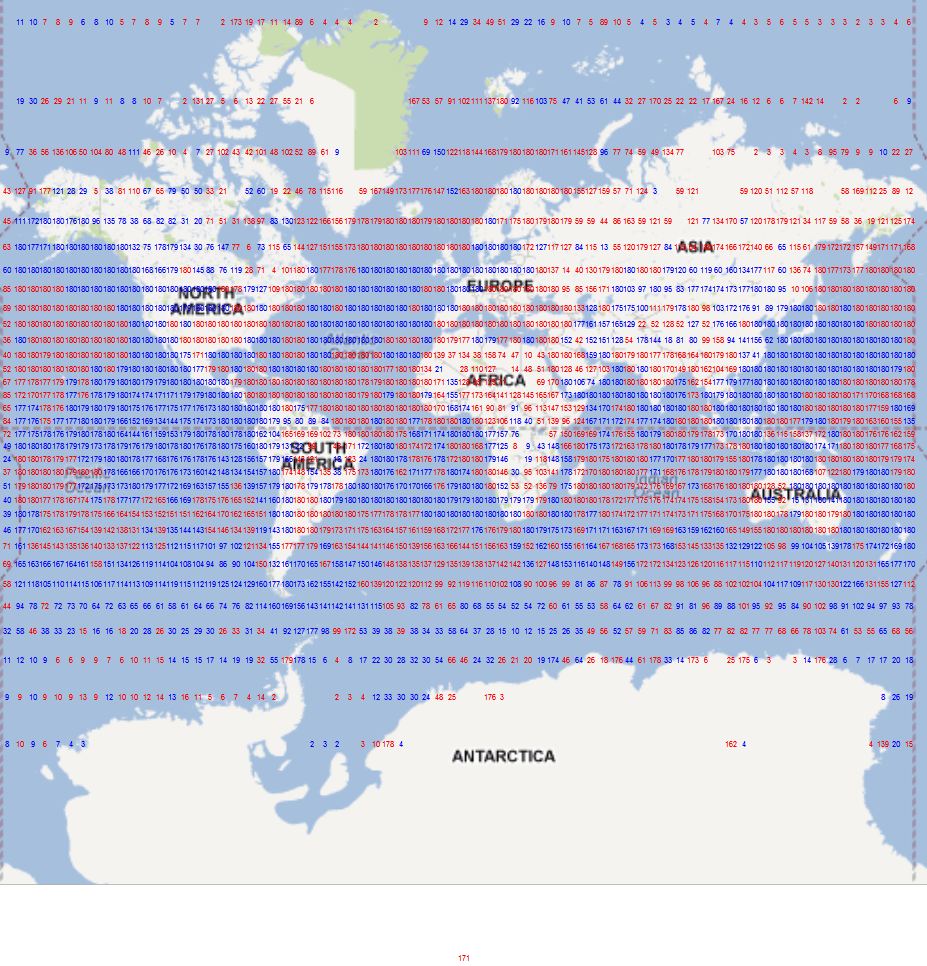
In the first map, I am showing the grid cells that have 170 data points out of the last 180 months. I believe that is close to what CRU does for the HADCRUT3 data summarized by month. The 2nd map has all the grid cells with 2 or more data points.

The * represents the magnitude of the data roughly. If there is a + it is too large to show (like the giant red star). Red = warming. Blue = cooling.


HADCRUT3 Gridded Last 15 years – Some Data is Missing

My first look at the gridded data ended up with a Big Red Star. This post looks at how much data there is over the last 15 years counting back from June 2012 (the most recent gridded data).

For grids with temperature stations there should be 180 data points (15 years x 12 months).

I found 2,315 grid cells with data out of a possible 2,592. 731 of those grid cells have a 180 data points. 1,132 grid cells have 170 or more data points.

I calculated the trend for each gridcell.

I’ve used RGoogleMaps before to map spatial data, so here is a map of the world with the count of data points centered in each grid cell. You might want to click on it and zoom in. Cells with a cooling trend are in blue, warming cells are colored red. 1253 cells are warming, 1058 are cooling and 4 have a trend of 0.

There are a lot of cells without much data.

Giant Red Star’s in the Arctic – HADCRUT3 gridded data

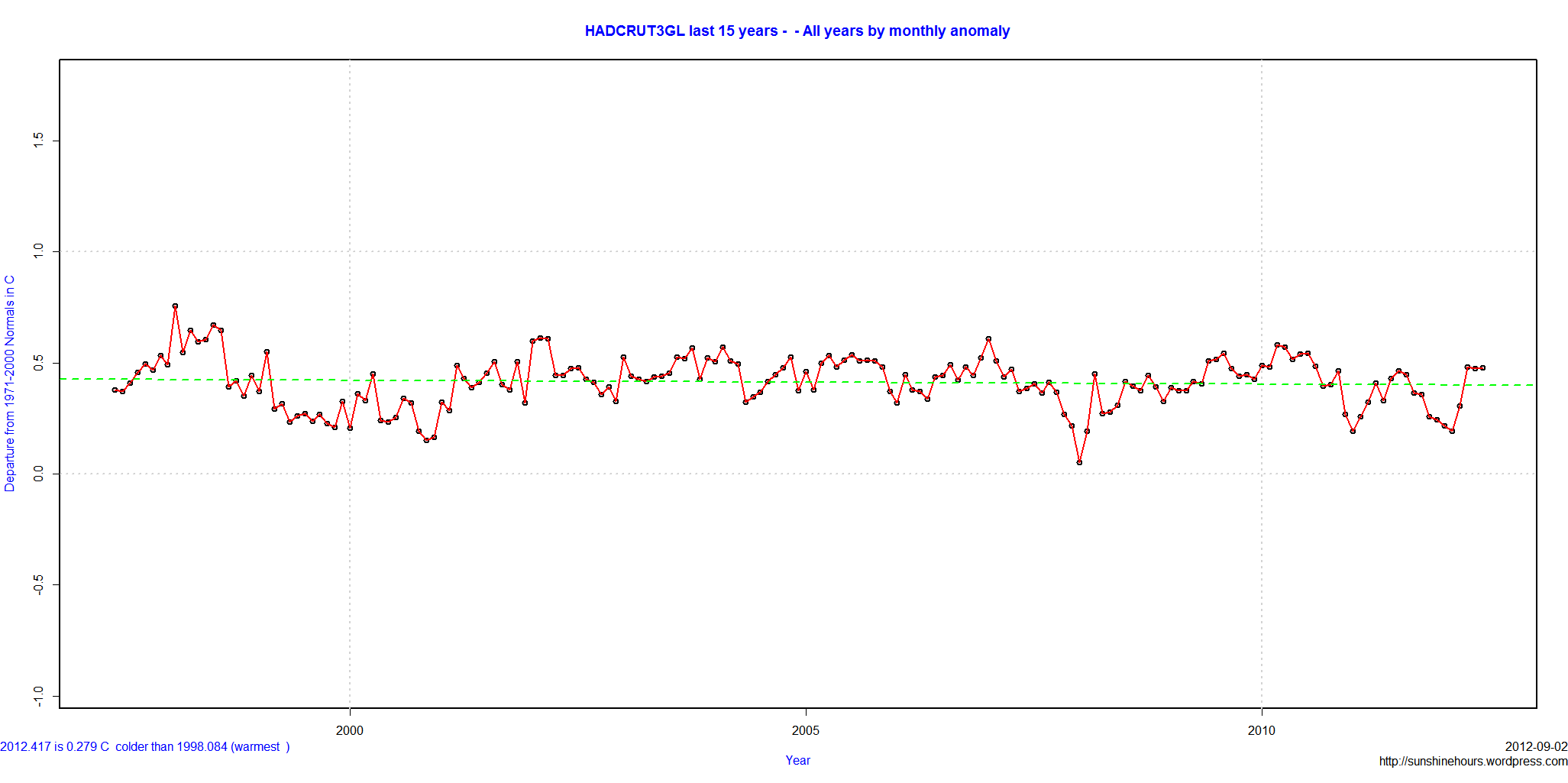
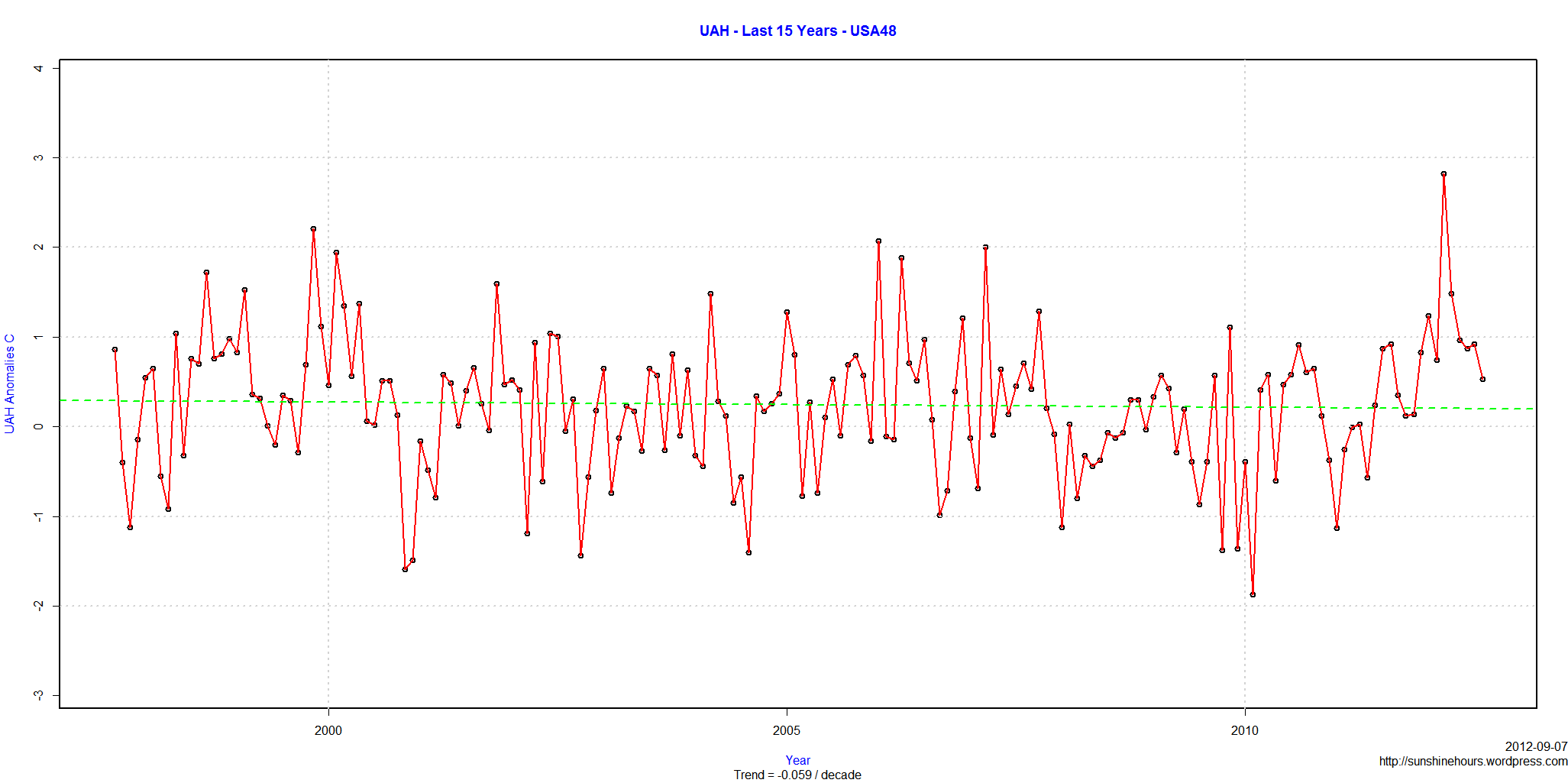
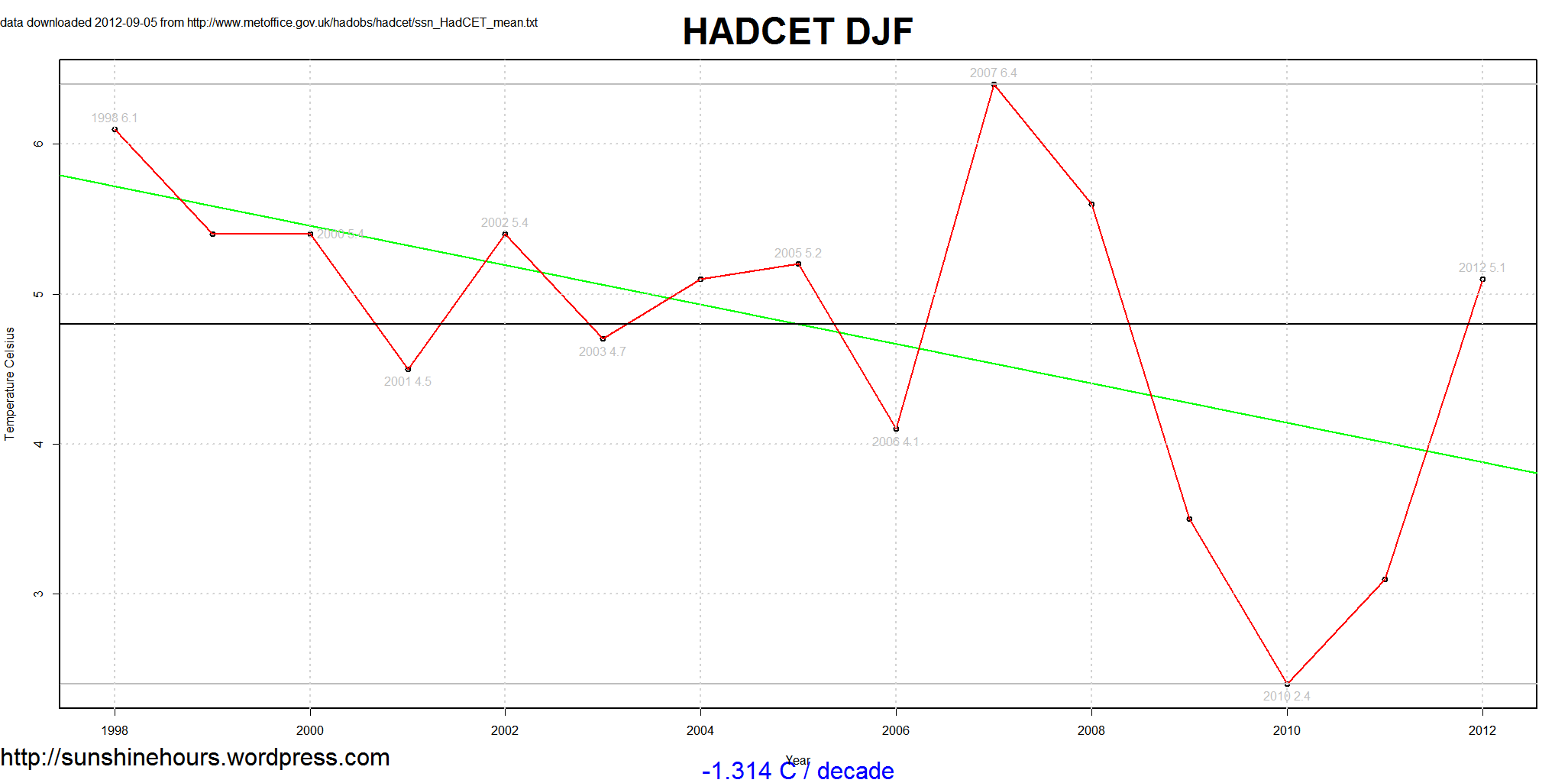
I’ve graphed HADCRUT3 before.  It shows a flat temperature trend over the last 15 years (actually a very small negative trend). So I thought I would take a look at the gridded data (HADCRUT3 Zipped Ascii) and find out which grid cells (5 x 5)  are warming and which are cooling by how much.

I’m using the R package RGoogeMaps which I’ve used before. So I started by calculating  the trend in Celsius / Decade for each grid roughly near North and South America. The code puts an asterisk * at the middle of each grid square. Red for warming and blue for cooling. And I used this formula to set the size of the asterisk:

tCex = 1 + (abs(grid$Trend[i]) * 1)

Which means each asterisk starts at 1 and then the absolute Trend is added on. So if a grid square was warming at 1C / Decade, there would be a red asterisk 2 units in size.

So thats when I saw the giant red asterisk. One of the grid squares is warming at 247C / Decade. Of course it turns out there are only two measurements in those 15 years.

The grid square is Latitude 75 to 80 and Longitude -110 to -105. Somewhere near Melville Island in the Canadian North.

Global Warming solved

Just like Polar Bears, if you stop killing whales, they stop dying in large numbers and the damage “caused” by global warming disappears.  (h/t Tom Nelson)

But to be politically correct you still have to blame global warming.

“An institute that tracks the population of Humpback whales that reproduce along Brazil’s coast says the number of the once-threatened mammals has tripled over the last 10 years.

The Humpback Whale Institute says in a news release there are now almost 10,000 humpbacks off the Brazilian coast. In 2002, the institute counted approximately 3,000 whales.

Institute chief Milton Marcondes says the whales’ fat once was used as fuel for public lighting and in construction. Hunting was banned in 1966, when only about 1,000 whales were left.

Marcondes says restoration efforts have helped the species recover in spite of global warming, accidents with boats and fishing nets.”

Global Warming, the mass killer of whales … or was that harpoons? They both look alike … to climate scientists.