Paris Bans Cars Due To Pollution

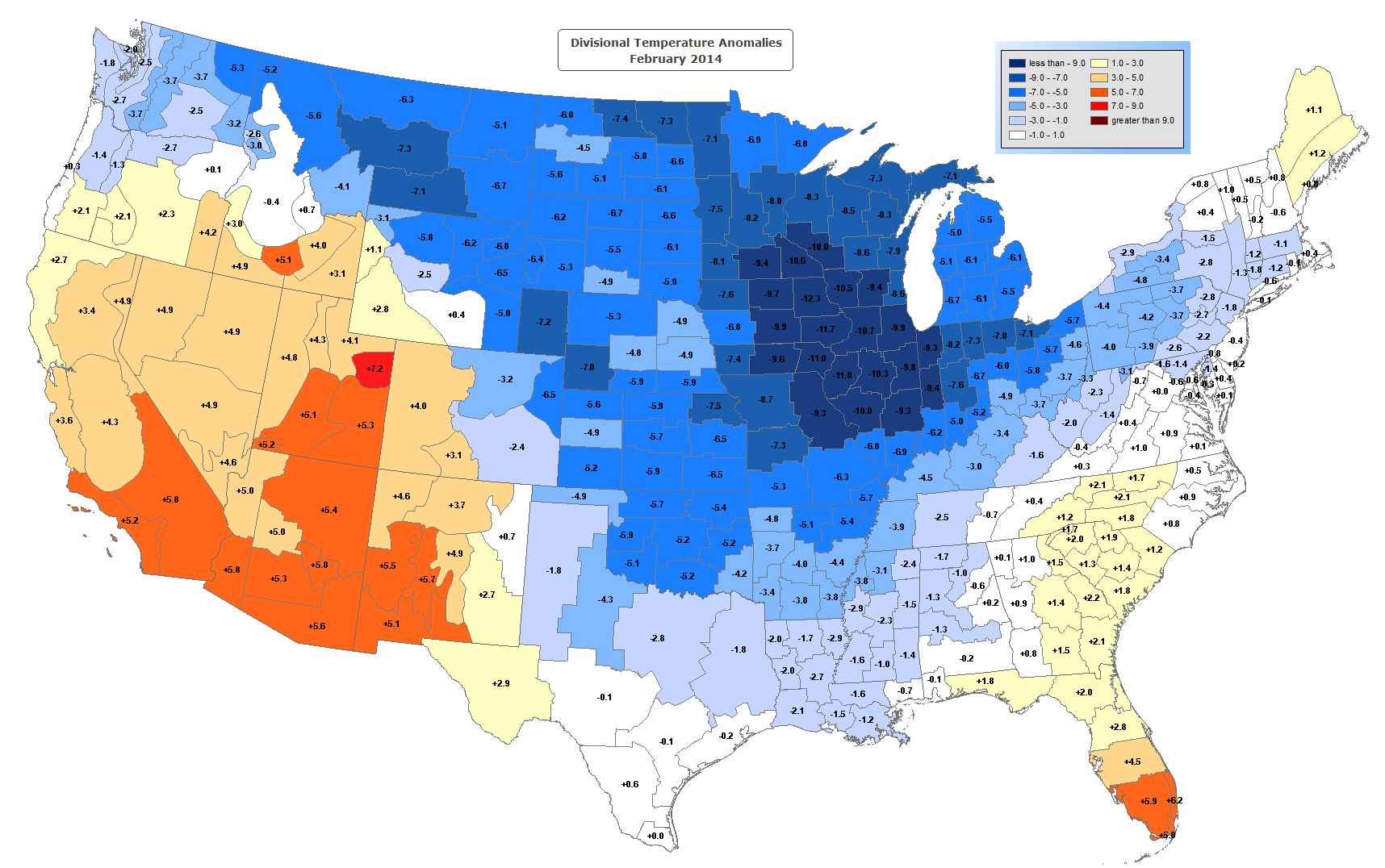
Paris air pollution is getting so bad they are banning half the cars and only allowing cars with odd number plates in on some days and even numbered plates on other days.

I know the world likes to blame bad air pollution in China on the coal power plants, but Paris gets most of its electricity fro nuclear power. So obviously they got the right conclusion – blame cars. Could all the new wealth in China and all the new cars be behind their pollution, and not coal power (or not as much)?

“Hundreds of police are monitoring traffic in Paris after pollution levels prompted the French government to impose major restrictions.

Only motorists whose cars have odd-numbered registration plates are allowed to drive.

On Tuesday, if the restrictions remain in place, it will be the turn of those with even-numbered plates.

Ministers acted after air pollution exceeded safe levels for five days running in Paris and surrounding areas.

The smoggy conditions have been caused by a combination of cold nights and warm days, which have prevented pollution from dispersing.”
http://www.bbc.com/news/world-europe-26599010

Royal Society for the Prevention of Birds.

James Delingpole has a good article on the corruption of  The National Trust and the Royal Society for the Protection Prevention of Birds.

“There’s a problem here and it’s so glaring it’s a wonder that the authors of the report were able to write this section without burying their heads in shame and wishing the earth would swallow them up as punishment for their intellectual dishonesty and positively Gorean levels of hypocrisy. The fact that they were capable of doing so speaks volumes as to just how out of touch with reality environmentalists like the ones who have taken over the RSPB hierarchy have become.

That problem – *exasperated sigh* – is this: if the RSPB is really concerned about the potential disturbance to wildlife of a few noisy lorries and drill rigs (which, let’s not forget, are only up for a short period, after which they are replaced by a silent extraction device called a Christmas tree), how come it’s so cheerfully complacent about the epic numbers of rare birds and protected bats which are sliced and diced (or, in the case of bats, barotraumatised – i.e. made to implode) by the industrial wind turbines which the RSPB not only champions but from which it benefits financially.

Yes that’s right. The RSPB – supposed guardians of Britain’s birdlife – makes hundreds of thousands of pounds in partnership with the wind industry, despite the fact that wind turbines around the world kill as many as 22 million birds every year, including rare and protected species such as America’s national bird the Bald Eagle, Whooping Cranes and Hen Harriers.

And how many birds does the fracking industry kill each year? Well, put it this way: the number is an awful lot closer to zero than it is to 22 million.”

http://www.breitbart.com/Breitbart-London/2014/03/15/National-Trust-And-RSPB-mislead-over-fracking


Arctic Sea Ice Extent Climbs 335,000 sq km in 3 Days – Avoids Being 3rd Lowest Maximum

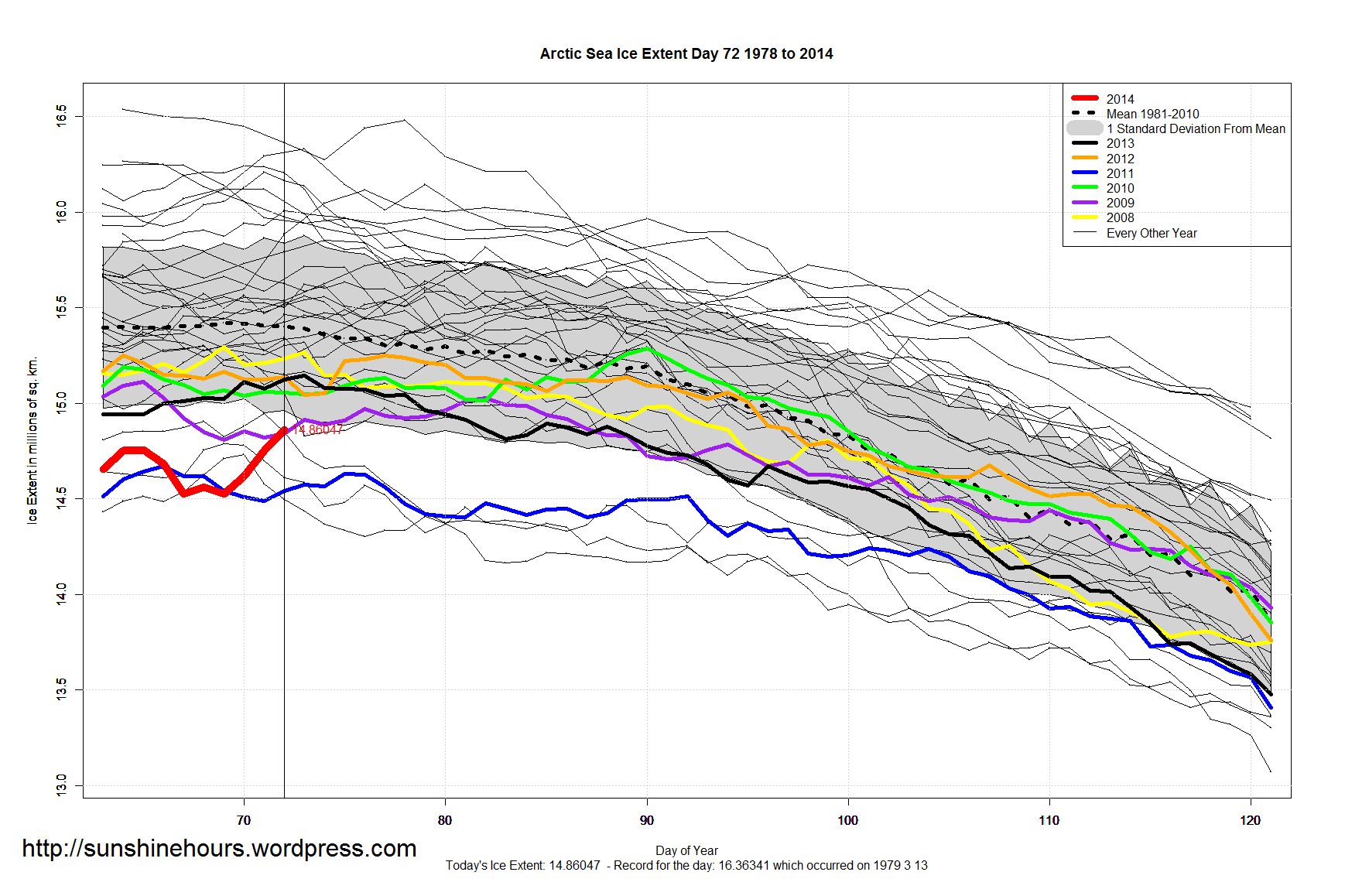
The 3 lowest maximums for Arctic Sea Ice are:

2011 14.67084 million sq km
2006 14.73298
2007 14.78963

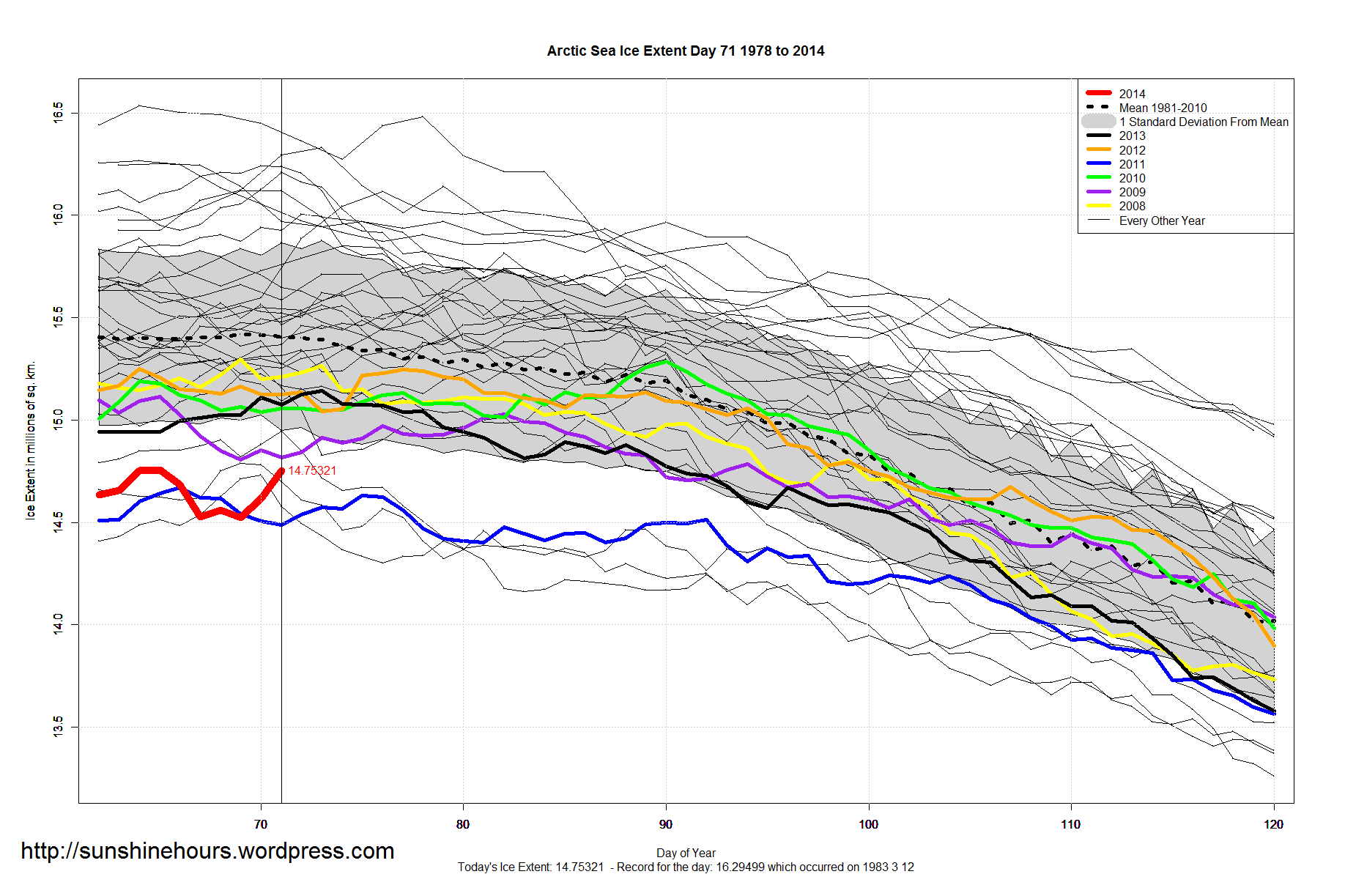
On March 6 the the Extent was 14.75613, which would have made it the 3rd lowest, replacing 2007. Arctic Extent fell to 14.52475 on March 10th. Since then it has rebounded by 335,000 sq km, guaranteeing it won’t go any lower than 4th lowest maximum. Of course it could keep climbing.  It may even get within one standard deviation again.

It is only day 72 in the Arctic. The latest maximum was day 90 in 2010. The earliest maximum was on day 52 in 1987 which was the 6th highest maximum.

Arctic_Sea_Ice_Extent_Zoomed_2014_Day_72_1981-2010


California February 2014 – Almost 6 Times As Much Rain Compared to January

Update: I had 2013 in the title. Sorry. (thanks justsoeguy31167)

According to the NOAA, California averaged 3.43 inches of rain in February 2014, which was only .42 inches below the 1901-2000 mean.

That is about 5.7X as much rain compared to January when California only averaged only .6 inches of rain.

One month of average rainfall won’t end a drought, but it sure helps.

NOAA_Feb_2014_California_Rainfall

Sea Ice Update March 13 2014 – Global Sea Ice Is Normal / Antarctic 4th Highest / Arctic Up 250,000 km in 2 days

A quick update for sea ice extent:

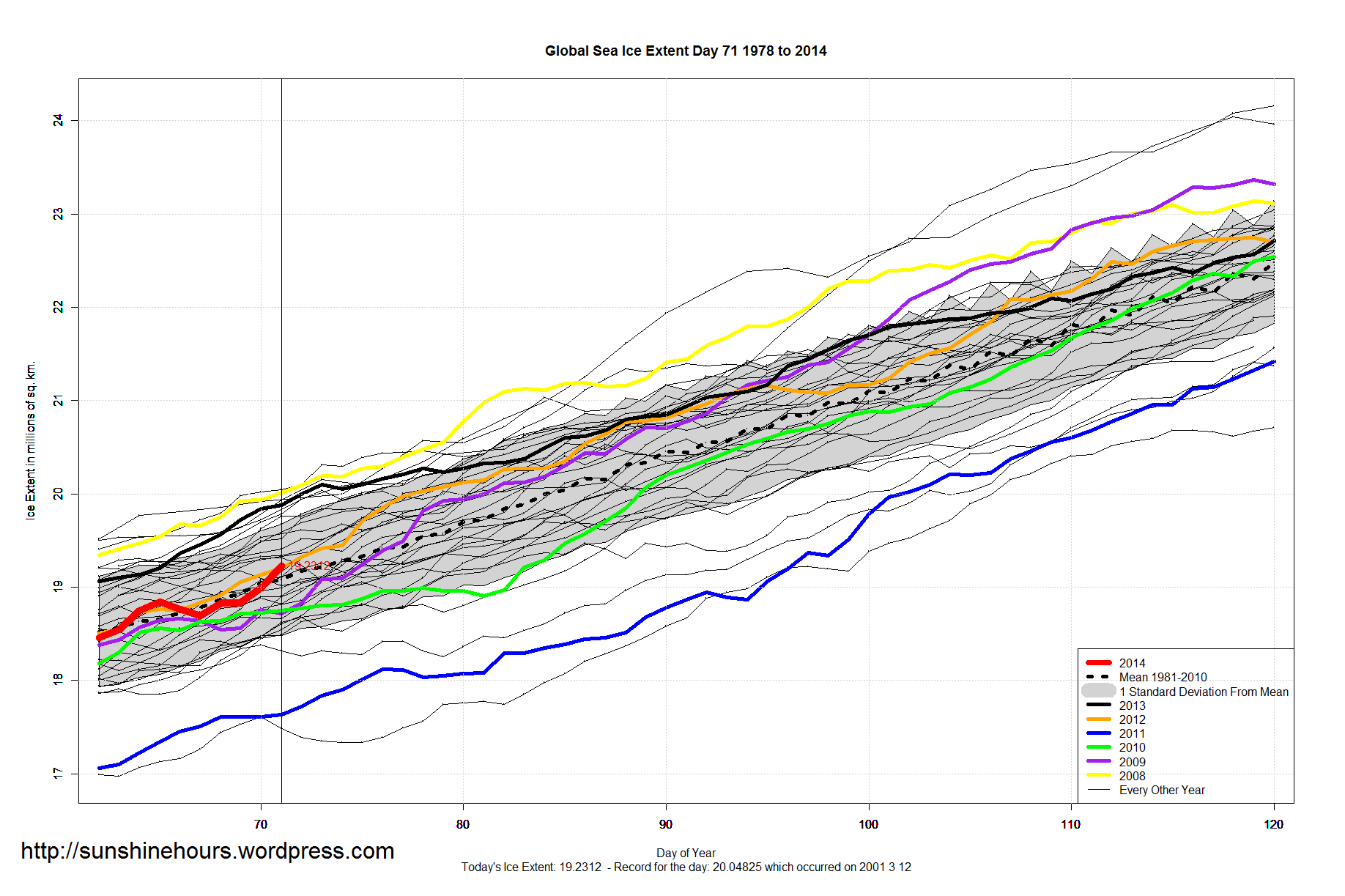
  • Global Sea Ice is only 152,000 sq km above the 1981-2010 mean.  That is 0.8% abovethe mean.
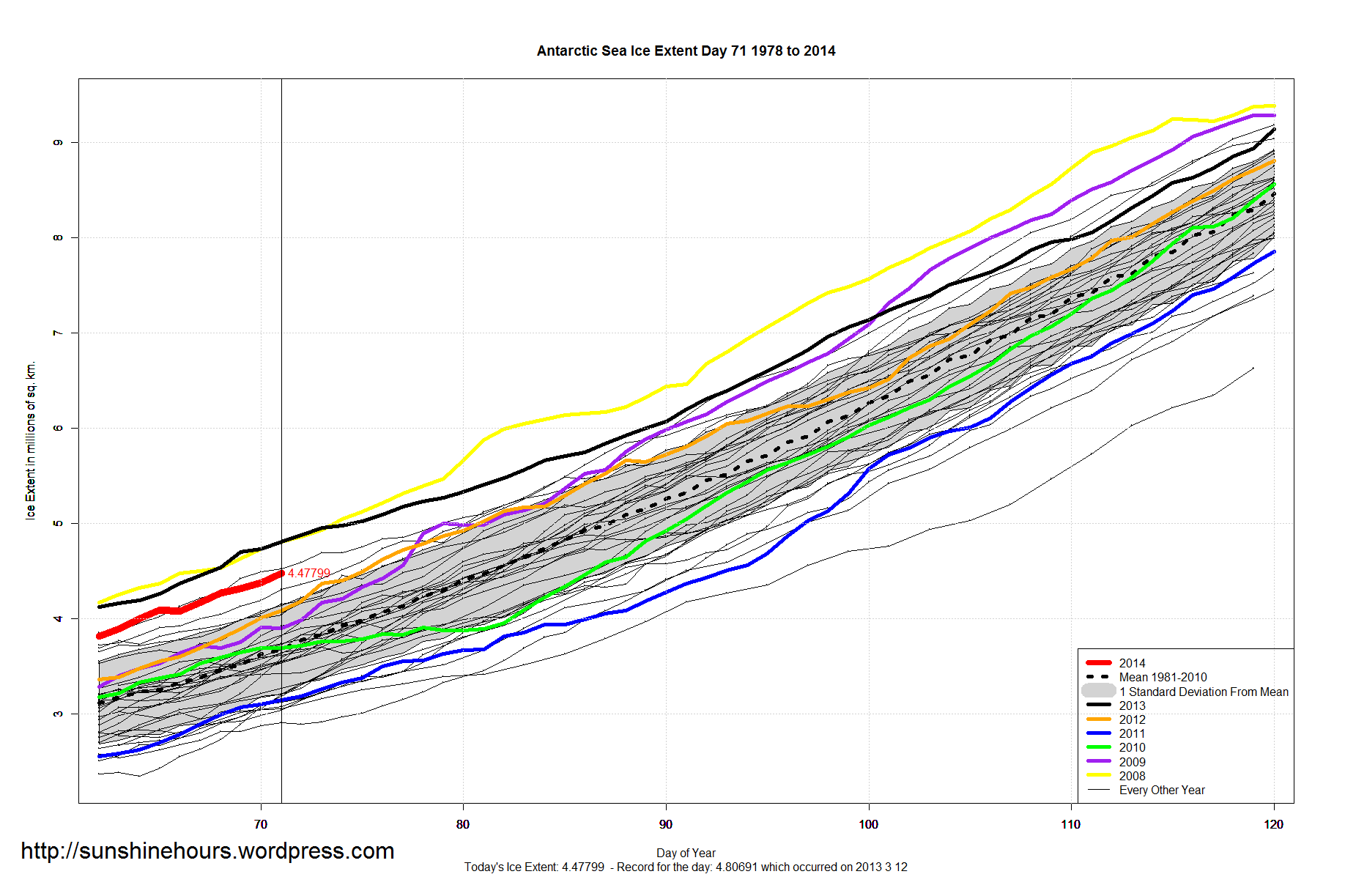
  • Antarctic Sea Ice is  806,000 sq km above the 1981-2010 mean. That is 22% above the mean and 4th highest in the satellite era.
  • Arctic Sea Ice is 654,000 sq km below the 1981-2010 mean.  That is 4.2% below the mean . Arctic Sea Ice rose 250,000 sq km in 2 days.

Data here. Graphs below. Click for bigger.

Global_Sea_Ice_Extent_Zoomed_2014_Day_71_1981-2010 Antarctic_Sea_Ice_Extent_Zoomed_2014_Day_71_1981-2010 Arctic_Sea_Ice_Extent_Zoomed_2014_Day_71_1981-2010

Railways Are Building Even If the Keystone XL Isn’t

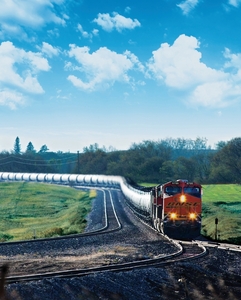
There is oil to be moved. Obama and company keeps delaying approval of the Keystone XL.  So Warren Buffet and his railway the BNSF (and other railways) are stepping up and building thousands of miles of new track.

Right through the middle of cities.

Bakkentrain_13946551525353-300x300-noup

BNSF will make the following investments:

-$162 million to double track the rail line from Minot, N.D., to Glasgow, Mont., to help address major congestion issues for westbound traffic to destinations in the Pacific Northwest.

-$26 million to add sub sidings to address congestion from Fargo, N.D., to Grand Forks, N.D.

-$14 million to add sub sidings to address congestion from Fargo, N.D., to Glendive, Mont.

-$13 million to add sub sidings to address congestion from Minot, N.D., to Grand Forks, N.D.

-$13 million to add sub sidings and an interchange track to address congestion from Canada to the U.S.

-$11 million for centrailized traffic control to improve service from Bismarck, N.D., to Fargo, N.D.

-$8 million to add sub sidings and conduct signal work along track from Fargo, N.D., to Minot, N.D.

The company also recently issued a request for proposal to major rail-car manufacturers to submit bids for the construction of 5,000 next-generation tank cars used to move crude oil.

http://thebakken.com/articles/551/bnsf-plans-record-nd-investments-in-2014

NSF Beclowns Itself With Scare Story About Genghis Khan And Perfect Weather

According to PNAS and the NSF and the Daily Mail, Genghis Khan conquered Asia because an ideal combination of warmth and rainfall caused grass production to rise..

All this conjecture about perfect weather leading to huge crops resulting in Genghis Khan conquering of Asia comes from the tree rings of only 17 trees.

“Between 1211 and 1225 – the exact time of the Mongols’ rise – central Mongolia saw one of its wettest, and warmest, periods for 1,000 years

“We propose that these climate conditions promoted high grassland productivity and favored the formation of Mongol political and military power.”

“They think the conditions created those needed for a boost in lush growth of grass, which would have fuelled the soldiers’ horses and fattened their livestock. The good weather lasted from 1211 to 1225 – the exact period when Genghis Khan and his armies rose to prominence.”

“Such a strong and unified center would have required a concentration of resources that only higher productivity could have sustained, in a land in which extensive pastoral production does not normally provide surplus resources,” the paper states.”

The incredible leap in logic from 17 tree rings is breathtaking. Maybe some goat herd tethered  goats to the trees and the urinated on them. There are many explanations for why a few trees grew better for exactly 14 years.

But even more amazing is that the lesson “we” the gullible should learn is that extreme weather will bring drought!

“The researchers said the trees, some of them more than 1,000 years old, gave them an indication of what the future could hold for the region, with drought and other extreme weather likely to become more common in central Asia.”

The stupidity is alarming. First they claim than natural variation in climate brought warm moist conditions to Mongolia and in fact brought perfect growing conditions … and their conclusion is to worry about drought and extreme weather.

What a waste of grant money.