NOAA September 2012 = 15 Year Trend By State

There has been much discussion in the climate blogosphere over the flat line in HADCRUT over the last 15 years.

Here are the 15 year trends from NOAA by State. Highlighted = Cooling

State 15 Year Trends in F/Decade
Alabama 0.1
Arizona -0.2
Arkansas 0
California 0.5
Colorado -0.3
Connecticut 0.4
Delaware 1
Florida -0.2
Georgia -0.1
Idaho -0.7
Illinois -0.1
Indiana -0.1
Iowa -0.7
Kansas -0.3
Kentucky -0.2
Louisiana 0.1
Maine 0.7
Maryland 0.4
Massachusetts 0.2
Michigan -0.3
Minnesota -0.7
Mississippi 0.1
Missouri 0
Montana -0.9
Nebraska -0.8
Nevada -0.1
New Hampshire 0.3
New Jersey 0.8
New Mexico 0.1
New York 0.4
North Carolina 0.2
North Dakota -0.9
Ohio 0
Oklahoma 0.3
Oregon -0.6
Pennsylvania -0.1
Rhode Island 0.1
South Carolina 0.3
South Dakota -1
Tennessee 0
Texas 0
Utah -0.5
Vermont 0.8
Virginia 0.5
Washington -1.2
West Virginia 0.1
Wisconsin -0.6
Wyoming -0.1

HADCRUT4 and Met Office Claims

Read this article: Met Office reply to David Rose Sunday Mail article:

As we’ve stressed before, choosing a starting or end point on short-term scales can be very misleading. Climate change can only be detected from multi-decadal timescales due to the inherent variability in the climate system. If you use a longer period from HadCRUT4 the trend looks very different. For example, 1979 to 2011 shows 0.16°C/decade (or 0.15°C/decade in the NCDC dataset, 0.16°C/decade in GISS). Looking at successive decades over this period, each decade was warmer than the previous – so the 1990s were warmer than the 1980s, and the 2000s were warmer than both.”

Ok, lets look at a non-arbitrary endpoint (the last datapoint) and go back in 5 year increments.

HADCRUT4 Last 5 years colder than previous 5 years

Mean of the anomaly of the last 5 years = .45C

Mean of the anomaly of the previous 5 years = .49C

Mean of the anomaly of the previous previous 5 years = .41C

HADCRUT3 – Last 5 years colder than previous AND colder than the previous previous 5.

Mean of the anomaly of the last 5 years = .39C

Mean of the anomaly of the previous 5 years = .45C

Mean of the anomaly of the previous previous 5 years = .41C


Warming stopped. HADCRUT3 trend is negative.

IPCC predicted .2C per decade. HADCRUT4 has been created to change the negative trend of HADCRUT3 to a positive one.

But even with the “adjustments”, the last 15 years trend in HADCRUT4 is 1/6th that predicted by the IPCC.


NOAA September 2012 Precipitation

Four of the 48 continental US states set a record for lowest rainfall in September 2012 according to the NOAA. The ranks are out of 118 with 1 being driest. 19 out of the 48 states were below average (rank 59 and lower) and 29 were ranked above average.

Indiana, Kentucky, Mississippi, Missouri, Tennessee and Nebraska’s driest September were before 1900.

State Sep 2012 Sep Rank Driest Sep Lowest Rainfall Wettest Sep Highest Rainfall
Minnesota 0.56 1 2012 0.56 2010 6.7
Montana 0.15 1 2012 0.15 1986 3.71
North Dakota 0.24 1 2012 0.24 1900 5
South Dakota 0.24 1 2012 0.24 1986 4.27
Washington 0.11 2 1975 0.09 1959 4.78
Nebraska 0.51 3 1899 0.44 1973 6.5
Oregon 0.07 4 1999 0.03 1986 2.83
Idaho 0.19 7 1987 0.08 1959 3.23
Wisconsin 1.61 9 1952 0.78 1986 8.25
Wyoming 0.31 9 1979 0.22 1923 3.42
Iowa 1.62 15 1939 0.84 1926 9.75
California 0.1 24 1974 0.02 1904 2.42
South Carolina 2.36 24 2005 0.81 1928 13.12
Georgia 2.77 33 2005 0.93 2004 12.32
Michigan 2.69 36 1979 0.98 1986 8.62
Kansas 2.08 39 1956 0.29 1973 8.35
Florida 5.66 42 1921 2.13 1979 12.98
Oklahoma 2.9 55 1956 0.27 1945 7.86
New Mexico 1.49 58 1956 0.08 1941 5.84
Utah 0.85 61 1979 0.04 1982 3.71
Arizona 1.18 63 1953 0.02 1939 4.14
New Jersey 3.97 71 1941 0.27 1938 9.78
Colorado 1.4 72 1956 0.1 1961 2.93
Delaware 4.09 74 1941 0.15 1935 11.59
North Carolina 4.89 77 1990 1.22 1999 13.3
Maryland 4.16 81 1941 0.58 1999 10.45
Mississippi 4.15 85 1897 0.72 1906 10.06
Virginia 4.08 85 2005 0.79 1999 10.47
Nevada 0.69 90 1922 0.02 1982 2.57
Missouri 5.23 92 1897 0.7 1993 11.65
Rhode Island 5.2 92 1941 0.5 2008 9.51
Texas 4.01 92 1931 0.55 1936 6.9
Alabama 5.55 95 1984 0.66 1906 10.03
Maine 4.95 97 1948 1.26 1999 9.1
Massachusetts 5.32 97 1914 0.58 1933 9.66
Arkansas 5.19 98 2004 0.41 1913 9.94
Louisiana 6.01 98 1953 0.96 1913 12.92
Vermont 5.08 98 1908 0.96 1999 8.61
New Hampshire 5.46 99 1914 0.77 1938 9.81
New York 4.8 99 1964 1.18 1977 7.87
Connecticut 5.96 100 1914 0.35 1938 13.89
Pennsylvania 5.21 103 1943 0.79 2011 10.08
Illinois 5.12 104 1979 0.49 1926 9.68
Indiana 5.2 105 1897 0.6 1926 8.25
Tennessee 6.02 107 1897 0.6 1977 7.86
West Virginia 5.45 108 1985 0.69 2004 7.45
Kentucky 5.99 112 1897 0.28 2006 8.55
Ohio 5.57 115 1908 0.58 1926 7.16

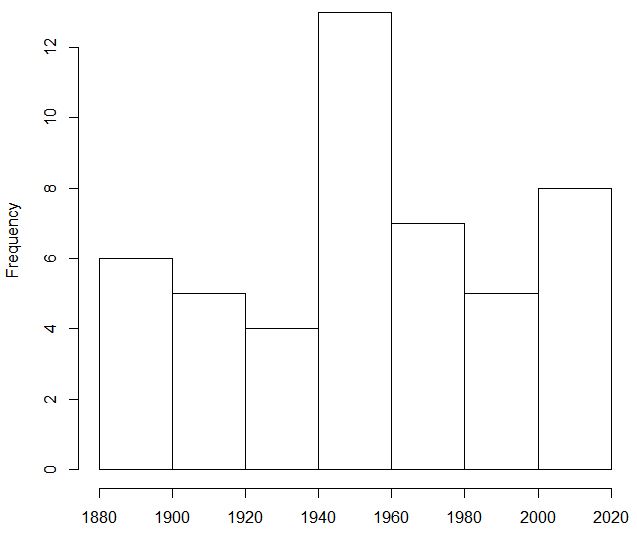
The 1940-1959 period has the largest number of driest Septembers.

NOAA September 2012 – States by Ranking

Update: Histogram added at bottom.

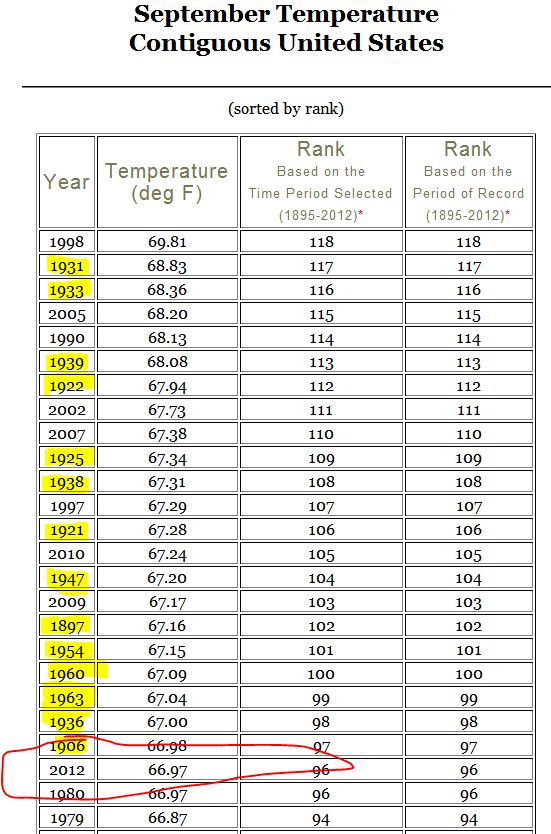
NOAA September 2012 – Ordered By Rank out of 118.  No State broke the record for its warmest September.

As an example, Indiana had the 30th warmest September, meaning 88 were warmer. The warmest September for Indiana was 1925 — 8.1F warmer than 2012!

Minnesota and North Dakotas record for September is 1897! Arizona’s is 1899.

State Sep 2012 Sep Rank Warmest Temp
Indiana 64.1 30 1925 72.2
Illinois 64.7 32 1925 72.7
Kentucky 67 34 1925 76.5
Alabama 73 35 1925 83.1
Missouri 66.7 37 1931 74.7
Ohio 63.2 37 1931 69.6
Iowa 61.8 39 1931 70
Michigan 58.5 41 1908 65.4
Tennessee 69 43 1925 79.2
Wisconsin 57.8 43 1931 64.8
Kansas 67.6 44 1931 76.7
North Carolina 69.8 47 1921 76.6
Georgia 74.1 52 1925 83.5
Mississippi 74.2 52 1925 82.9
Pennsylvania 62.3 52 1931 67.8
West Virginia 64 55 1900 69.9
Minnesota 57.1 56 1897 64
Virginia 67.1 56 1930 73.4
South Carolina 73.4 61 1925 81.6
Louisiana 77.2 62 1911 81.7
Maryland 67.2 63 1930 72.3
Rhode Island 62.9 64 1961 67.5
Arkansas 73.1 65 1925 80.1
Florida 79.5 65 1925 82.5
Maine 56.4 65 1961 62.7
Nebraska 63.4 67 1931 69.8
New York 60 67 1961 66.5
Vermont 58.1 75 1961 65.1
North Dakota 57.2 77 1897 63.4
Massachusetts 61.9 78 1961 66.8
New Hampshire 58.3 78 1961 64.5
Texas 76.7 79 1911 81
Oklahoma 74.1 83 1931 79.8
Connecticut 62.9 84 1961 67.7
New Mexico 66.1 85 2010 68.8
Arizona 73.7 88 1899 77.5
South Dakota 62.5 89 1897 68
Delaware 69.5 91 1930 73.1
Colorado 59.6 92 1998 62.6
New Jersey 67 92 1961 71.4
Washington 60.6 93 1967 63.7
Oregon 60.9 100 2011 63.2
Montana 58.4 104 1998 62.3
Idaho 59.3 107 1990 62.2
Wyoming 58.3 109 1998 60.4
Utah 64.1 110 2001 65.5
California 72.7 113 2009 73.6
Nevada 65.4 116 2009 66.5


A histogram of Warmest Septembers (kinda looks like it is giving the 1920s/30s finger to the IPCC):


HADCRUT4 hates 1998

Once upon a time there was a global average temperature set call HADCRUT3.

HADCRUT3 loved 1998. 4 out of the top 10 warmest months were from 1998.

year month anomaly
1998 Jul 0.671
1998 Apr 0.647
2007 Jan 0.61
2002 Mar 0.609
1998 Jun 0.606
2002 Jan 0.598
2010 Mar 0.583
2010 Apr 0.571
2003 Oct 0.566
1998 Mar 0.548

And then along came HADCRUT4 whose primary purpose seems to be to make sure the graph of the last 15 years slopes up instead of down.

HADCRUT4 hates 1998. Not only did 2 months from 1998 drop out of the top 10, but Jan 2007 was made .208C warmer than the old Jan 2007.

year month anomaly
2007 Jan 0.818
2002 Mar 0.689
2006 Dec 0.687
2010 Apr 0.673
2010 Mar 0.662
1998 Jul 0.66
2002 Jan 0.66
1998 Apr 0.611
2003 Oct 0.602
2010 Jul 0.601

Why? I have no idea.

Paul Homewood has more. Take note of his footnote. There are no new stations in Antarctica. It looks like maybe 6 new stations south of the equator … and we know it is cooling in the south.