Notice which years beat out September 2012 … 5 from the 1930s … 3 from the 1920s. 1897. 1906. Not much evidence of “dangerous warming” this September.
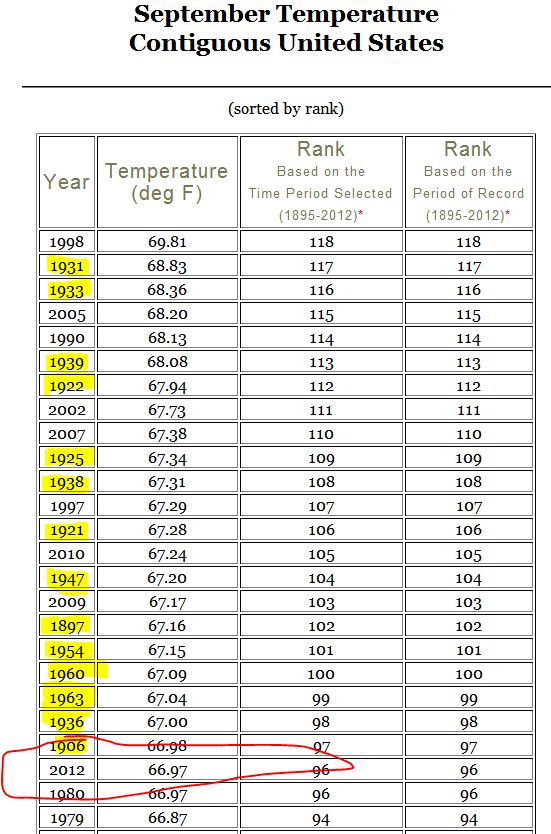
Notice which years beat out September 2012 … 5 from the 1930s … 3 from the 1920s. 1897. 1906. Not much evidence of “dangerous warming” this September.
Update: Histogram added at bottom.
NOAA September 2012 – Ordered By Rank out of 118. No State broke the record for its warmest September.
As an example, Indiana had the 30th warmest September, meaning 88 were warmer. The warmest September for Indiana was 1925 — 8.1F warmer than 2012!
Minnesota and North Dakotas record for September is 1897! Arizona’s is 1899.
| State | Sep 2012 | Sep Rank | Warmest | Temp |
| Indiana | 64.1 | 30 | 1925 | 72.2 |
| Illinois | 64.7 | 32 | 1925 | 72.7 |
| Kentucky | 67 | 34 | 1925 | 76.5 |
| Alabama | 73 | 35 | 1925 | 83.1 |
| Missouri | 66.7 | 37 | 1931 | 74.7 |
| Ohio | 63.2 | 37 | 1931 | 69.6 |
| Iowa | 61.8 | 39 | 1931 | 70 |
| Michigan | 58.5 | 41 | 1908 | 65.4 |
| Tennessee | 69 | 43 | 1925 | 79.2 |
| Wisconsin | 57.8 | 43 | 1931 | 64.8 |
| Kansas | 67.6 | 44 | 1931 | 76.7 |
| North Carolina | 69.8 | 47 | 1921 | 76.6 |
| Georgia | 74.1 | 52 | 1925 | 83.5 |
| Mississippi | 74.2 | 52 | 1925 | 82.9 |
| Pennsylvania | 62.3 | 52 | 1931 | 67.8 |
| West Virginia | 64 | 55 | 1900 | 69.9 |
| Minnesota | 57.1 | 56 | 1897 | 64 |
| Virginia | 67.1 | 56 | 1930 | 73.4 |
| South Carolina | 73.4 | 61 | 1925 | 81.6 |
| Louisiana | 77.2 | 62 | 1911 | 81.7 |
| Maryland | 67.2 | 63 | 1930 | 72.3 |
| Rhode Island | 62.9 | 64 | 1961 | 67.5 |
| Arkansas | 73.1 | 65 | 1925 | 80.1 |
| Florida | 79.5 | 65 | 1925 | 82.5 |
| Maine | 56.4 | 65 | 1961 | 62.7 |
| Nebraska | 63.4 | 67 | 1931 | 69.8 |
| New York | 60 | 67 | 1961 | 66.5 |
| Vermont | 58.1 | 75 | 1961 | 65.1 |
| North Dakota | 57.2 | 77 | 1897 | 63.4 |
| Massachusetts | 61.9 | 78 | 1961 | 66.8 |
| New Hampshire | 58.3 | 78 | 1961 | 64.5 |
| Texas | 76.7 | 79 | 1911 | 81 |
| Oklahoma | 74.1 | 83 | 1931 | 79.8 |
| Connecticut | 62.9 | 84 | 1961 | 67.7 |
| New Mexico | 66.1 | 85 | 2010 | 68.8 |
| Arizona | 73.7 | 88 | 1899 | 77.5 |
| South Dakota | 62.5 | 89 | 1897 | 68 |
| Delaware | 69.5 | 91 | 1930 | 73.1 |
| Colorado | 59.6 | 92 | 1998 | 62.6 |
| New Jersey | 67 | 92 | 1961 | 71.4 |
| Washington | 60.6 | 93 | 1967 | 63.7 |
| Oregon | 60.9 | 100 | 2011 | 63.2 |
| Montana | 58.4 | 104 | 1998 | 62.3 |
| Idaho | 59.3 | 107 | 1990 | 62.2 |
| Wyoming | 58.3 | 109 | 1998 | 60.4 |
| Utah | 64.1 | 110 | 2001 | 65.5 |
| California | 72.7 | 113 | 2009 | 73.6 |
| Nevada | 65.4 | 116 | 2009 | 66.5 |
A histogram of Warmest Septembers (kinda looks like it is giving the 1920s/30s finger to the IPCC):

Once upon a time there was a global average temperature set call HADCRUT3.
HADCRUT3 loved 1998. 4 out of the top 10 warmest months were from 1998.
| year | month | anomaly |
| 1998 | Jul | 0.671 |
| 1998 | Apr | 0.647 |
| 2007 | Jan | 0.61 |
| 2002 | Mar | 0.609 |
| 1998 | Jun | 0.606 |
| 2002 | Jan | 0.598 |
| 2010 | Mar | 0.583 |
| 2010 | Apr | 0.571 |
| 2003 | Oct | 0.566 |
| 1998 | Mar | 0.548 |
And then along came HADCRUT4 whose primary purpose seems to be to make sure the graph of the last 15 years slopes up instead of down.
HADCRUT4 hates 1998. Not only did 2 months from 1998 drop out of the top 10, but Jan 2007 was made .208C warmer than the old Jan 2007.
| year | month | anomaly |
| 2007 | Jan | 0.818 |
| 2002 | Mar | 0.689 |
| 2006 | Dec | 0.687 |
| 2010 | Apr | 0.673 |
| 2010 | Mar | 0.662 |
| 1998 | Jul | 0.66 |
| 2002 | Jan | 0.66 |
| 1998 | Apr | 0.611 |
| 2003 | Oct | 0.602 |
| 2010 | Jul | 0.601 |
Why? I have no idea.
Paul Homewood has more. Take note of his footnote. There are no new stations in Antarctica. It looks like maybe 6 new stations south of the equator … and we know it is cooling in the south.
Experts: Global warming means more Antarctic ice (h/t Marc Morano)
“This subtle growth in winter sea ice since scientists began measuring it in 1979 was initially surprising, they say, but makes sense the more it is studied.”
Translation: It was embarrassing us, so we’ll make something up.
“A warming world can have complex and sometimes surprising consequences,”
Translation: Antarctica is cooling, we don’t know why, so we will claim it is warming.
“”It sounds counterintuitive, but the Antarctic is part of the warming as well.”
Translation: More Ice = Warming and Less Ice = Warming. Our scam wins either way!
“But that doesn’t mean we shouldn’t be paying attention to it and shouldn’t be talking about it.”
Translation: We ignored the records in 2006 and 2012 and finally a few bloggers embarrassed us so much about 2012 that we had our buddy Seth Borenstein make up some crap.
“Antarctica’s weather peculiarities, on the other hand, don’t have much effect on civilization.”
Translation: It threatens our gravy train of grant money so we kept quiet about it.
“And the wind works in combination with the ozone hole, the huge gap in Earth’s protective ozone layer that usually appears over the South Pole”
Translation: We plan to ignore the ozone hole over the Arctic … which we never predicted either.
“Antarctic sea ice is also getting snowier because climate change has allowed the air to carry more moisture.
Guffaw.
“Winter sea ice has grown by about 1 percent a decade in Antarctica. ”
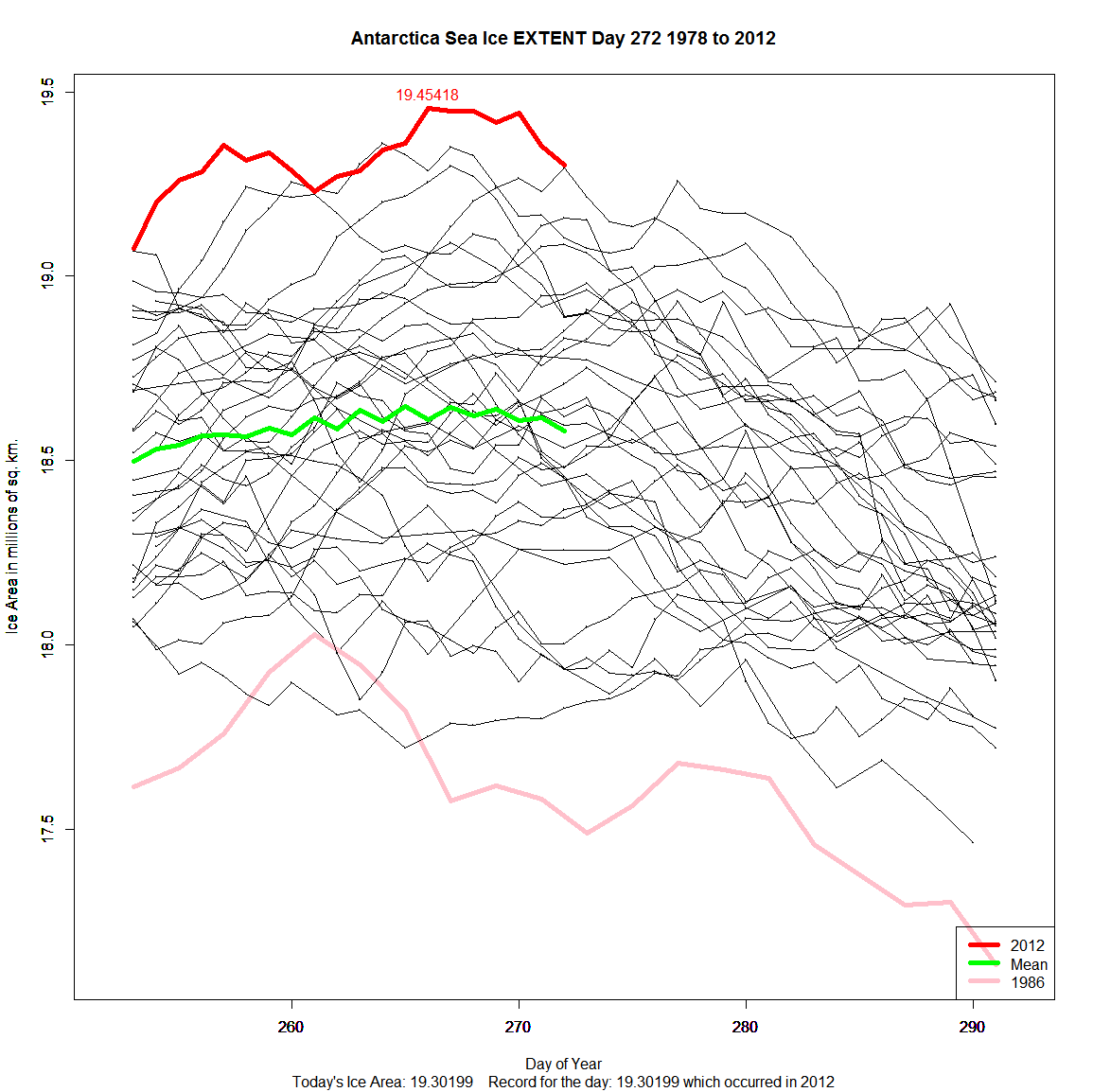
Actually, only one year before 1998 (1980 had 3) had days over 19 million sq km of Antarctic Ice. 2006 had 30 and 2012 had 28.
“computer models have long predicted that Antarctica would not respond as quickly to global warming as other places. ”
Translation; Models said it would melt too. Our models are crap.
“Scientists on the cruise with Maksym are spending eight to 12 hours a day on the ice bundled up against the fierce wind with boots that look like Bugs Bunny’s feet.”
Translation: Clown Feet would be more appropriate.
Update: In an earlier version the legend on the graph had blue labeled as Antarctic even though it was Arctic. The body of the post had it right (thanks Tom,Hugh,Tom,Anthony,Mike and Sundance for noticing ).
I decided to graph the AMO vs Arctic Sea Ice Extent vs Antarctic Sea Ice Extent. AMO data comes from NOAA, Sea Ice data comes from NSIDC.
The green is the AMO – Atlantic Multidecadal Oscillation. The red is Antarctic Sea Ice Extent. The blue is the Arctic Sea Ice Extent.
The dashed lines are the liner trends for each.
There are three amazing things:
1) The AMO trend is identical to the Antarctic trend even though the AMO is the sea surface trend of the North Atlantic Ocean! The trend are so close it is hard to see the AMO and Antarctic trends as separate items.
2) The Arctic trend is almost a mirror image of the Antarctic trend.
3) The cross over point is around 1997 which is when the AMO went officially positive (it sometimes goes opposite to the main trend for a few months)
The AMO is cyclic and will return to negative soon enough and this graph implies that sea ice trends will just reverse in a few years.
Click on the graph for a larger size.

Update: Take at look at the amazing AMO vs Arctic vs Antarctic graph here.
As you may know, I have been using Cryosphere’s Antarctic Sea Ice Area data to show the record levels of Antarctic Sea Ice.
But I just found another data set, NOAA’s Sea Ice Extent here. (thanks to commenter HaroldW at the Blackboard)
And it turns out day 265 set an all time record, and then day 266 broke that record. Days 265 through 270 are now the 6 highest Antarctic Sea Ice Extent’s of all time!!!!
11 of the top 15 are now 2012.
Anyone wonder why NOAA isn’t making a fuss about this?
| Year | Day of Year | Ice Extent |
| 2012 | 266 | 19.45418 |
| 2012 | 268 | 19.4478 |
| 2012 | 267 | 19.44631 |
| 2012 | 270 | 19.4433 |
| 2012 | 269 | 19.41601 |
| 2012 | 265 | 19.36135 |
| 2006 | 264 | 19.35934 |
| 2012 | 257 | 19.35567 |
| 2012 | 271 | 19.35207 |
| 2006 | 267 | 19.34999 |
| 2012 | 264 | 19.34204 |
| 2012 | 259 | 19.33522 |
| 2006 | 265 | 19.3289 |
| 2006 | 268 | 19.32669 |
| 2012 | 258 | 19.31503 |
Using data from the Climate Research Unit of the UEA , it appears sea surface temperatures may explain Antarctic Sea Ice at record levels.
SST in the southern hemisphere have a cooling trend of -0.068C / decade.over the last 15 years.

Antarctic Sea Ice Area is now just 28,255.4 sq km short of an all time record!!!! Go Red Go!!!!
Ice Area is 1.964296 million sq km higher than the lowest amount every recorded for this day in 1986.
After a few days of shrinking, Antarctic Sea Ice Area is growing again and trying for a new all time record.
The horizontal blue line is the all time record (by warmist standards). Go red go!

Only 112,000 sq km to go!
| Year | Day of Year | Ice Area |
| 2007 | 263 | 16.2323818 |
| 2007 | 264 | 16.2156487 |
| 2007 | 265 | 16.1711521 |
| 2007 | 266 | 16.1504288 |
| 2012 | 259 | 16.1458836 |
| 2012 | 266 | 16.1204205 |
| 2007 | 267 | 16.1177235 |
| 2012 | 258 | 16.1003437 |
| 2012 | 257 | 16.0984936 |
| 2007 | 262 | 16.0848694 |
| 2007 | 268 | 16.0605392 |
| 2012 | 256 | 16.0570793 |
| 2012 | 260 | 16.0534458 |
| 2010 | 227 | 16.0503387 |
| 2000 | 253 | 16.0354385 |
| 2007 | 256 | 16.0280628 |
| 2007 | 272 | 16.0231705 |
| 2010 | 226 | 16.0212231 |
| 2012 | 255 | 16.0202618 |
| 2012 | 254 | 16.0092392 |
| 2010 | 228 | 16.0086727 |
After a few days of shrinking, Antarctic Sea Ice Area is growing again.

 sunshine hours