Remember the big noise a few weeks back about Germany being essentially powered by wind turbines.
Not so much noise now that wind is 5GW or less for about 6 days in a row.
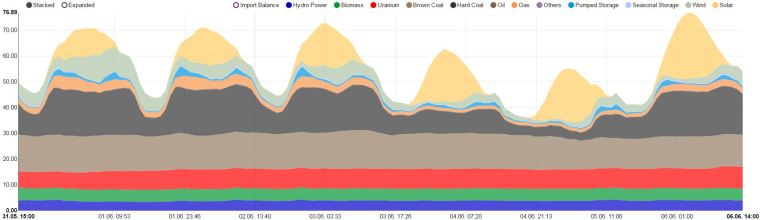
Remember the big noise a few weeks back about Germany being essentially powered by wind turbines.
Not so much noise now that wind is 5GW or less for about 6 days in a row.
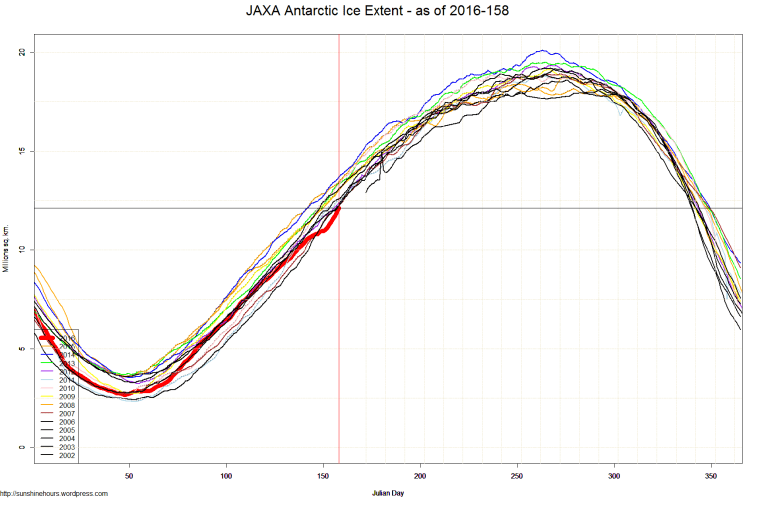
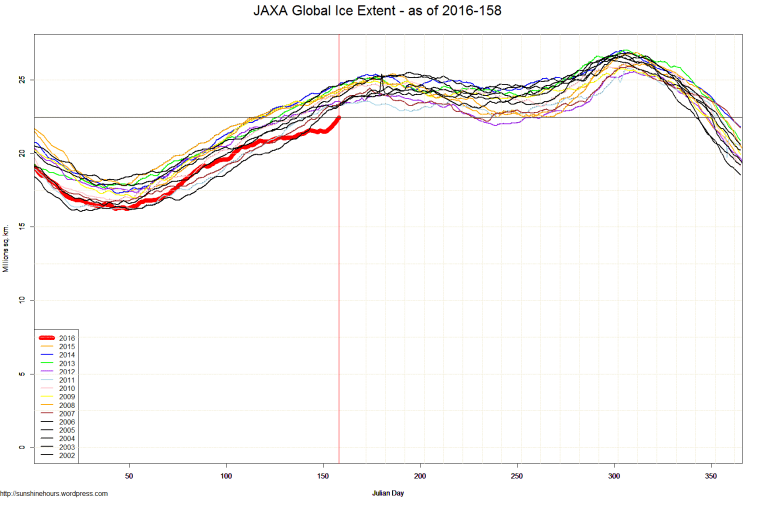
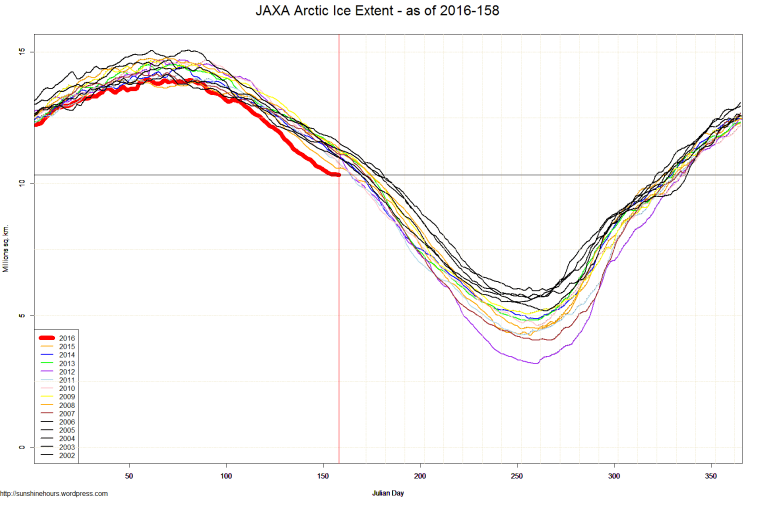
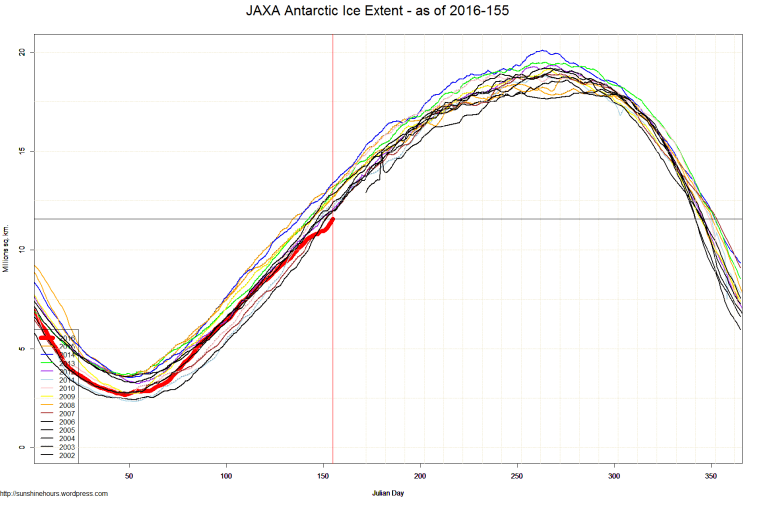
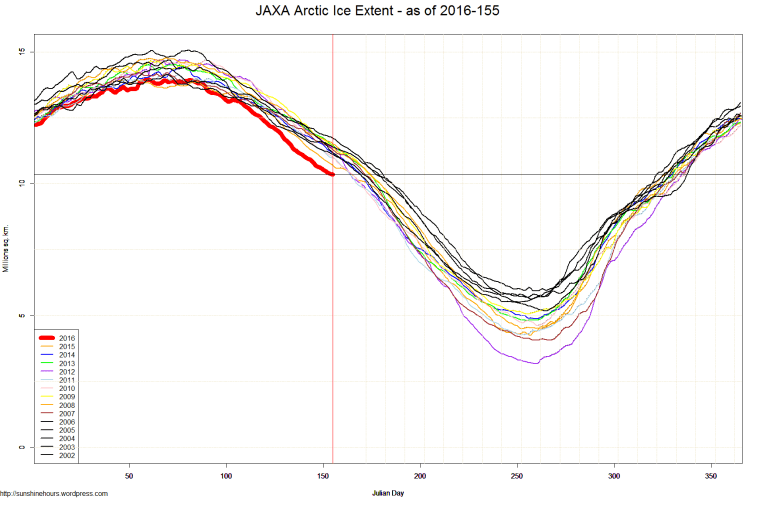
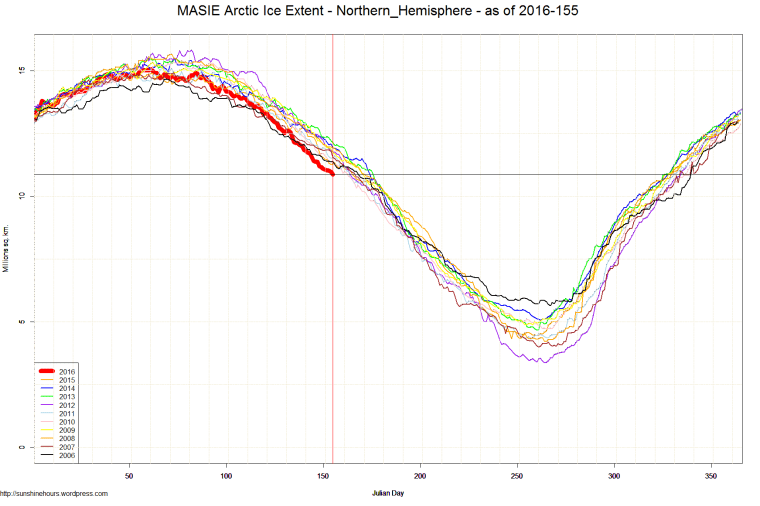
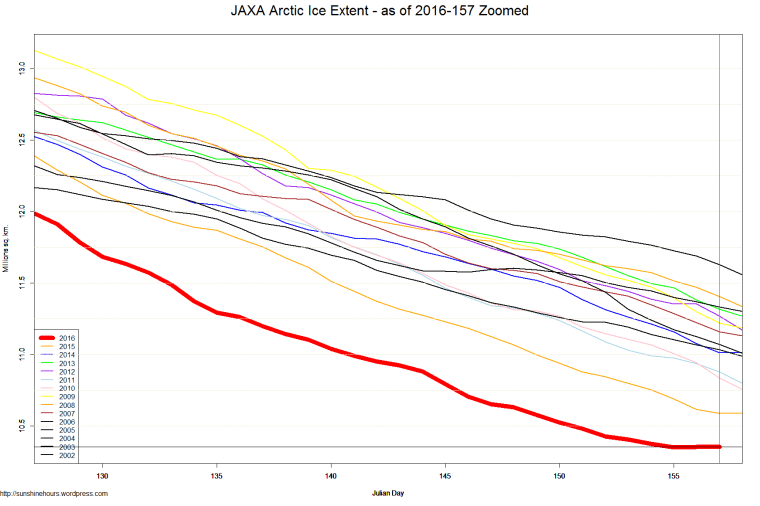
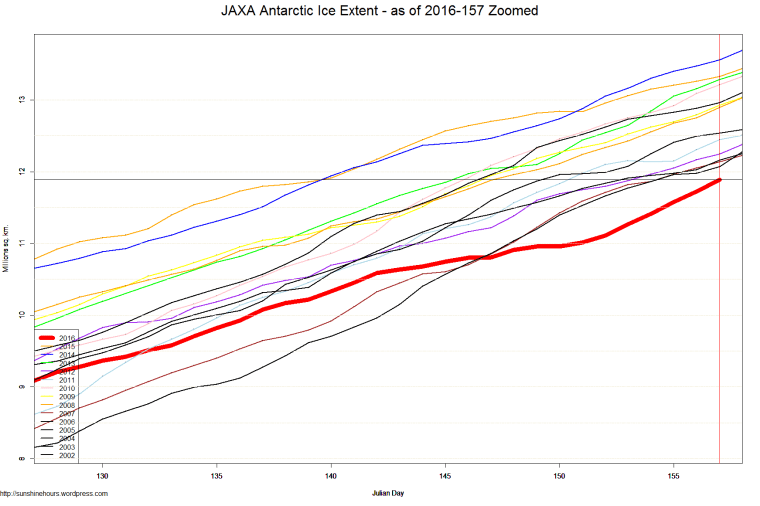
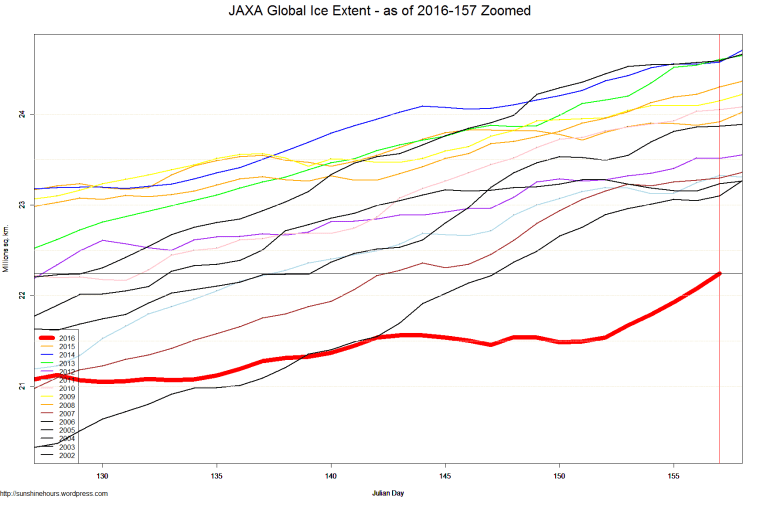
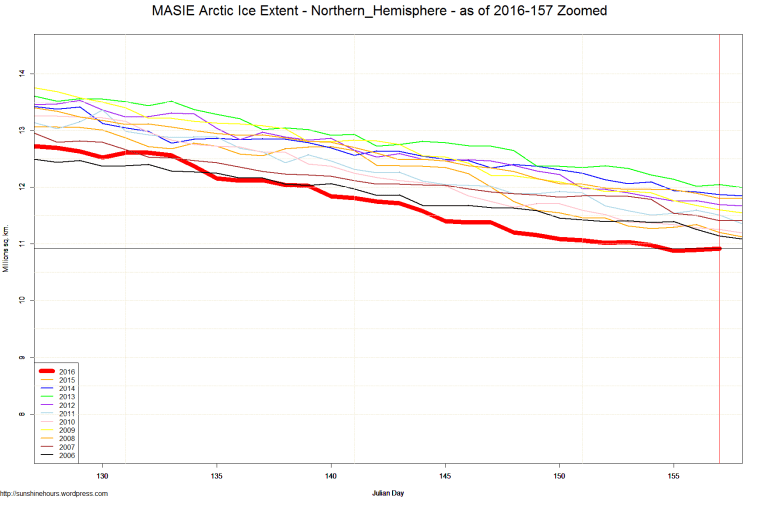
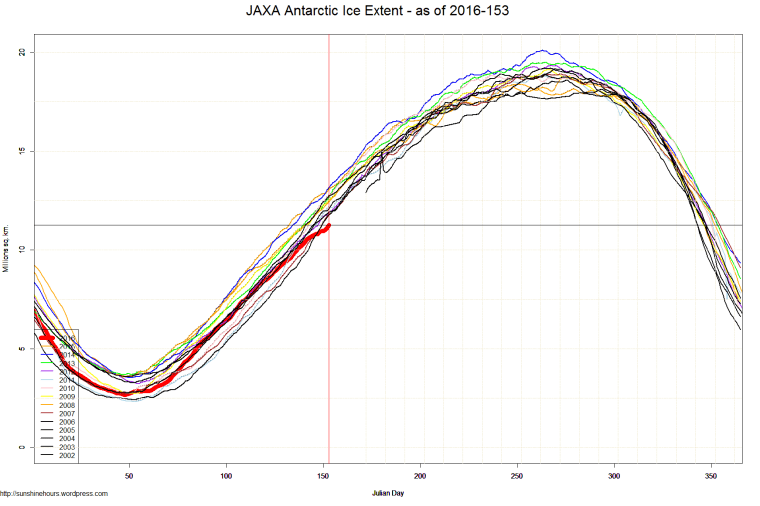
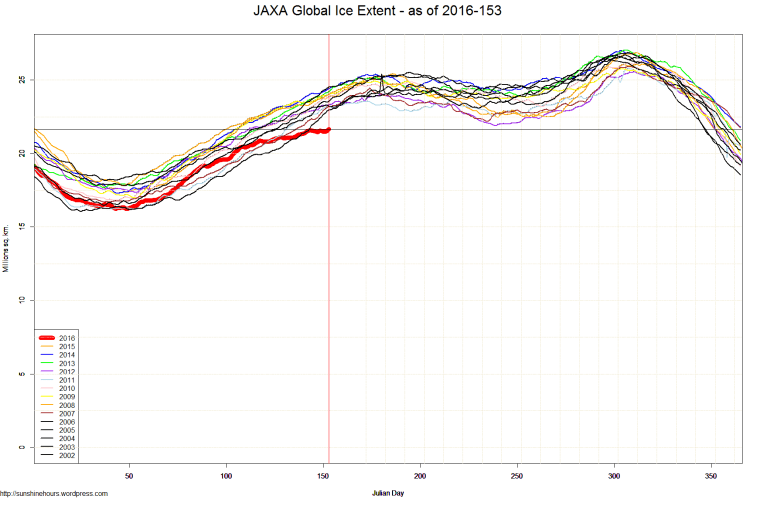
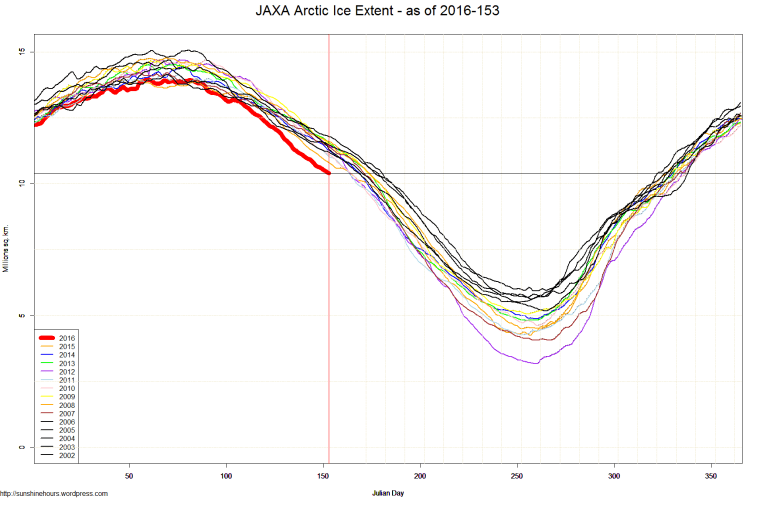
JAXA shows almost 0 melt for 3 days in Arctic. And Antarctic is climbing rapidly.
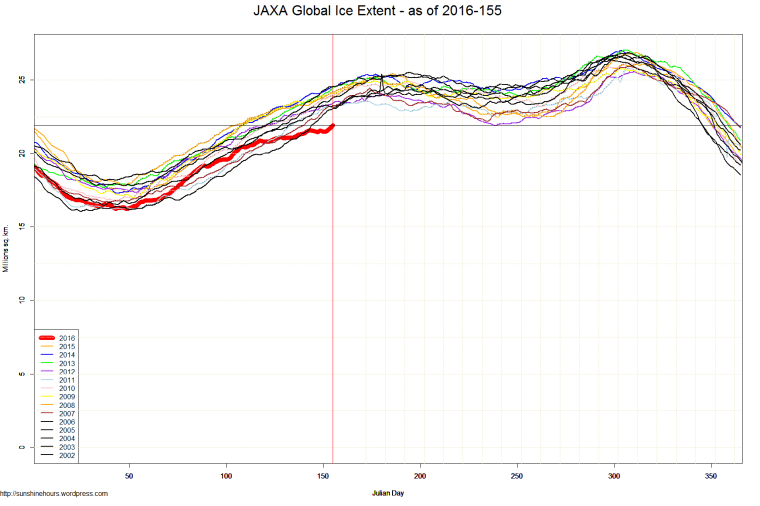
JAXA sea ice extent data from Japanese Aerospace Exploration Agency.
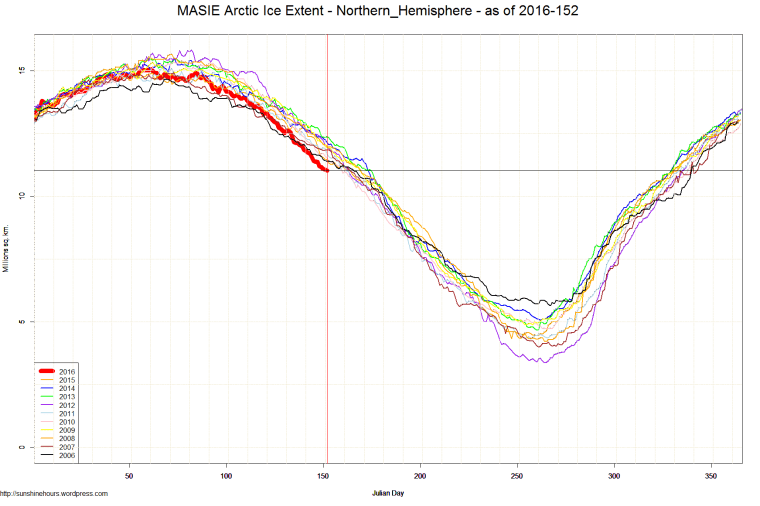
MASIE (Arctic only)
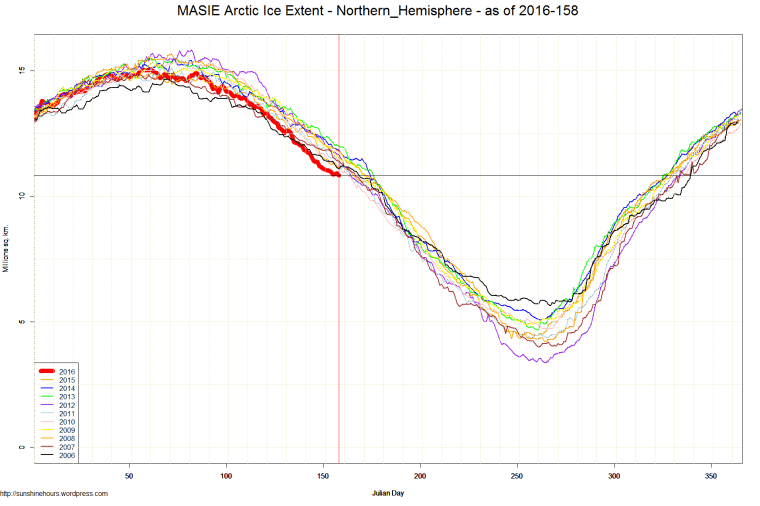
JAXA sea ice extent data from Japanese Aerospace Exploration Agency.
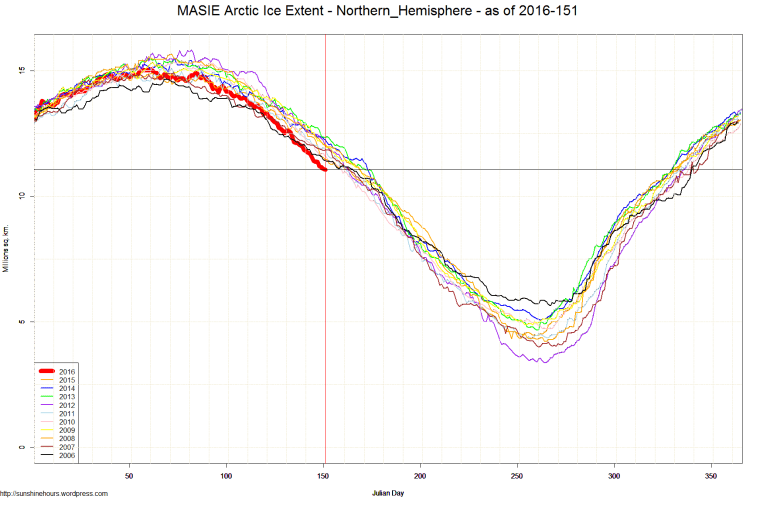
MASIE is a different sea ice index for the Arctic only.
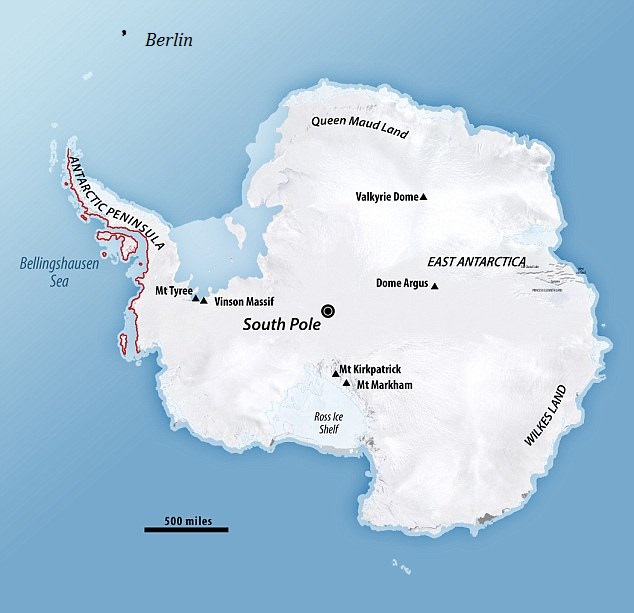
New research has revealed that parts of West Antarctica’s coastline have lost about 386 square miles (1,000 square kilometres) of ice – an area equivalent to the city of Berlin.
Over 40 years.
Berlin is 386 sq miles.
Antarctica is 5,400,000 sq miles.
East Antarctica is growing ice.
RICO!
June 1, 2016 – Resolute Forest Products Inc. has announced a federal lawsuit in the United States District Court for the Southern District of Georgia against Greenpeace International, Greenpeace USA, Greenpeace Fund, Inc., STAND (formerly ForestEthics) and a number of their associates. The complaint included federal racketeering claims and racketeering, trademark, defamation and tortious interference claims under Georgia law.
These alleged claims arise from, among other things, Greenpeace’s self-described “Resolute: Forest Destroyer” campaign falsely accusing Resolute of, among other things: (a) “destroying endangered forests,” and “operating and sourcing wood . . . in violation of law”; (b) causing the “destruction of endangered species” and “critical caribou habitat” and risking a “Caribou Herd Death Spiral,” “extirpation” and “extinction;” (c) “abandoning” and “impoverishing” the Boreal’s indigenous communities; and (d) impairing the Boreal’s ability to mitigate climate change.
The complaint describes in detail the falsity of these and other malicious and defamatory accusations. Among other things, the complaint explains that far from being a “forest destroyer,” Resolute has planted well over a billion trees in the Boreal – which is a billion more than Greenpeace – and is responsible for virtually no permanent lost forest acreage. The complaint also demonstrates that Resolute also has not impaired the Boreal’s ability to absorb greenhouse gases, and, instead, has improved that ability through harvesting and forestation as recognized and encouraged by the U.N. Intergovernmental Panel on Climate Change. Nor has Resolute abandoned, exploited or impoverished First Nations or other communities within the Boreal forest, but instead – and again unlike Greenpeace – has created and sustained substantial benefits for these peoples through shared economic participation in the forestry business. The complaint also details how, to support its false accusations, Greenpeace has fabricated evidence and events, including, for example, staged photos falsely purporting to show Resolute logging in prohibited areas and as having harvested areas that were actually impacted by fire.
“Our company strives for the highest standards of environmental stewardship, which is why the attacks on us are so obviously cynical and thoroughly irresponsible. We have an obligation to our business ethics, and our many shareholders, customers, partners and stakeholders to draw the line after all other means have been exhausted,” stated Richard Garneau, Resolute’s President and Chief Executive Officer.
Resolute is seeking compensatory damages in an amount to be proven at trial as well as treble and punitive damages, and is represented by Michael J. Bowe from Kasowitz, Benson, Torres & Friedman LLP. Resolute’s counsel is continuing its investigation of Greenpeace’s campaign and practices, and one can provide information on a confidential basis by telephone at 212 542-4700. A website has also been established (resolutevgreenpeace.com) to catalog information and progress reports on the case and, when necessary, to set the record straight as the facts warrant.
A new paper is out trying to explain why Antarctica isn’t warming.
“These findings suggest the Southern Ocean responds to greenhouse gas forcing on the centennial, or longer, timescale over which the deep ocean waters that are upwelled to the surface are warmed themselves. It is against this background of gradual warming that multidecadal Southern Ocean temperature trends must be understood.
There is a little name calling aimed at deniers (who happen to be right)
Those who said there was a conundrum were just deniers. It’s right there in the press release, paragraph two:
The study resolves a scientific conundrum, and an inconsistent pattern of warming often seized on by climate deniers.
Which rather begs the question: If there was a conundrum then the skeptics who pointed it out were not deniers, but correct. And if there was no conundrum, and deniers were denying something, then this is not a new finding at all. Alternately perhaps some researchers “knew” the answer they were going to find, and the other researchers, who can’t see the future, are deniers?
But the thought that came to me was … if there have been episodes of global warming in the past that last a few hundred years …. the ice cores would have missed them completely. Right?
Yesterday I wrote about trees being able to seed clouds. Lubos of the Reference Frame takes it further.
It’s been generally thought that the sulfuric acid was almost necessary. Chimneys (or volcano eruptions etc.) should increase cloudiness. However, there have been inconclusive hints in some papers that some organic molecules are enough. You may have worried: How could have the clouds existed in the past, before the chimneys were built? 😉
Jasper Kirkby and collaborators have found out that the molecules known as “aroma of the trees” may indeed do the same job and that is decisive in the pristine environments without chimneys.

More precisely, the molecules that can do the job are the “highly oxygenated molecules” (HOMs) which are produced by ozonolysis of α-pinene.
The lesson for “global warming” seems clear: deforestation may decrease the amount of aroma from the trees, and therefore the amount of clouds, and it may therefore lead to global warming.
This may be the explanation of the changes in the 20th century and because the deforestation is over, so may be “global warming”.
So … what other periods of global warming took place?
“The Roman Warm Period or the Roman climatic optimum has been proposed as a period of unusually warm weather in Europe and the North Atlantic that ran from approximately 250 BC to 400 AD”
What is Rome famous for (other than killing and conquering and so on)? Roman baths. What did the heat the baths with? Firewood.
“The baths were BIG; the Baths of Caracalla, completed in 235, could handle 8,000 visitors a day. Its 50 furnaces burned ten tons of wood every day to keep the water warm.
Deforestation was huge in Roman times.
Wood was a primary source of heating and used extensively in industry. Wood fuel constituted about 90 percent of the consumption overall,[citation needed] and was a major factor in Roman deforestation. Wood was essential fuel in industries like mining, smelting, and the making of ceramics.[4] Wood and charcoal were the primary ancient fuels in public facilities, households, public baths and industries that produced light and heat.
Forest areas around mining centers were deforested first, consuming all natural resources around the area of work. Once all the natural resources around the area of production were consumed, wood was then shipped and carried in to supply the furnaces and smelters for the mining centers. Eventually, these centers would shut down and move to areas within Roman territory to repeat the same cycle of deforestation, supplying an ever-growing population and consumption demand.
Deforestation and the fall of Rome :
In the ancient world, fossil fuels were unusual enough to be a curiosity, and certainly did not provide any major heating source. Almost all heating was done by wood and wood products1and while it may not seem like such a major factor it becomes a different story if you think about the Roman baths. The public baths2 were kept constantly at a minimum of 130 degrees Fahrenheit (54 degrees Celsius), and even a very small bath required 228,000lb (103,421kg) of wood per year. The Emperors recognised the importance of the baths in keeping the populace happy, and made keeping them running a primary goal. A whole guild, equipped with 60 ships, was created specifically for the purpose of obtaining bath-heating wood. Large palaces and villas also often had personal central heating systems; one such system has been evaluated and determined to require 2,506,000lb (1,136,722kg) of wood per year in order to properly heat the villa.
 sunshine hours