Ozone Hole Excuse For Record Antarctic Ice Blows Up in “Scientists” Faces

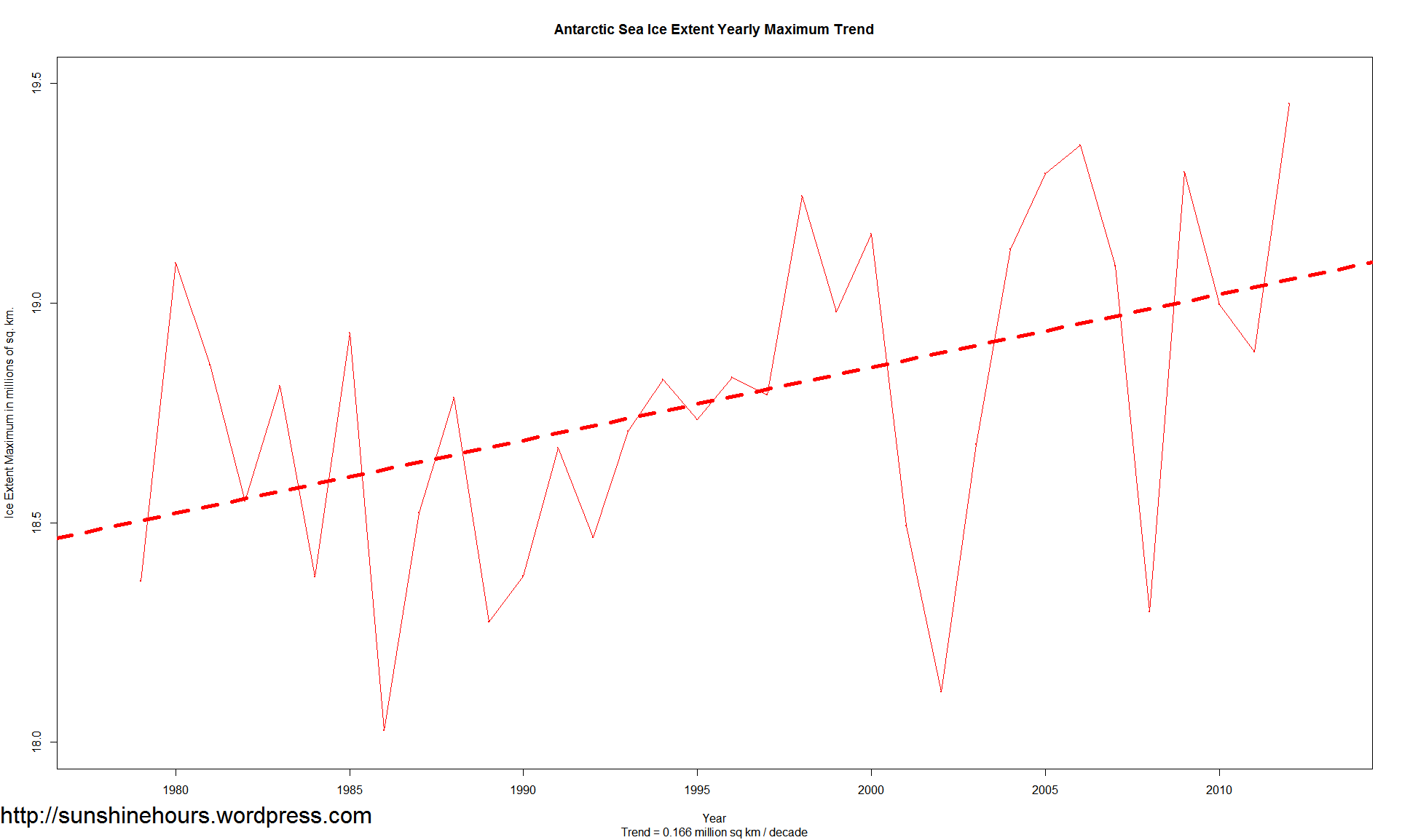
The NSIDC and many other used the ozone hole as an “excuse” for why Antarctic Sea Ice Extent broke records this year.

“Both warming and ozone loss act to strengthen the circumpolar winds in the south. This is due primarily to persistently cold conditions prevailing on Antarctica year-round, and a cold stratosphere above Antarctica due to the ozone hole. Stronger winds generally act to blow the sea ice outward, slightly increasing the extent”

Guess what, WUWT tells us it was the 2nd smallest ozone hole in 20 years.

“The average area covered by the Antarctic ozone hole this year was the second smallest in the last 20 years, according to data from NASA and National Oceanic and Atmospheric Administration (NOAA) satellites.”

What a shock. The “scientists” excuses for more Antarctic Sea Ice was bogus.

AGW “Experts” Are Idiots!

Experts: Global warming means more Antarctic ice (h/t Marc Morano)

“This subtle growth in winter sea ice since scientists began measuring it in 1979 was initially surprising, they say, but makes sense the more it is studied.”

Translation: It was embarrassing us, so we’ll make something up.

“A warming world can have complex and sometimes surprising consequences,”

Translation: Antarctica is cooling, we don’t know why, so we will claim it is warming.

“”It sounds counterintuitive, but the Antarctic is part of the warming as well.”

Translation: More Ice = Warming and Less Ice = Warming. Our scam wins either way!

“But that doesn’t mean we shouldn’t be paying attention to it and shouldn’t be talking about it.”

Translation: We ignored the records in 2006 and 2012 and finally a few bloggers embarrassed us so much about 2012 that we had our buddy Seth Borenstein make up some crap.

“Antarctica’s weather peculiarities, on the other hand, don’t have much effect on civilization.”

Translation: It threatens our gravy train of grant money so we kept quiet about it.

“And the wind works in combination with the ozone hole, the huge gap in Earth’s protective ozone layer that usually appears over the South Pole”

Translation: We plan to ignore the ozone hole over the Arctic … which we never predicted either.

“Antarctic sea ice is also getting snowier because climate change has allowed the air to carry more moisture.

Guffaw.

“Winter sea ice has grown by about 1 percent a decade in Antarctica. ”

Actually, only one year before 1998 (1980 had 3) had days over 19 million sq km of Antarctic Ice. 2006 had 30 and 2012 had 28.

“computer models have long predicted that Antarctica would not respond as quickly to global warming as other places. ”

Translation; Models said it would melt too. Our models are crap.

“Scientists on the cruise with Maksym are spending eight to 12 hours a day on the ice bundled up against the fierce wind with boots that look like Bugs Bunny’s feet.”

Translation: Clown Feet would be more appropriate.

Impact of more Antarctic Sea Ice

What is the impact of more Antarctic Sea Ice? Many warmists claim that less Arctic Sea Ice will have a more dramatic effect on earth’s albedo than increasing Antarctic Sea Ice.

Poster RACookPE1978 at WUWT disagrees and I hope he does not mind me reblogging  his comment here.

“The Antarctic Sea Ice at its 16.5 million km^2 maximum near the equinox in mid-September is a near crown-shape: A circular ring whose edge is between 62 south and 60 south latitude. During its mid-winter GROWTH range – that period BEFORE its maximum extent when its will reflect the most solar energy – it will have about 50% of its area between 66.5 south (the Antarctic Circle) and 60 south latitude.

Now, at that latitude, EVEN AT MID NH SUMMER (darkest time of the year for the Antarctic continent in mid-winter) the Antarctic sea ice WILL be reflecting light energy … for the simple reason that the Antarctic sea ice is exposed to southern hemisphere sunlight every day – even at the shortest day if the winter at June 22.

BUT … Antarctic Sea Ice is NOT at its maximum at mid-winter (the darkest days), but rather, Antarctic Sea Ice is at its maximum at the equinox when there IS sunlight for 12 hours per every latitude on the planet. Further, Antarctic Sea Ice at its maximum IS exposed to strongly absorbed sunlight at solar incidence angle between 15 and 30 degrees for 10 of those 12 hours. Worse, from a cooling world standpoint, a DECREASE in Arctic Sea ice from its present “circular cap” up between 81 north latitude and the pole DOES NOT result in increased solar absorption into the exposed sea surface, but rather an increased LOSS of heat energy from the exposed water due to evaporation and radiation.

The difference? The angle of the incidence sunlight. In the Antarctic, the light is inbound on the newly freezing sea ice at 30 degrees angle: At 30-25 degrees incidence angle, open water absorbs 90-95% of the inbound energy, sea ice reflects about 98 percent of the incident energy.

in the Arctic, at 4-8 degrees incidence angle, open (rough) water reflects 95% of the solar energy. Ice reflects about 98% of the incoming solar energy. Open water loses another 117 watts/m^2 compared to ice-covered water.

Thus, “simple” physics and geography shows that an increase in Antarctic Sea by 1.5 million km^2 ABOVE its previous “average” of 15.0 million km^2 SIGNIFICANTLY increases heat loss from the planet. An (potential) loss even of the entire remaining sea ice of 3.4 million km^2 increases heat loss from the planet.

And NO IPCC report nor ANY climate model predicts ANY increase in Antarctic sea ice at the same time as a Arctic Sea Ice decline. They only predict sea ice declines due to “a warming world” and “prove” a warming world by that same sea ice decline.”


HADSST2 Southern Hemisphere Aug 2012 – Cooling For 15 Years

Using data from the Climate Research Unit of the UEA , it appears sea surface temperatures may explain Antarctic Sea Ice at record levels.

SST in the southern hemisphere have a cooling trend of -0.068C / decade.over the last 15 years.

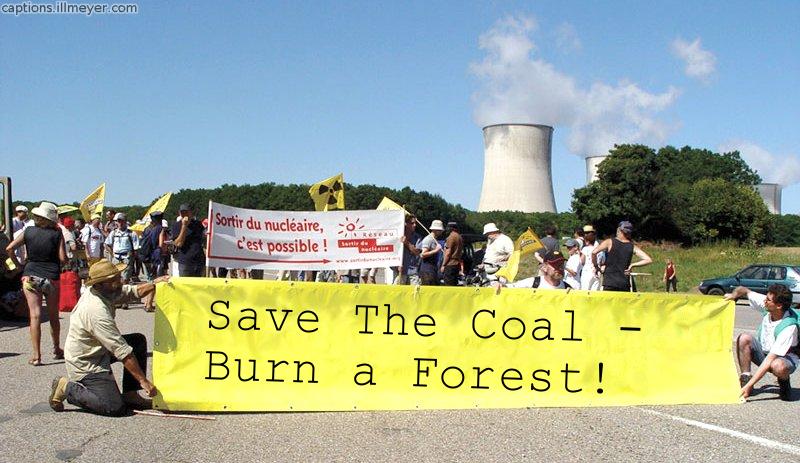
Save The Coal – Burn a Forest!

Drax Group Plc (DRX) will spend $1 billion to turn the U.K.’s biggest coal-fired plant into western Europe’s largest clean- energy producer. The utility plans to convert one of the site’s six units to burn wood pellets by June, said Chief Executive Officer Dorothy Thompson. It intends to switch two more units to wood at a later date, investments that if completed will see it harvest a forest four times the size of Rhode Island each year

“While burning biomass releases carbon dioxide, the EU deems the technology carbon-neutral because trees absorb emissions in a similar proportion to what they release in burning. Opponents argue that it’s hard to ensure enough is being planted to compensate for what is burned.”

Opponents? By opponents do they mean sane people? Or do they mean greenies who are slightly less insane than the average greenie?

“Wood pellets are bulkier than coal, need to be kept dry and handled more gently. They can create dust if stored in the open. To deal with this, Drax is building silos out of plastics, foam, steel and concrete, with conveyor floors and capable of holding 700,000 metric tons of biomass.”

This is great … all those jobs and all that plastic and foam and steel and concrete (did you know concrete produces a lot of CO2?)

Green policies are saving the poor unfortunate coal and killing off four forests the size of Rhode Island (which is actually quite small but it sounds scary).

I like trees. I have no objection to trees being cut down to provide useful things like houses and paper.

But to burn vast quantities of trees and to build up a huge new infrastructure to burn wood instead of burning coal (or preferably natural gas) is insane. But thats what green policies do. They distort the market. They rewards people for doing insane things … like burning forests instead of coal or building wind turbines (and backup power plants) instead of reliable natural gas power plants.

Imagine … power plants burning forests will act as the backup power for unreliable wind turbines!


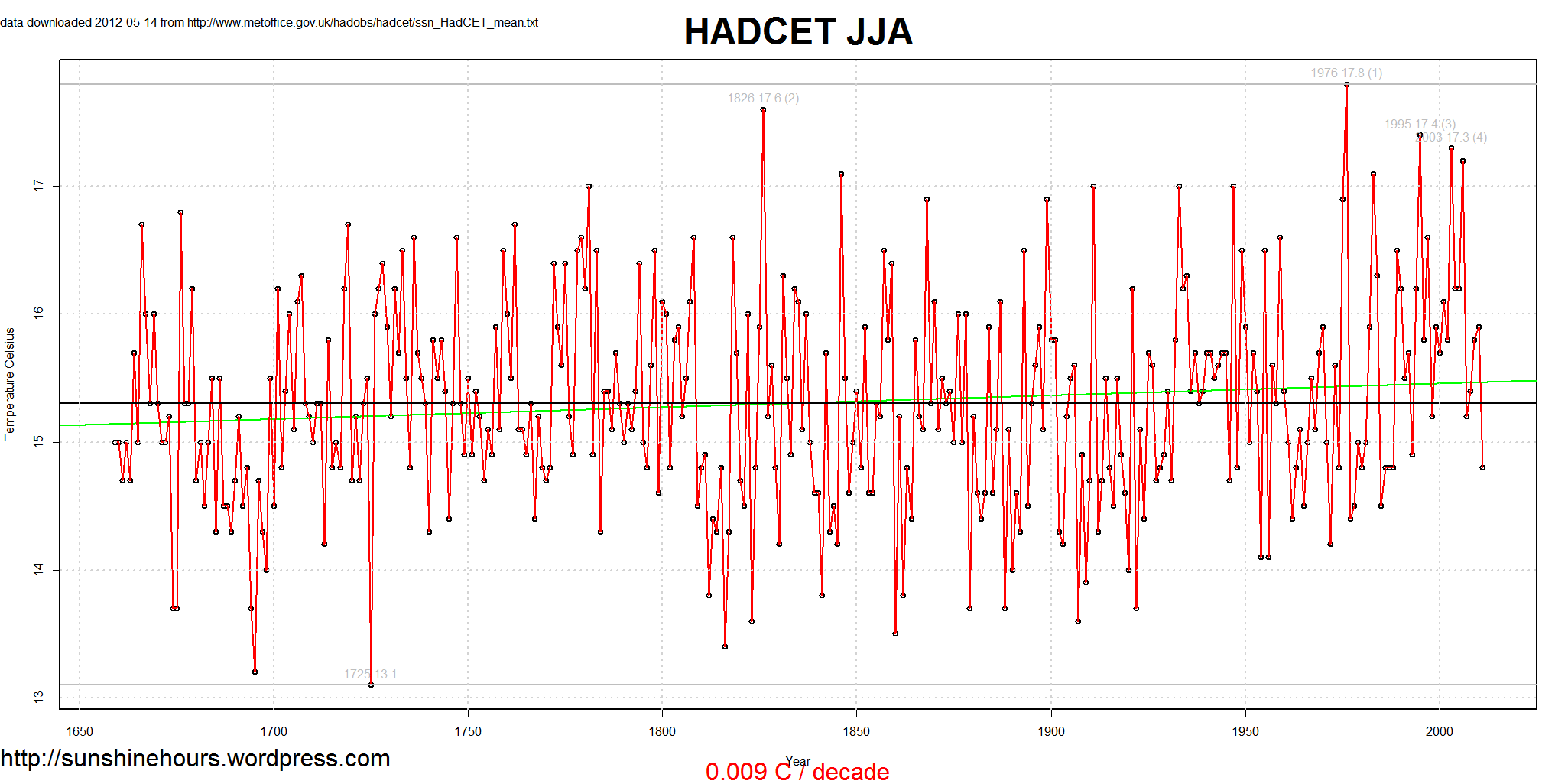
HADCET June July and August trend for 350 years is a measly .009C per decade

HADCET is the Central England Temperature record maintained by the UK Met. The seasonal mean data is available here.

If you graph JJA (June, July and August) the trend is a measly .009C per decade.

The two warmest years are 1976 and 1826. 2011 JJA was 14.8C, below the mean, and 3C colder than 1976.

We were told we were going to fry as “Global Warming” gets going.

West Coast has been cooling since 1983!

Update:  See the cooling as an animated gif.

Did you know it is cooling on the west coast of North America from 1983 to 2011? Before I show you how I found that out and what I found, I will tell you a story.

About a month ago I was reading the Victoria Times Colonist and read an article titled Warmer weather in B.C. threatens waterfront, forests. The key sentence to me wasAn analysis of 62 years of Environment Canada weather data by the University of Victoria’s Pacific Climate Impacts Consortium has found that B.C.’s temperature has been warming by about 0.25 degrees Celsius per decade”  which came from this report .

My first thought was “No Way”. I live in BC. It hasn’t been warming recently. But how was I to prove otherwise?  I sent an email to Francis Zwiers who is the Director and I sent him a couple of screen shots from GISS from a few nearby climate stations showing that it has been warmer , and recently it hasn’t been warming. I sent a screenshot of Clearbrook (and a few others) which is right on the border with BC in Washington State. Fig 1 Clearbrook from GISS.
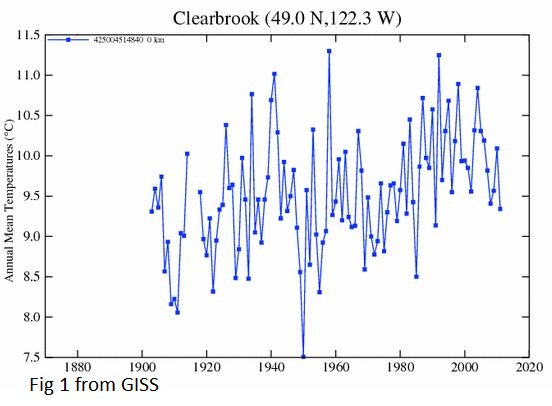
The key number in the quote was 62 years, which means they were using 1950 as a starting year. Clearbrook exhibits one of the common signatures of west coast climate stations – 1950 was amazingly cold. You can see that temperatures dropped 3.5C from 1940 to 1950.1950 on the west coast is kind of like a micro Little Ice Age. Sure it warmed after 1950 because every year was warmer than 1950.

After a few emails back and forth I asked for his data. Guess what he said? “It’s publically available from Environment Canada.” Sound familiar? That kind of ticked me off. To be fair, after a couple more emails he offered to send me the data and also pointed me at an Environment Canada website where I could scrape it myself or I could wait for the public access portal they were planning.

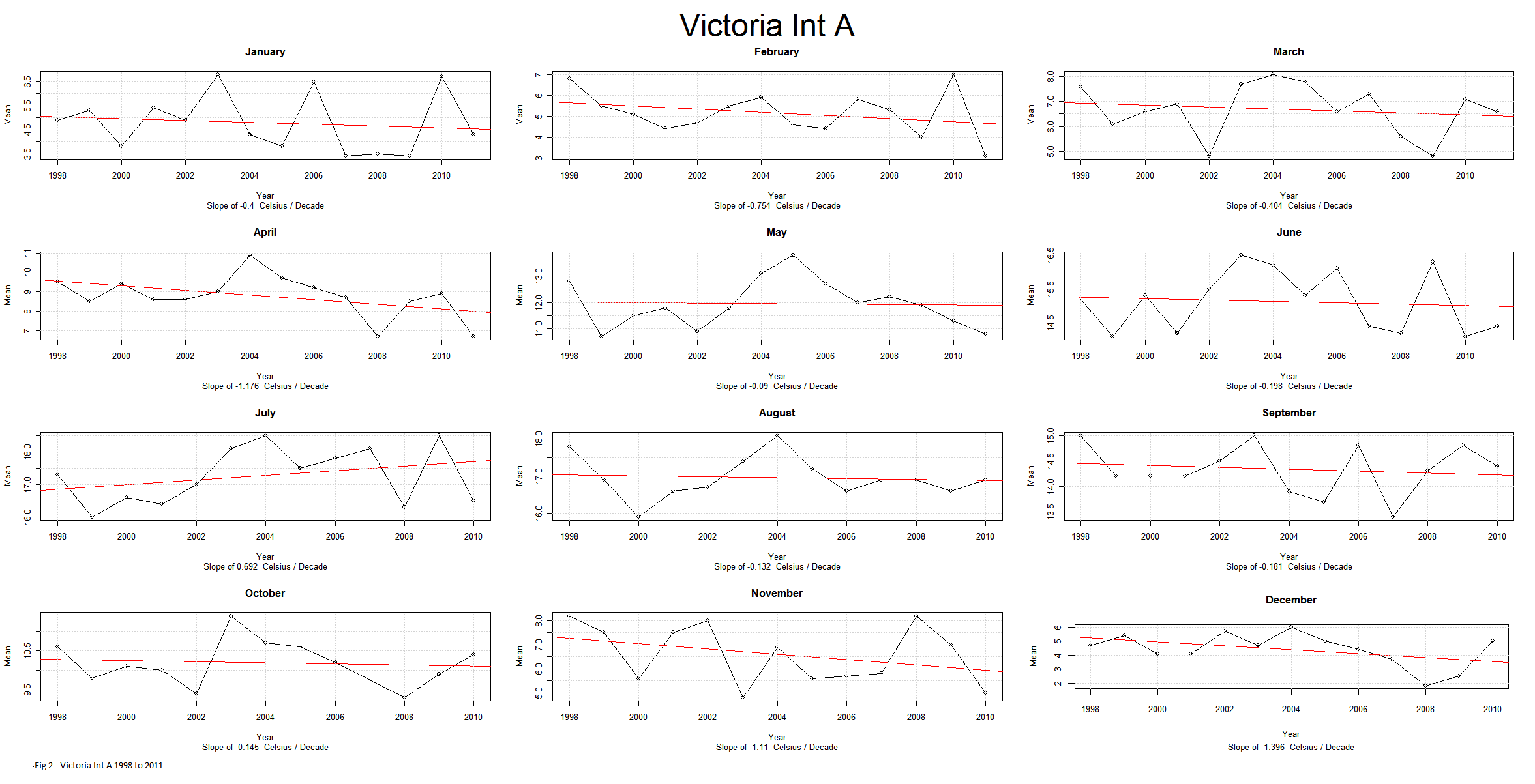
By then I had decided it was time to learn R. I wrote an R script to scrape the EC site for data and then I came across a tip that would allow me to segment a plot into 12 subplots and thought why not show each month.  I picked Victoria Int A from 1998 to 2011. I chose to take the lm  (linear model) value from [R] and multiply it by 10 to show the trend in C per decade.

Fig 2 – Victoria Int A 1998 to 2011
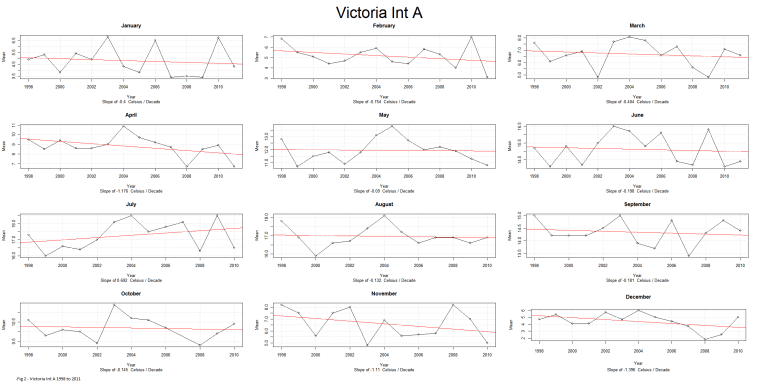
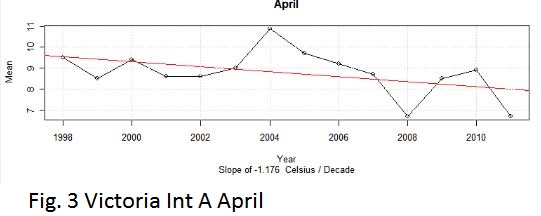
Even though it was an airport some months were cooling. Fig. 3 Victoria April 1998 to 2011
Then the BEST data came out with a new release. I decided to compare BEST with Environment Canada and found some interesting things out. But that’s a different story. I decided to rewrite my [R] script and analyze the Quality Controlled release, and I came up with another idea of “mapping” the stations by color (red for warming and blue for cooling) against latitude and longitude.

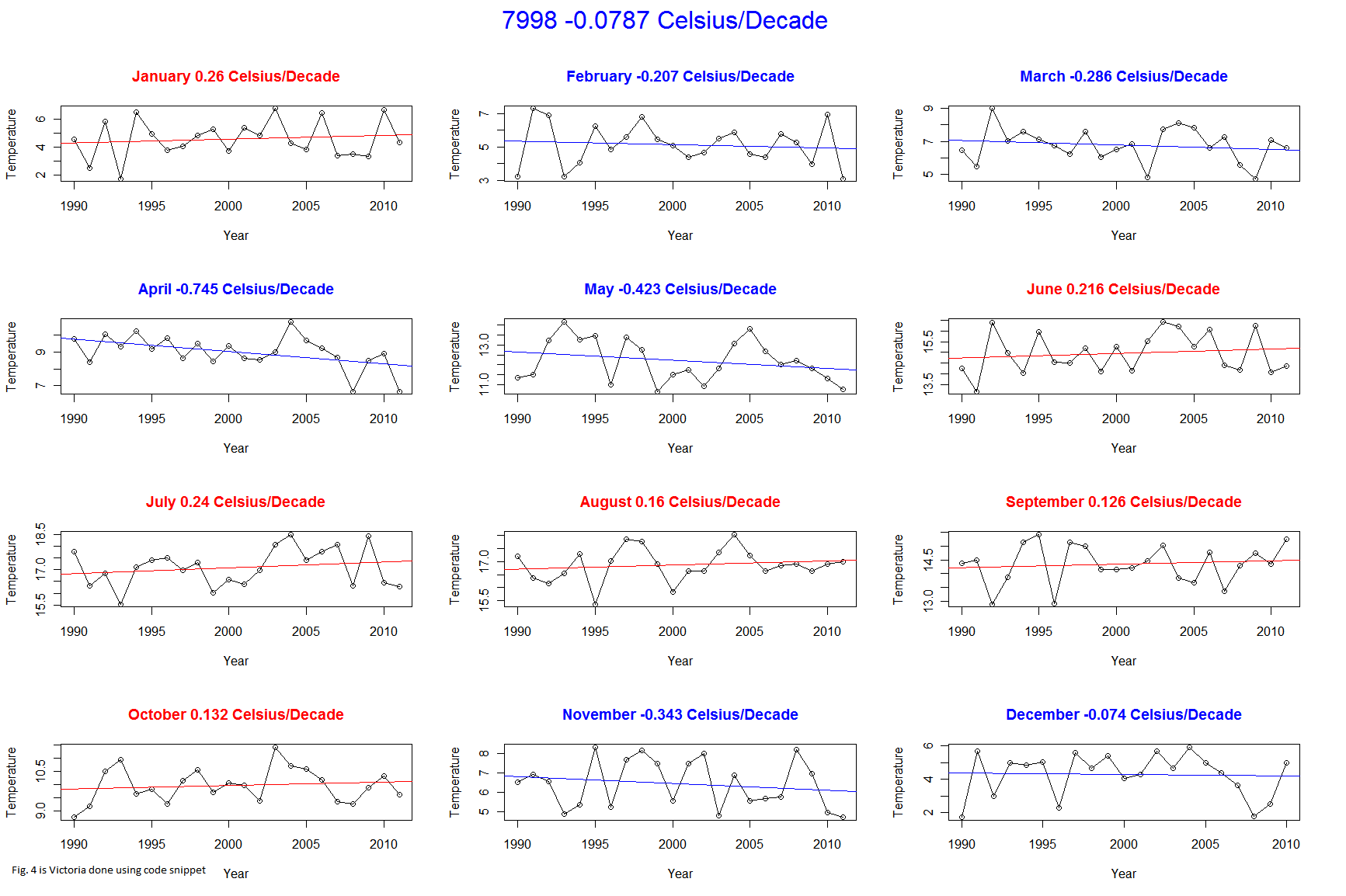
The code to do Victoria (or any other station) is not complex. Assuming you have the BEST data loaded as BESTdata and the column names are Year, Tm, Month and Station_ID here is a snippet of code to graph Victoria.

months <- c(“January”,”February”,”March”,”April”,”May”,”June”,”July”,”August”,”September”,”October”,”November”,”December”)
dev.new(width=1200,height=800)
split.screen( figs = c( 4, 3 ) )
par( oma = c( 0, 0, 3, 1 ) )
sid<- 7998
dfOneStation <- subset(BESTdata,Station_ID == sid & Year >= 1990,select=c(Year,Tm,Month))
decslope.all <- 0
decslope.count <- 0
for (i in 1:12) {
screen(i)
dfOneStation.m <- subset(dfOneStation,Month == i )
r = lm(dfOneStation.m$Tm~dfOneStation.m$Year)
Decadal_slope <- round(coef(r)[2],digits=4) * 10
decslope.all <- decslope.all + Decadal_slope
decslope.count <- decslope.count + 1
mTitle = paste(months[i],Decadal_slope,”Celsius/Decade”)
if (Decadal_slope > 0) {
colmain = “red”
} else { colmain = “blue”}

plot(dfOneStation.m$Year,dfOneStation.m$Tm,main=mTitle,type=”o”,xlab=”Year”, ylab=”Temperature”,col.main=colmain)
abline(r,col=colmain)
}
ds <- decslope.all/decslope.count
if (decslope.all > 0) {
colmain = “red”
} else { colmain = “blue”}
mtext(paste(sid,” “,round(ds,digits=4),” Celsius/Decade”,sep = “”,collapse = NULL), outer = TRUE, cex=2,line=1 ,col=colmain)

Fig. 4 is Victoria done using code snippet
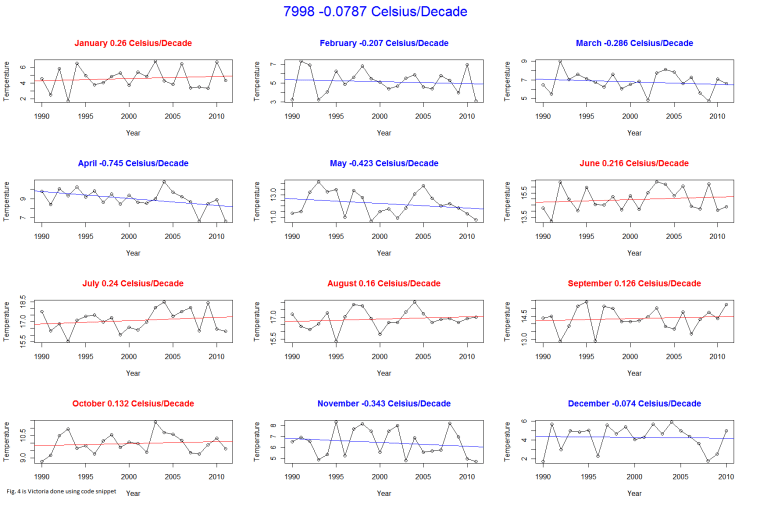
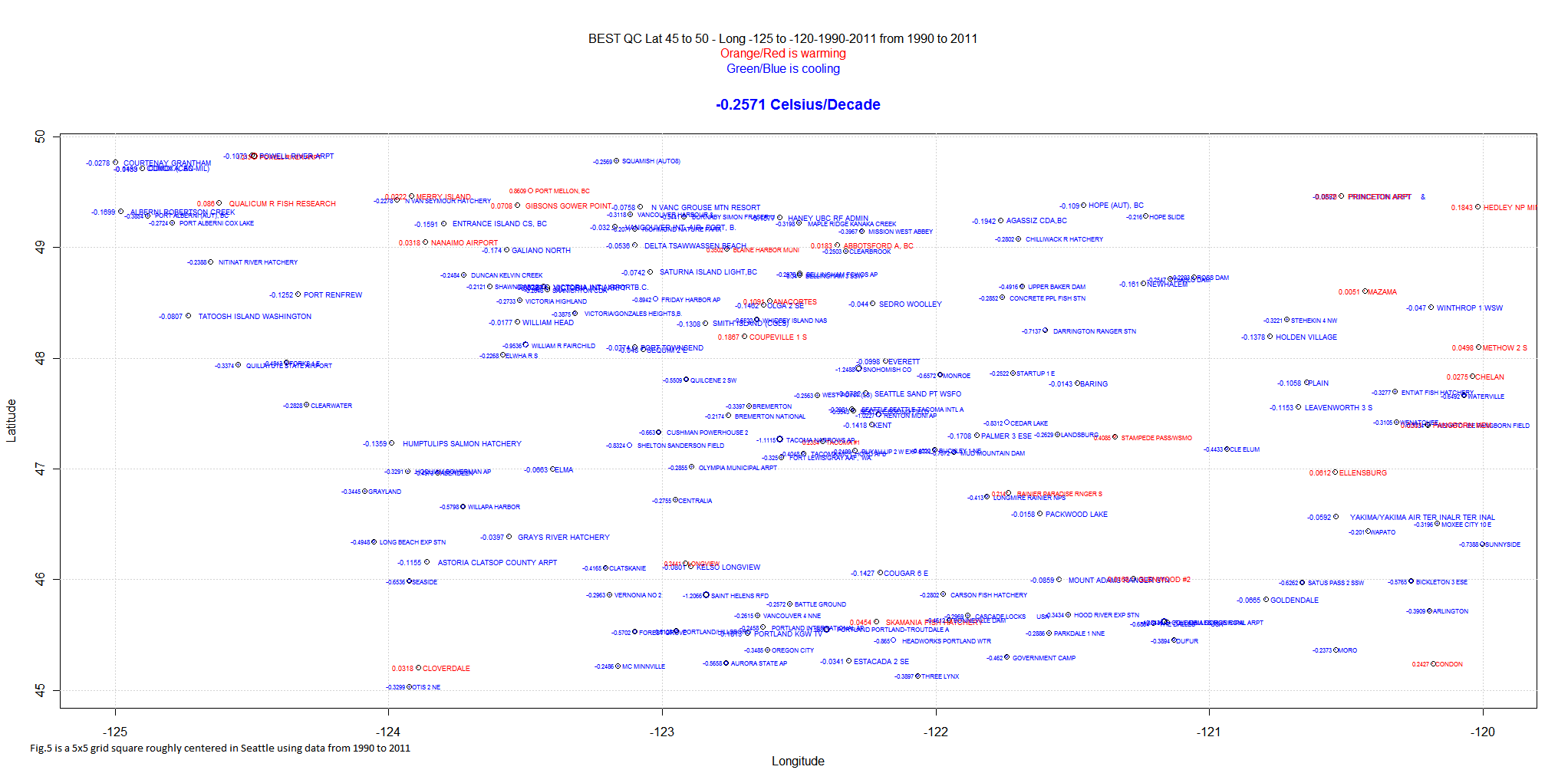
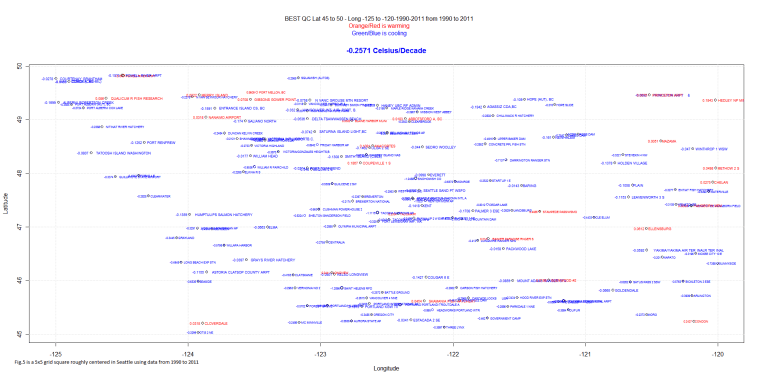
Fig. 5 is a “map” Fig. 5 is a 5×5 grid square centered around Seattle using data from 1990 to 2011 (only stations with data in 1990 and data in 2011) It is really cooling by -.2571 Celsius per decade.
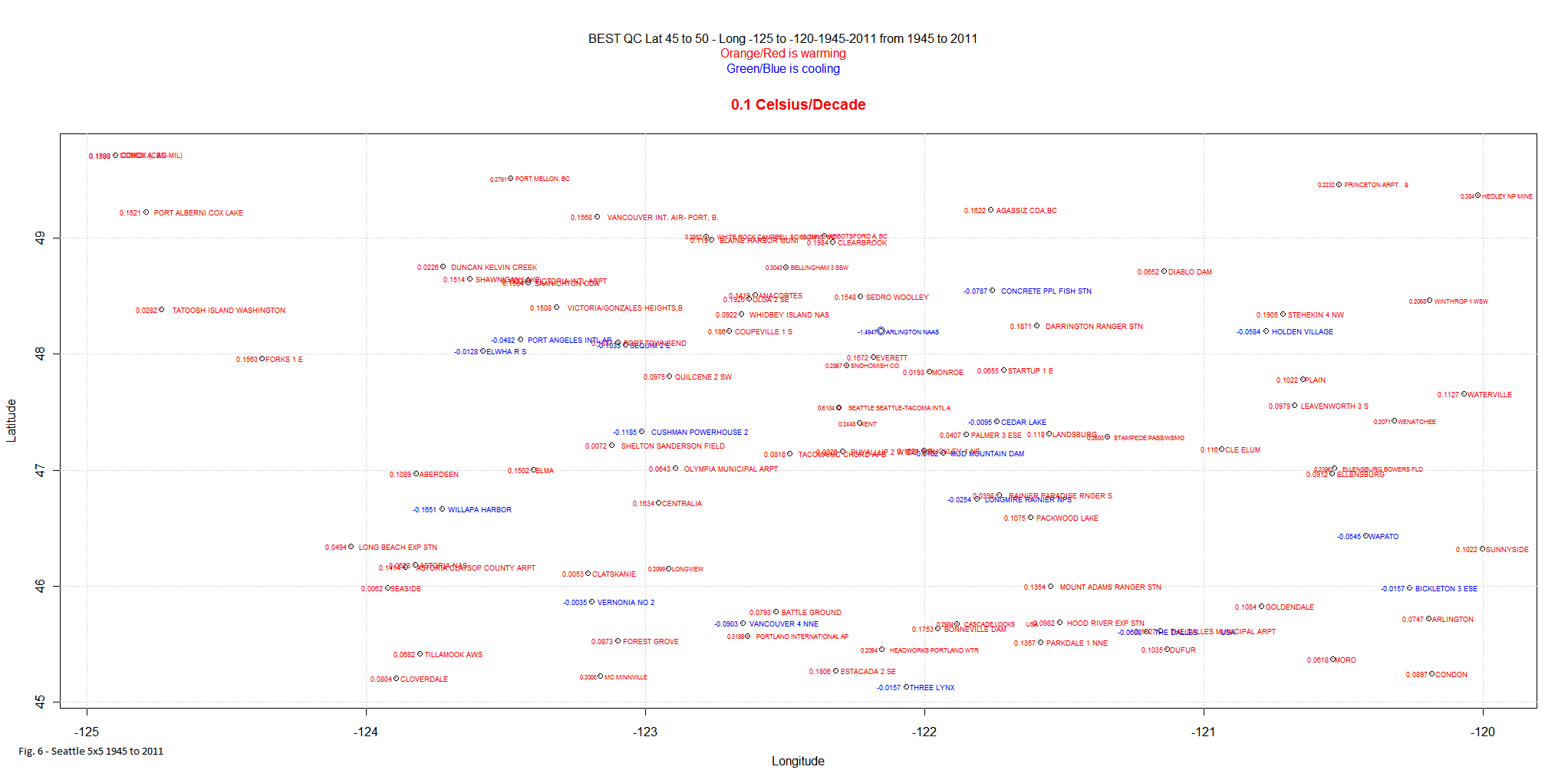
And, just to be fair, Fig. 6 is the same grid square 1945 to 2011. Notice that a few stations are still cooling and the warming trend is only .1C per decade.
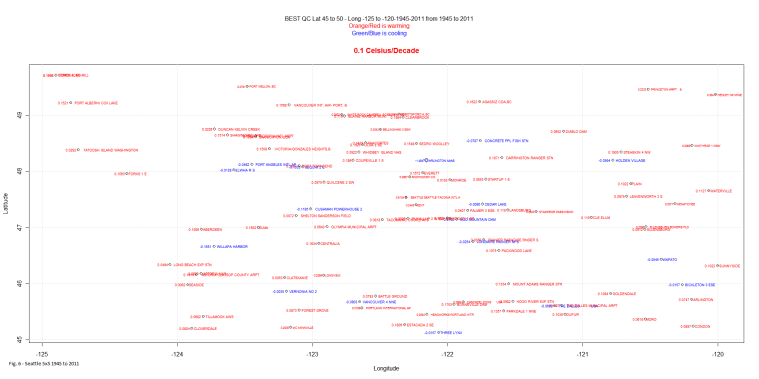
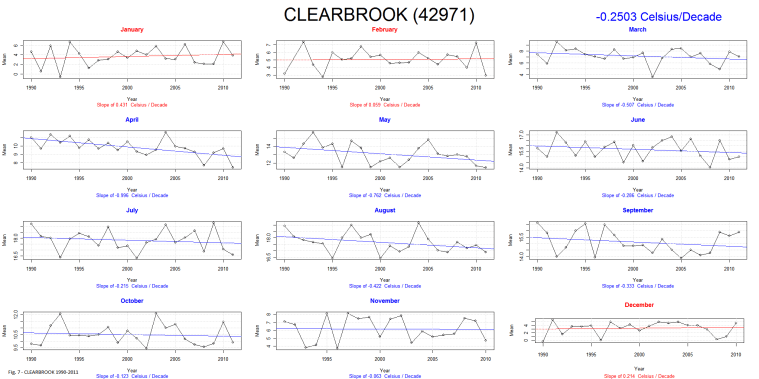
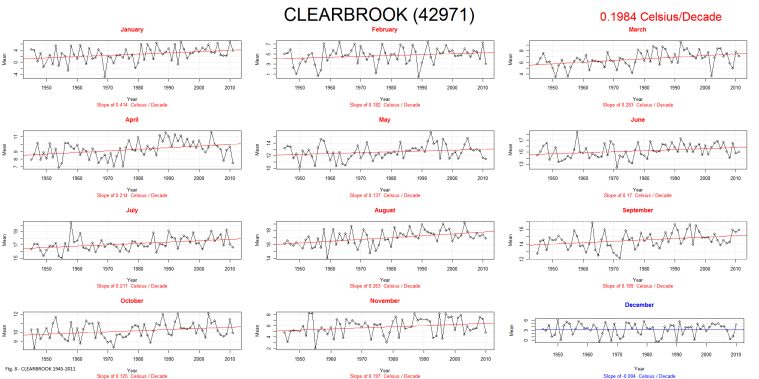
Fig. 7 is Clearbrook for 1990 to 2011 and Fig. 8 is Clearbrook for 1945 to 2011.

Notice that on both graphs there is still one or more months that are contrary to the overall trend. That is quite common.  Of course sometimes the trends are quite miniscule one way or the other. And other times they are huge.

After running my script for a few regions I am just amazed at the difference between stations. Fig. 9 is Crete Nebraska, warming at a miniscule .031C/Decade since 1910! And yet July, August, September and October (not shown) are cooling and have never been as warm as the 1930s:

I could bounce all over the world with fascinating examples.

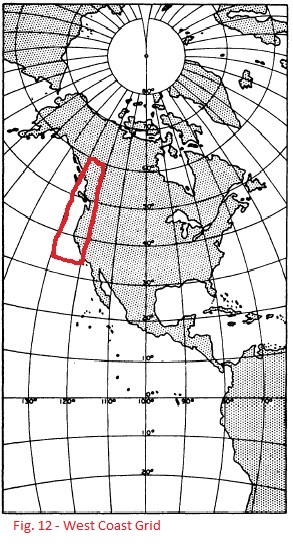
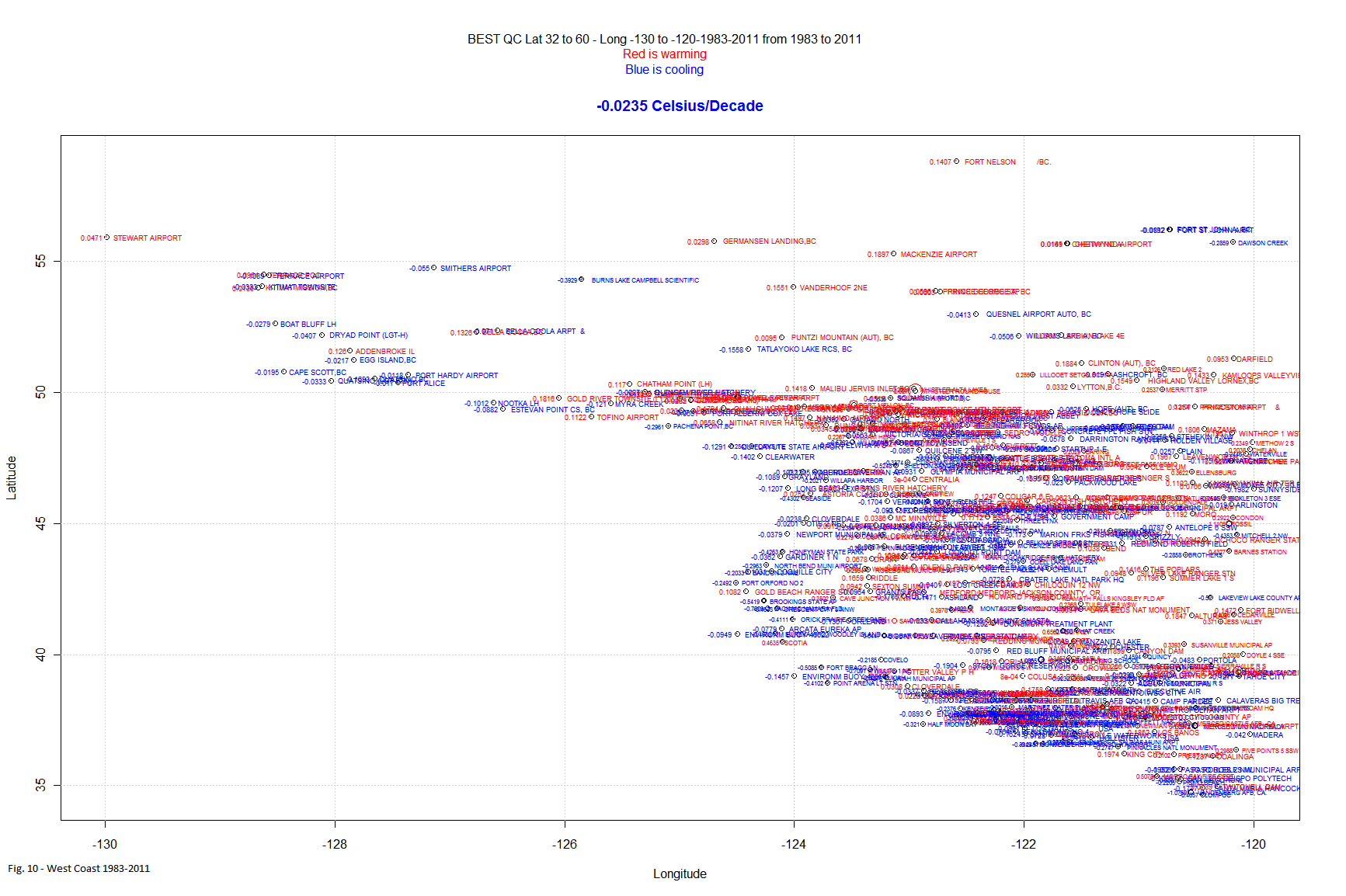
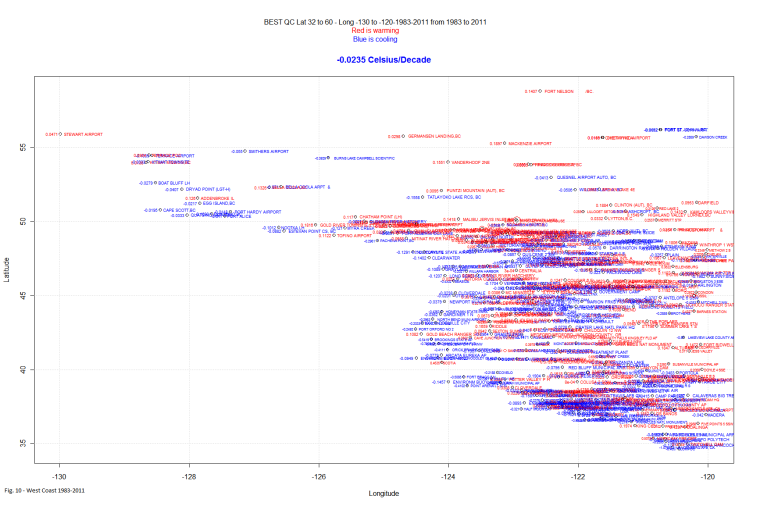
But, is the west coast warming? In this case, by West Coast, I mean a box Latitude 32 to Latitude 60 and Longitude -130 to -120. It is slightly cooling from 1983 to 2011. There appears to have been a climate shift well before the 1998 one seen in the global indexes like CRU.  Fig. 10 – West Coast 1983-2011
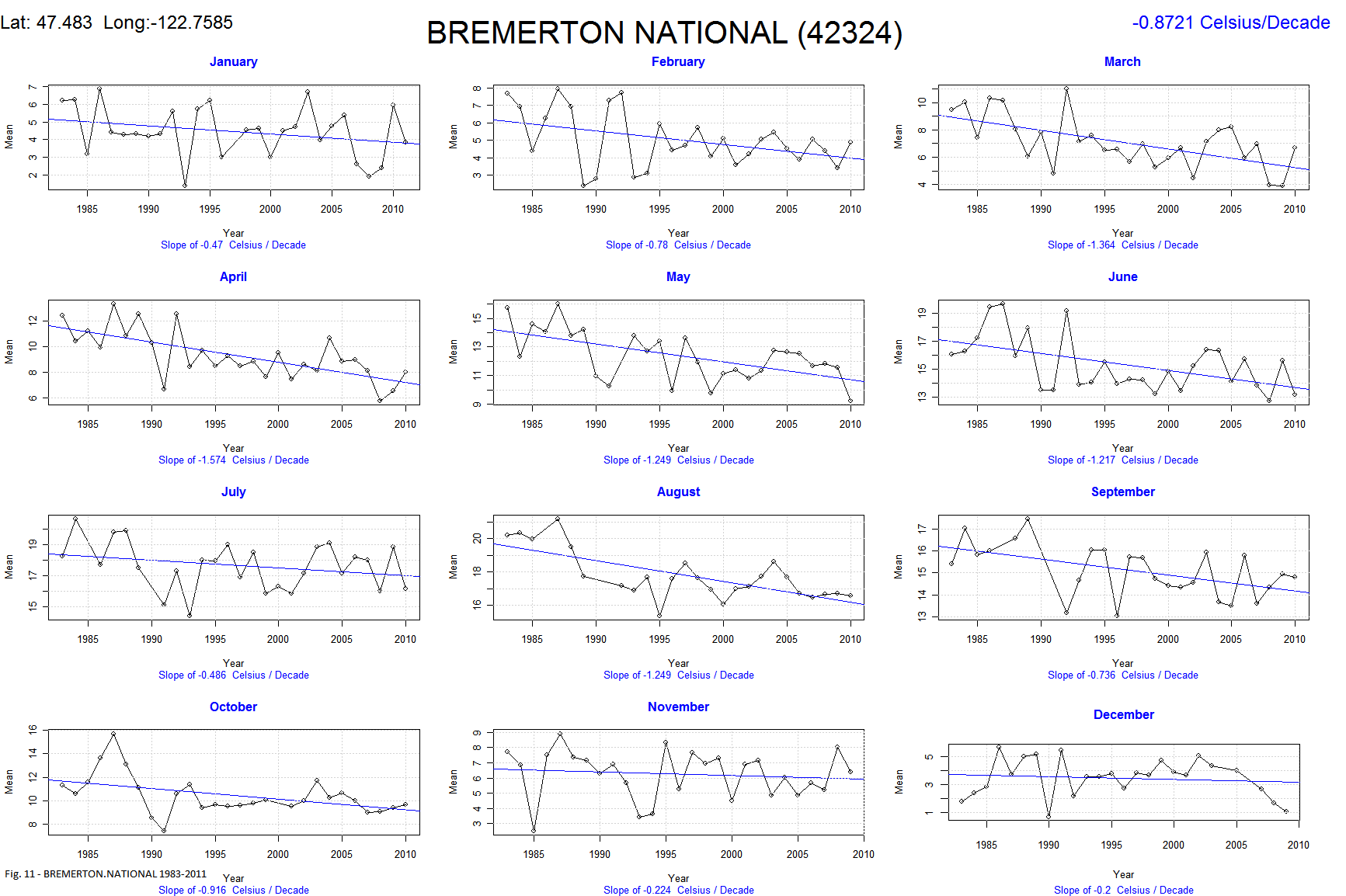
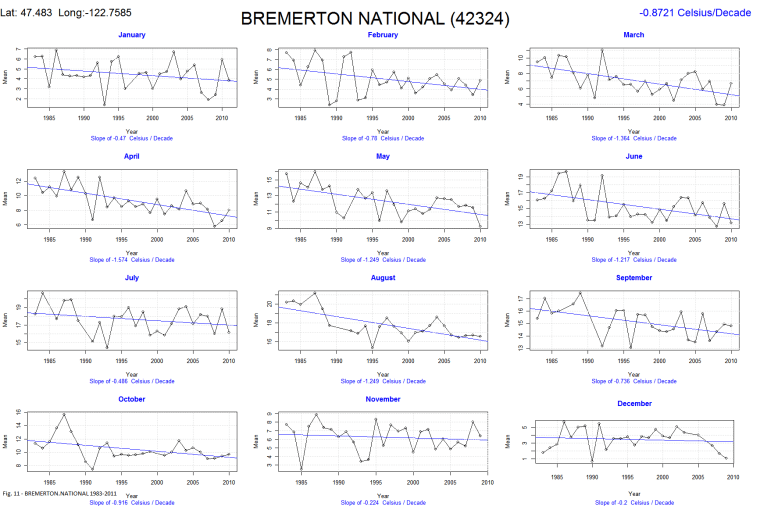
One of the stations with the biggest cooling trend is Bremerton National. It is cooling at a rate of -.87 Celsius/decade.  And it is an airport! Fig. 11 – BREMERTON.NATIONAL 1983-2011
The grid I call the West Coast is shown here in Fig. 12