Precipitation Canada February 2013

The data is from the monthly summaries put out by Environment Canada. The Normals are the station where the anomaly from the 1971-2000 average is calculated by EC.

Precipitation is in mm of rain equivalent. Some of it would be snow. About 25mm to the inch for the non-metric.

Boat Bluff’s 677mm is about 27 inches. In one month.  Toronto had 328% of normal. Triple.

Top 10 Wettest Stations in Canada by % of Normal. (Only stations with EC Normals)

Province Station Year Month Precipitation (mm) Precipitation % of Normal
ONT TORONTO 2013 2 165.4 328
SASK LEROY 2013 2 27 244
ONT TORONTO LESTER B. PEARSO 2013 2 92 216
SASK QUAPPELLE 1 2013 2 25.1 212
ONT WROXETER 2013 2 117.9 211
QUE GASPE A 2013 2 121.8 206
ONT FOLDENS 2013 2 98.4 192
SASK DUVAL 2013 2 20.6 186
NU RANKIN INLET A 2013 2 16.2 183
NWT FORT SIMPSON A 2013 2 31.6 181

Top 10 Wettest Stations by amount of precipitation.  Any station is eligible. NA means EC does not calculate normals.

Province Station Year Month Precipitation (mm) Precipitation % of Normal
BC BOAT BLUFF 2013 2 677.2 147
BC ZEBALLOS MURAUDE CREEK 2013 2 473.9 NA
BC TOFINO A 2013 2 469.6 NA
BC ESTEVAN POINT 2013 2 430.8 125
BC PRINCE RUPERT MONT CIRC 2013 2 430.7 NA
BC ADDENBROKE ISLAND 2013 2 425.4 NA
BC LENNARD ISLAND 2013 2 419.5 120
BC BELLA BELLA 2013 2 396 NA
BC PORT ALICE 2013 2 387.2 101
BC TAHSIS VILLAGE NORTH 2013 2 370.5 NA

Wind Farm Could Cause Cancer, Diabetes

Conservation groups in Southern California sued the Department of the Interior on Tuesday in an attempt to block construction of a wind farm they claim could cause nearby residents to develop health problems ranging from diabetes to cancer to attention deficit disorder.

The project is an unnecessary industrialization of pristine wilderness areas,” they said in the complaint.”

Original Article

Bright Sunshine Canada February 2013

Once upon a time, there were over 250 weather stations collecting bright sunshine data in Canada each month.

Alas we are now down to 7 stations. In 3 provinces. And only 5 of the 7 are considered reliable enough or old enough to have “% of Normals” calculated.

February 2013 was pretty gloomy in BC where sunshine was around 60% of normal  (the 1971-2000 average).

Goose Airport in NFLD was 3% sunnier than normal. Wiarton Airport in Ontario was gloomiest at 54% of normal.

Province Station Year Month Bright Sunshine Hours Bright Sunshine % of Normal
BC VICTORIA INTL A 2013 2 55 61
BC COMOX A 2013 2 53 62
BC VANCOUVER INTL A 2013 2 50 59
ONT WIARTON A 2013 2 50 54
ONT TORONTO LESTER B. PEARSO 2013 2 82 NA
NFLD CARTWRIGHT 2013 2 102 NA
NFLD GOOSE A 2013 2 130 103


Update: Eureka Top 15 Sunshine Months From the Past (See comment)

Province Station Year Month Bright Sunshine Hours Bright Sunshine % of Normal
NU EUREKA 1987 5 667 134
NU EUREKA 1989 5 632 127
NU EUREKA 1973 5 621 125
NU EUREKA 1991 5 593 120
NU EUREKA 1997 6 586 NA
NU EUREKA 2005 5 574 116
NU EUREKA 1976 5 573 115
NU EUREKA 2002 5 567 114
NU EUREKA 1981 6 565 141
NU EUREKA 1998 5 564 114
NU EUREKA 1988 7 563 156
NU EUREKA 1975 5 554 112
NU EUREKA 1981 5 548 111
NU EUREKA 1974 5 544 110
NU EUREKA 1972 5 543 109
NU EUREKA 1979 5 543 109

Conservation group sues to stop California solar plant

It’s only fair …

“LOS ANGELES – A U.S. conversation group has sued the federal government over its approval of a major solar power plant in the California desert, the latest in a string of challenges to the nation’s renewable energy goals from the environmental community.

According to court papers, the non-profit Western Watersheds Project alleged U.S. regulators approved Brightsource Energy’s 370-megawatt Ivanpah solar energy plant without conducting adequate environmental reviews, and asked the court to order the defendants to withdraw their approvals.”

“”In an ill-conceived rush to accommodate massive renewable energy projects … the federal defendants precipitously approved unnecessarily destructive energy development of the California Desert Conservation Area without first conducting adequate environmental reviews.The complaint said the project’s approval process failed to analyze and mitigate the Ivanpah plant’s impact on migratory birds, the desert tortoise, which is a threatened species under federal law, desert bighorn sheep, groundwater resources and rare plants.“”

Original Article


Antarctic Sea Ice Extent Daily Records Count

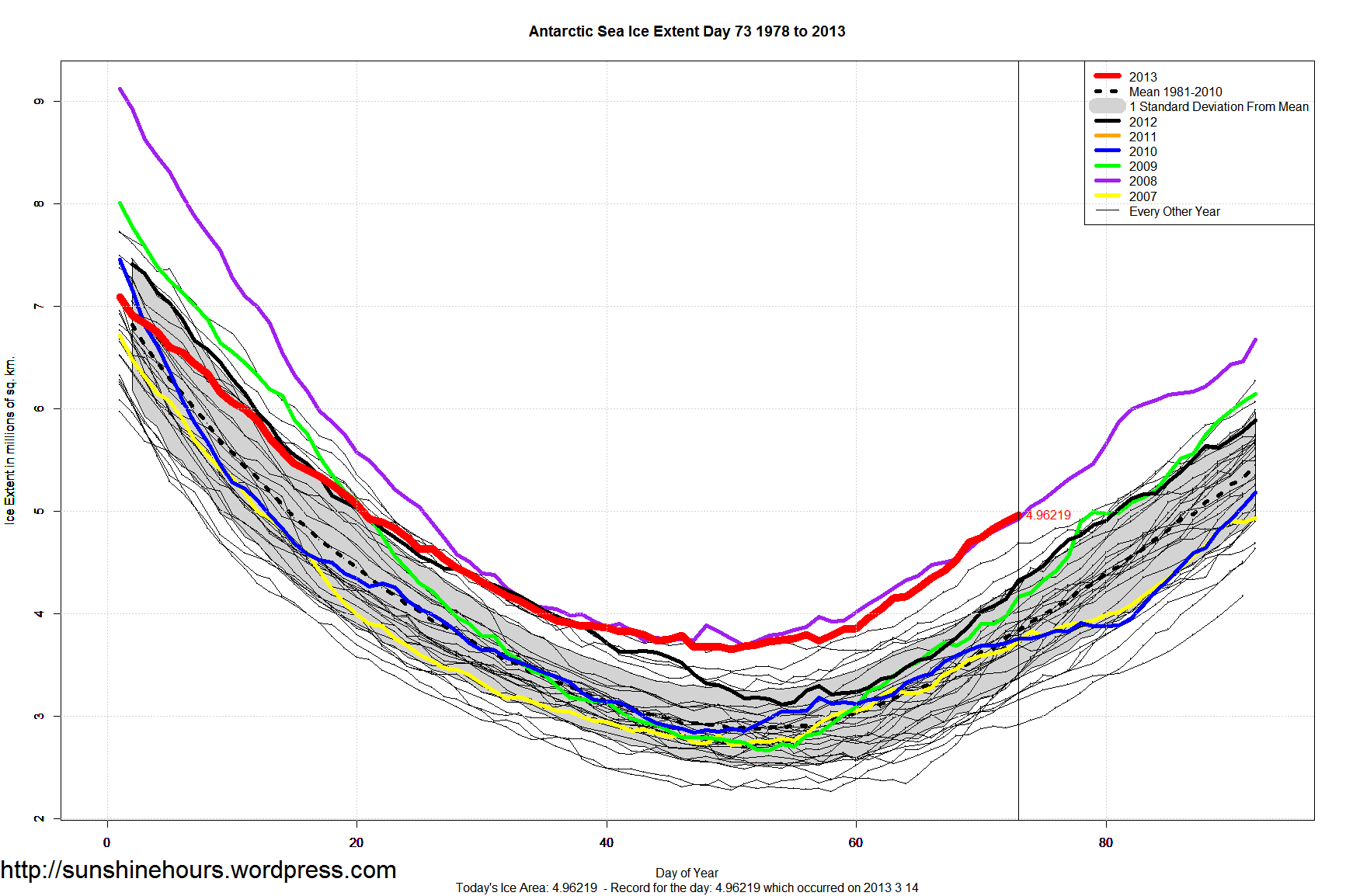
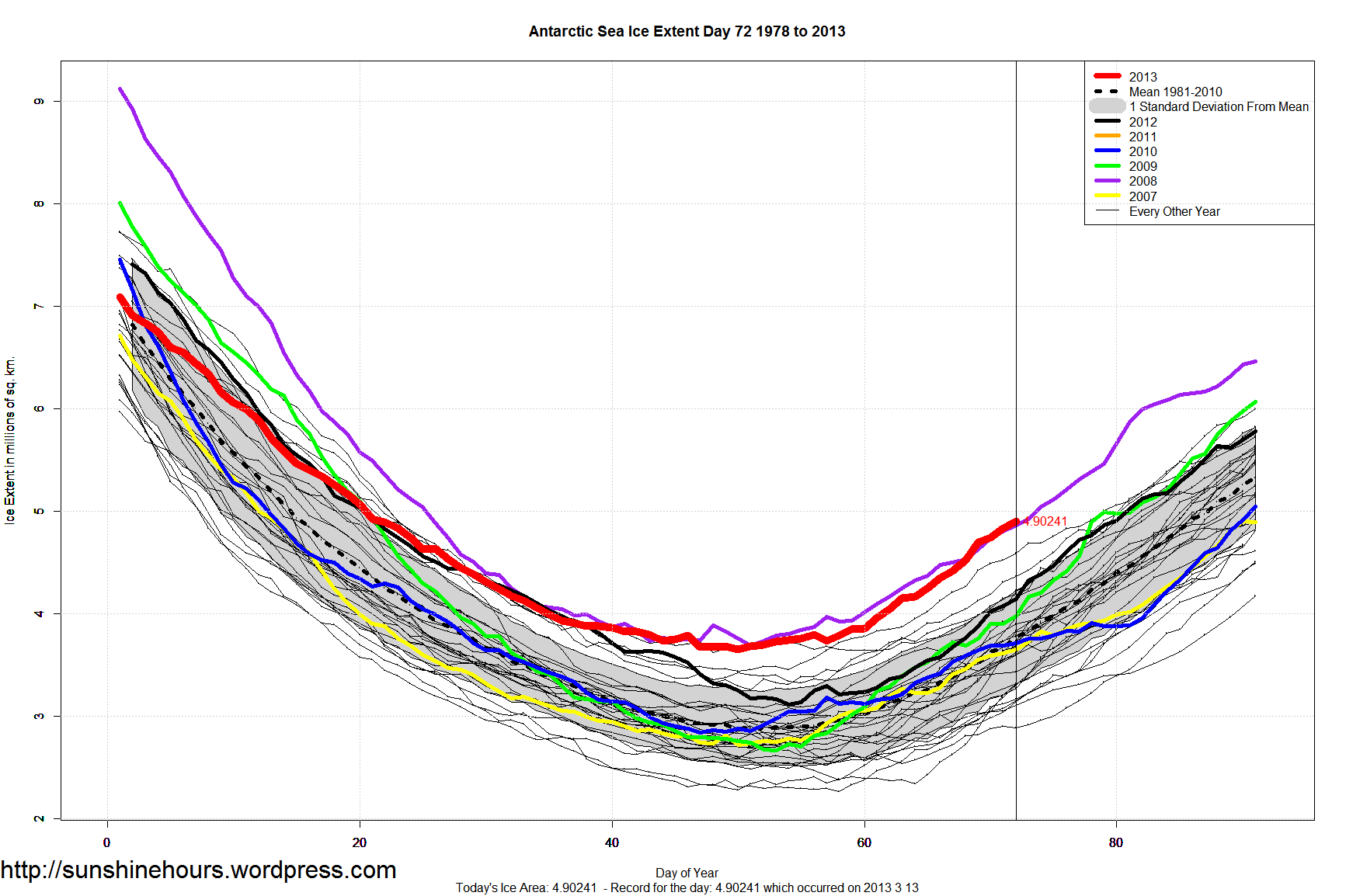
Now that 2013 Antarctic Sea Ice Extent has broken the 8th daily record, I thought I would post the updated scoreboard.

2013 has a long, long way to go to break 2010s totals or 2008.  If there were scientists at NSIDC and the MSM instead of propagandists 2008 and 2010 would have made great stories.

Don’t 1998, 1980 and 1979 look so lonely at the bottom of the list?

Year No of Records
2010 129
2008 126
2006 29
2012 24
2007 21
2009 8
2013 8
2000 6
2004 5
1998 4
2005 3
1979 2
1980 1

8th Antarctic Sea Ice Extent Daily Record For 2013 – 5th in a row

Day 73 (March 14) had Antarctic Sea Ice Extent set its 8th daily record – the 5th in a row.

2013 broke the old record from 2008 by 32,420 sq km.  2008 had broken the previous record (2001) by 240,070 sq km.

2008 was an amazing year for Antarctic Sea Ice. Did you know that on day 1 in 2008, the old record was broken by 1,391,120 sq km which had occurred in 1996?

Too bad the NSIDC “scientists” ignore Antarctica. It would have made a great story.


Antarctic_Sea_Ice_Extent_Zoomed_2013_Day_73_1981-2010

Cleaner Air = More Sunshine

I found this paper on Google Scholar. But I can’t find a direct link anywhere that works.

But it is important so I will put up this post anyway.


Cleaner Air: Brightening the Pollution Perspective?

Colin O’Dowd, Darius Ceburnis, Aditya Vaishya S. Gerard Jennings & Eoin Moran

School of Physics & Centre for Climate and Air Pollution Studies, National University of Ireland Galway

“This study has demonstrated for the first time, using in-situ PM measurements,
that reducing aerosol pollution is driving the Insolation Brightening phenomenon and
that the trends in aerosol pollution, particularly for sulphate aerosol, is directly linked
to anthropogenic emissions. Ultimately, the analysis demonstrates that clean air

policies in developed regions such as Europe are driving brightening of the
atmosphere and increasing the amount of global radiation reaching the Earth’s surface.
The actual impact of cleaner air and insolation brightening on temperature remains to
be elucidated”

As I’ve said before, cleaner air may have warming the earth after 1975. Dirtier air after 2000 may have stopped the warming.


USA NOAA Feb 2013 State Temperatures – Arizona 16th Warmest out of 119 – 103 Were Warmer.

Arizona was coldest state by ranking. 16th warmest out of 119 for February 2013. 103 February’s were warmer.

19 of the lower 48 states were ranked less than 60 out of 119, which is pretty cold.

The warmest state in terms of ranking was Maine at 105, still colder than 14 February’s.

The biggest difference between Feb 2013 and the warmest Feb was Minnesota, 14.9F colder than 1987.

Only twos state has the warmest February in the 2000s, Colorado and Connecticut.

No sign of “global warming” in February’s in the USA.

State Feb 2013 Feb Rank Out of 119 Warmest Year Warmest Year Temp Difference Warmest vs 2013
Arizona 42.1 16 1957 51.5 9.4
New Mexico 35.6 22 1995 44.4 8.8
Utah 27.2 28 1995 39.3 12.1
Colorado 25.2 37 2000 34.4 9.2
Nevada 32.6 38 1963 41.9 9.3
California 46.6 46 1991 53.2 6.6
West Virginia 32 47 1990 40.6 8.6
North Carolina 41.8 50 1990 49.9 8.1
South Carolina 46.1 50 1990 54.3 8.2
Arkansas 43.1 56 1930 51.5 8.4
Ohio 29.1 56 1930 37.7 8.6
Wyoming 22.7 56 1991 30.9 8.2
Indiana 30.2 57 1954 39.5 9.3
Kansas 33.3 57 1930 45.1 11.8
Oklahoma 40.8 57 1976 50.5 9.7
Mississippi 48.4 58 1927 57.5 9.1
Virginia 37.1 58 1976 44.7 7.6
Kentucky 36.5 59 1990 44.8 8.3
Maryland 34 59 1990 41.8 7.8
Illinois 29.6 60 1954 39.2 9.6
Missouri 34.2 60 1954 43.7 9.5
Georgia 48.9 61 1932 57.6 8.7
Wisconsin 17.2 61 1954 28.4 11.2
Michigan 20.9 62 1984 29.5 8.6
Minnesota 12.8 63 1987 27.7 14.9
Alabama 48.3 65 1932 58 9.7
Pennsylvania 27.9 65 1954 34.7 6.8
Tennessee 40.8 65 1932 49.1 8.3
Oregon 36.4 66 1991 42.4 6
Nebraska 28.2 69 1930 38.8 10.6
Idaho 28.4 72 1963 35.7 7.3
Iowa 23.9 73 1998 34.7 10.8
New York 23.4 73 1984 30.6 7.2
Rhode Island 30.9 76 1998 36.5 5.6
Louisiana 54.1 79 1927 61.1 7
New Jersey 33.2 79 1990 38.9 5.7
Texas 51.5 79 1957 56.7 5.2
Connecticut 29.2 82 2012 34.8 5.6
South Dakota 23.8 82 1999 32.9 9.1
Massachusetts 28.5 83 1984 33.5 5
Florida 61.8 84 1949 67.5 5.7
Delaware 37.2 86 1990 43 5.8
Washington 37 86 1958 41.6 4.6
North Dakota 16.2 87 1998 27.8 11.6
Montana 28 96 1954 33.7 5.7
New Hampshire 23.4 98 1984 29 5.6
Vermont 21.7 98 1984 27.5 5.8
Maine 20.7 105 1984 25.5 4.8

Cold May Kill As Many as 30,000 in UK this Winter

“BRITAIN’S relentless big freeze has sparked fears of the highest winter death rate for five years.
By: Nathan Rao
Published: Wed, March 13, 2013

The brutal Arctic blast has seen temperatures plummet to -13C (9F) amid what could be the coldest March for almost three decades.

Pensioner groups warned the death rate among Britain’s elderly has already soared this winter with fears it could hit 30,000 – 6,000 more than last year.”

Read the rest here.

(h/t Tom Nelson)