The NY Times Thinks It Is The “End Of Snow” For the Olympics

Some guy at the NY Times Thinks It Is The “End Of Snow” For the Olympics.

“In the last 47 years, a million square miles of spring snow cover has disappeared from the Northern Hemisphere

I suspect the “author” used 47 years because the Rutgers Snow Lab’s data for the Northern Hemisphere starts in 1967  (2014 – 47).

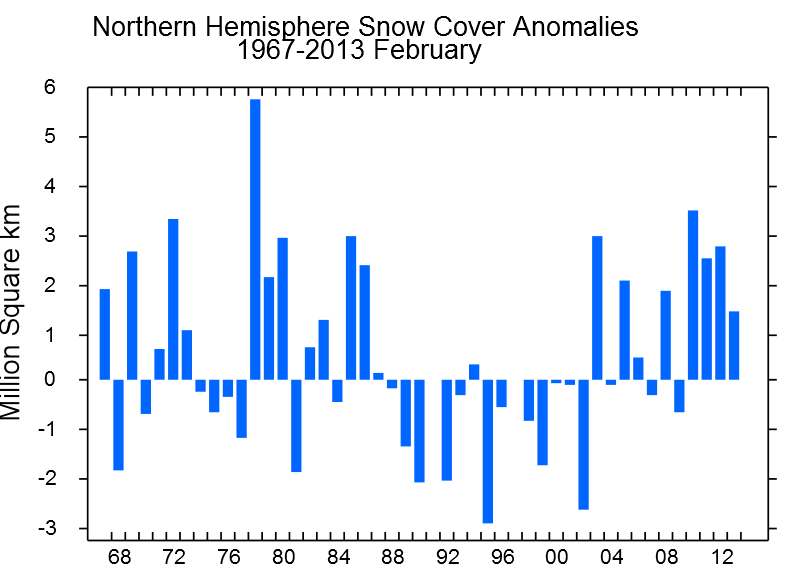
Now the Olympics usually runs in February, so lets look at snow cover data for February.
EndOfSnow

2013 in February certainly had a little less snow than 1967 (47 years ago).

But 2013 had a lot more than 1968. About 3.5 million sq km more in fact according the Rutgers snow lab.

And 2010-2013 were probably the snowiest 4 years ever. The late 1970s would be the snowiest 3 years (but that was the coldest winter in US history)

1989 to 2002 looked bad for snow. But that was a long time ago. Warmists do tend to live in the past.

Looking at that graph I would have to conclude that there is no end of snow. Snow is doing just fine in the Northern Hemisphere.

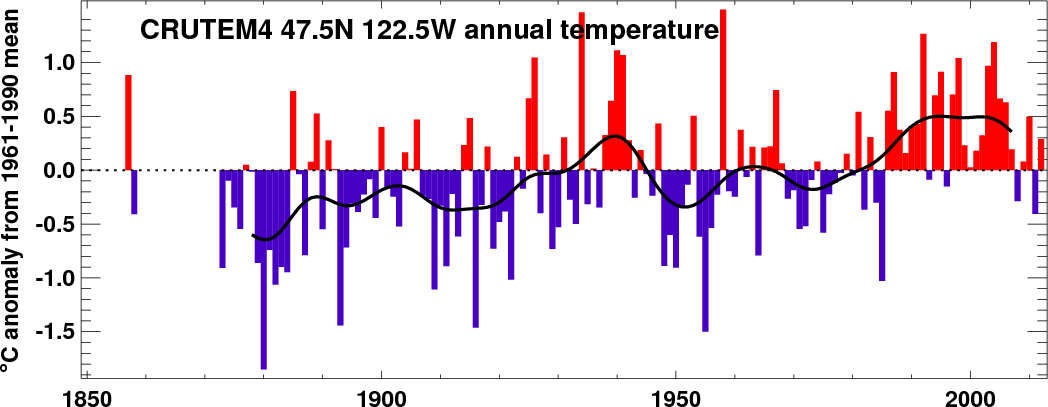
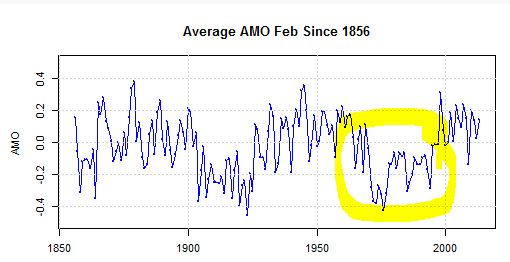
However, the lack of snow does somewhat coincide with the AMO in February being very low. But it has nothing to do with CO2.
AMO_EndOfSnow

Hail Mary Pass Attempt By Warmists to Claim Antarctica Sea Ice is Not Increasing

David Appell was kind enough to alert me to a paper written by I. Eisenman, W. N. Meier, and J. R. Norris.

They titled their paper “A spurious jump in the satellite record: is Antarctic sea ice really expanding?”

I don’t plan to demean myself by spending a lot of time on this silly hail mary pass attempt. But I will post the evidence from the papers own supplemental materials.

That evidence was pointed out by P.R. Holland in an interactive comment here.

“This paper contains solid and important science and I congratulate the authors on their
vigilance. It is certainly important to know that the uncertainties in the ice area/extent
timeseries might be larger than thought (depending upon how this finding is addressed
by the author of the timeseries in question).

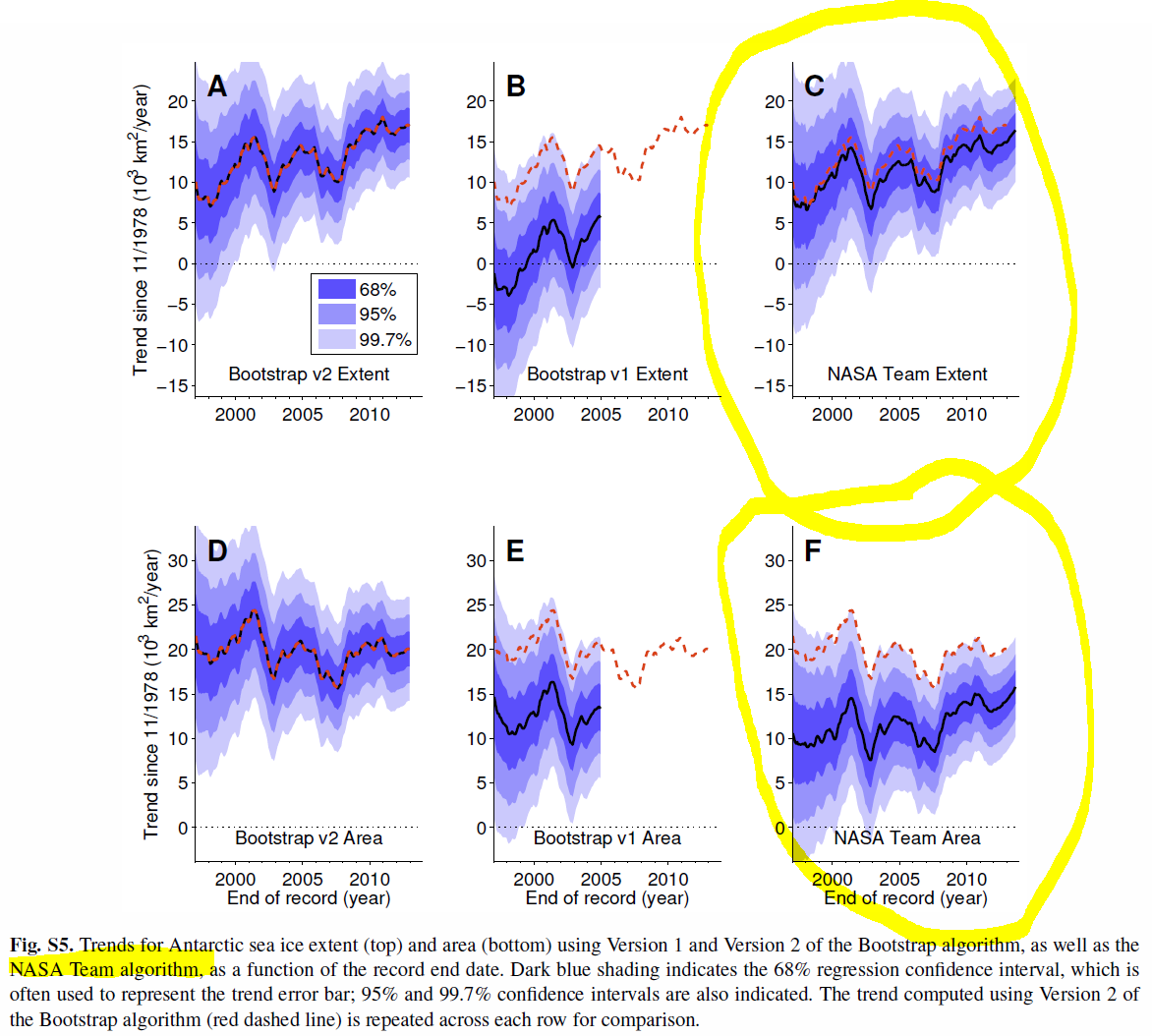
However, doesn’t Figure S5 in the supplementary material show that whatever the
source of the Bootstrap issue, there is no doubt that Antarctic sea ice is increasing in
both area and extent? The trends appear significant whichever of the three time series
one chooses. Even if one discards Bootstrap altogether on the basis of this paper, the
NASA Team series clearly shows significant increases. These two facts imply that the
title of this paper is misleading, and so is much of the discussion and abstract. The
clearly significant increases in all 3 datasets are not accurately reflected by the paper
text, abstract, or title.

With the eyes of the climate change lobbies (on both sides) watching this debate, it
is very important that papers’ titles, abstract, and conclusions accurately convey the
facts. Very few journalists will check the content of the paper before reporting its title,
and no-one should be expected to examine the supplementary figures of a paper.”

Figure S5 from supplement here. The yellow circled items are the NASA team data that is not using the bootstrap algorithm.

Cryosphere S5

XKCD and Global Warming and St Louis

XKCD is a funny geeky comic that I read quite regularly. The blog Inconvenient Skeptic has a good post about being annoyed with a recent XKCD strip that mocks people for using the recent cold days to “disprove” global warming.

Go ahead, read the blog posting (if you are still interested) and comic and then return here.

I was ticked at XKCD for the obvious reason. The mainstream media always loves to blame global warming for any warm spell but never uses cold spells to mock the concept of global warming. I guess when XKCD followed along I was disappointed.

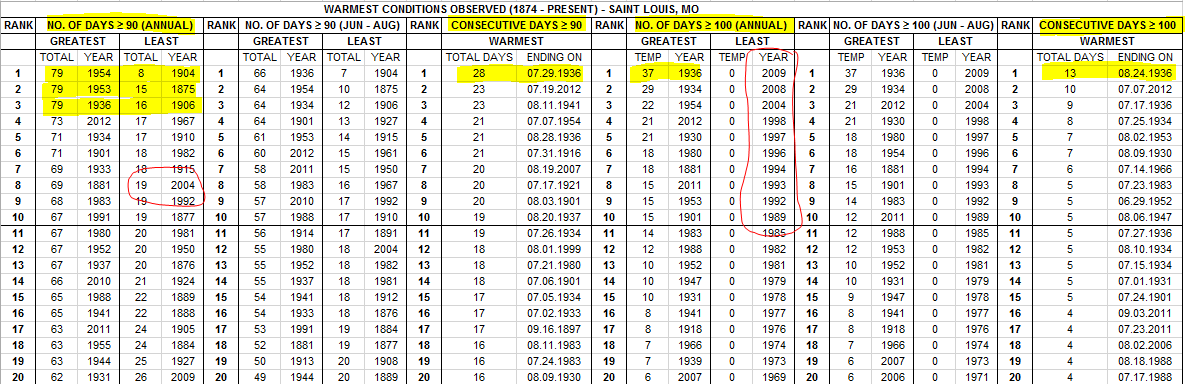
However, beyond that point I was interested in the St Louis data linked by the blog post here. I was immediately interested in the heatwave data in this Excel spreadsheet. I’ll just show the top twenty rows.

Notice 2012 didn’t make the top of any highlighted lists. It came close.  But 1954, 1963 and 1936 had more days greater than 90F. 1936 topped consecutive days above 90F.

And 1936, 1934 and 1954 topped the list of days over 100F. And 1936 was the year with most consecutive days above 100F.

And the red circled years are the Least number of days above 90F and 100F. Notice there are recent years without any 100F days at all.

And while I didn’t highlight it, notice that in 1954 22 days were above 100F. Only 18 were in Jun/Jul/Aug. The other 4 were int the spring or fall. Now thats hot.

So much for recent “warming”. St Louis had more extreme heat in the past. Even 2012 did not set new records.

StLouis_Heatwave


Baby Birds Doomed By Lightbulb Ban

Baby Birds are going to die.

“Ottawa’s Wild Bird Care Centre has put the call out for incandescent light bulbs, which it uses to provide warmth for injured and recovering birds, after the federal government banned manufacturers from making the bulbs.
In Canada, the more energy-efficient compact fluorescent light bulbs are considered the norm. The incandescent light bulbs use more power, but they are also warmer and serve an important role inside incubators.
“As the light bulb is on, it will obviously warm things up and then the setting will turn it off to keep the right temperature,” explained Mireille Goguen, who works at the centre.”

SAVE THE BABY BIRDS!!!

Call the Prime Minister of Canada.

613-992-4211

403-253-7990


Green Hypocrisy

“When they’ve got scientific evidence on their side, green campaigners spew hate speech about the evil science deniers on the other side. But the moment a scientific consensus attacks some cherished green myth (organic good, GMO bad, for example), they spew hate speech against scientists as corporate shills.”

Instapundit

Yup. Ever try and argue with a greenie that banning DDT killed millions? They get ugly really quick.

Antarctic Clown Convention HAD to Know The Ice Was Thick Way Back in October

The bunch of clowns on the MV Akademik Shokalskiy had to have known the ice was highest it has ever been. And the BBC propaganda arm still claims the voyage was to study “melting ice”.

Way back on October 16 2013 the Antarctic supply ship Aurora Australis set sail for summer season and they were interviewed:

“Voyage leader Tony Foy has told Radio National the weather forecast was not good for the start of the journey and there was a lot of ice to get through.

“We’re expecting thick sea ice on the way, but as I told the expeditioners yesterday they’ll get the full Southern Ocean experience which I’m sure they’ll all want,” he said.

“Microwave data we got last week shows the ice concentration this year is as high as it’s been since we started taking readings back in the late 70s.

I think we can expect it to be pretty slow when we hit the ice edge.”

BBC January 2 2014:

“Despite being trapped, the scientists continued their experiments, measuring temperature and salinity through cracks in the surrounding ice.

One of the aims was to track how quickly the Antarctic’s sea ice was disappearing.”

(h/t EUreferendum)

Andy Revkin Annoyed With “Climate Change Contrarians” Being “Energized”

Andy Revkin has posted an attack on the researchers who sailed into infamy in the Antarctic on the ill-fated MV Akademik Shokalskiy.

He is using terms like “bungled trip” , “unessential expedition” ,  “misadventure”,  “distraction from serious research”  and “tarnish the wider field of Antarctic science”.

But reading between the lines, it is clear to me what Revkin is really trying to say.

1) He has never gone to Antarctica and therefore managed to avoid reporting on record sea ice in Antarctica.

Revkin_Climate_Change_Contrarians_2

2) The attention brought to record sea ice in Antarctica has “energized climate change contrarians“.

Revkin_Climate_Change_Contrarians_1

I would translate the term “distraction from serious research” as meaning “brought attention to the wrong pole” … the one with record sea ice.

If the bunglers in charge of the expedition had found open water and managed to blame it on climate change, he would have jumped in with both feet trumpeting their success.