Extreme Weather Alert – Saskatchewan

“The province of Saskatchewan experienced extreme hardship during the Great Depression of the 1930s.

Grasshoppers, hail and drought destroyed millions of acres of wheat. The drought caused massive crop failures, and Saskatchewan became known as a dust bowl.

The term “Dirty Thirties” described the prairies, creating pessimistic perceptions and negative stereotypes about life in Saskatchewan.

In 1928, the net FARMING income was $363 million; by 1933, it dropped to $11 million; and by 1937, two-thirds of the farm population of Saskatchewan was destitute.

Relief costs for the Saskatchewan government escalated to $62 million, which was higher than its total revenues. At least 250,000 people left the prairie provinces between 1931 and 1941.

http://esask.uregina.ca/entry/great_depression.html


BBC: Heatwaves “More Likely” claim is ruined by the data

Paul Homewood discusses BBC claims that Heatwaves are more likely due to climate change. And because 2014 was the “hottest” year.

So I decided to look at the HADCET MAXTEMP data.

Not the average. The maximum.

I then arbitrarily set the heatwave boundary at 25C.

And then calculated the number of days over 25 and the longest stretch (ie Heatwave).

Guess what? 2014 barely ranks. Only 8 days above 25.  1911 had 29! (See large table at bottom for 25C heatwaves)

What if I set the Heatwave definition at 30C? There are only 8 years that have days over 30C.

1976 is the winner. And 1976 was 39 years ago! (Corrected from 30)

The 30C days and temps.

“1976-07-01” “1976-07-02” “1976-07-03” “1976-07-04” “1976-07-05” “1976-07-06” “1976-07-07”
“30.6” “31.8” “33.2” “31.4” “31.4” “31.6” “30.4”

30C Heatwaves

Year Days Longest Heatwave
1976 9 7
1995 5 4
1975 4 2
1906 3 3
1948 3 3
2006 3 2
1923 2 2
1990 2 2

25C Heatwave.

Year Days Longest Heatwave
1976 33 16
1995 33 10
1911 29 4
2006 26 7
1947 25 10
2003 23 10
1949 22 6
1933 21 6
1893 19 6
1921 19 6
1955 19 5
1975 19 8
1983 18 7
1989 18 7
1899 17 4
1887 16 3
1959 16 3
1990 16 4
1997 16 7
2013 16 8
2005 15 5
1884 14 5
1900 14 3
1935 14 4
1999 14 5
2001 13 5
1941 12 3
1878 11 6
1897 11 4
1898 11 5
1934 11 8
1970 11 5
1984 10 5
1901 9 5
1925 9 3
1942 9 4
1982 9 2
1991 9 3
1994 9 3
1996 9 5
2004 9 2
1906 8 5
1929 8 3
1957 8 4
1960 8 3
1969 8 3
1986 8 4
2014 8 5
1896 7 2
1919 7 2
1923 7 3
1944 7 3
1952 7 2
1973 7 4
1886 6 3
1895 6 2
1908 6 3
1914 6 2
1926 6 4
1937 6 2
1940 6 4
1945 6 3
1946 6 5
1961 6 2
2010 6 2
2011 6 3
1881 5 2
1885 5 4
1918 5 3
1930 5 4
1948 5 5
1953 5 2
1977 5 5
1987 5 2
1992 5 2
1998 5 4
2000 5 3
2009 5 4
1891 4 4
1902 4 2
1904 4 2
1912 4 3
1922 4 2
1928 4 2
1932 4 2
1936 4 3
1939 4 4
1943 4 2
1950 4 4
1963 4 2
1968 4 2
2008 4 2
1894 3 2
1905 3 2
1917 3 2
1978 3 2
1980 3 2
1988 3 2
2002 3 2
1880 2 2
1924 2 2
1972 2 2

The East Germans Have Successfully Take Over German Climate Policy

What was once launched as a – well-intentioned – green energy revolution has now mutated into a giant VEB [i.e. East German state company]. In Gabriel’s system electricity production is no longer determined by demand – as is usual in a market economy. It is not demand that determines supply – but the subsidy billions. Produced is only what wind and solar power and feed-in tariffs expensively allow, not what the public and the economy need – cheap energy. In Gabriel’s national energy system there is an ideological distinction between “good” (green) and “evil” (traditional) energy. Therefore, even profitable and clean gas power plants are switched off – as just happened to Europe’s most modern gas-fired power plant in Irsching. Instead, new subsidy-fed projects are connected to the grid without the necessary network capacity and without the necessary storage technology. For these intermittent power plants, coal power plants have to be kept running as backups, which in turn emit a lot more CO2, which now are also extra-taxed. It all feels like socialist self-perpetuating: this energy revolution cannot be stopped. 


http://www.thegwpf.com/the-madness-of-germanys-energy-socialism/

Time Magazine: Since the 1940s the mean global temperature has dropped about 2.7° F

Time magazine, June 24, 1974:

As they review the bizarre and unpredictable weather pattern of the past several years, a growing number of scientists are beginning to suspect that many seemingly contradictory meteorological fluctuations are actually part of a global climatic upheaval. However widely the weather varies from place to place and time to time, when meteorologists take an average of temperatures around the globe they find that the atmosphere has been growing gradually cooler for the past three decades. The trend shows no indication of reversing. Climatological Cassandras are becoming increasingly apprehensive, for the weather aberrations are studying may be the harbinger of another ice age.

Telltale signs are everywhere—from the unexpected persistence and thickness of pack ice in the waters around Iceland to the southward migration of a warmth-loving creature like the armadillo from the Midwest. Since the 1940s the mean global temperature has dropped about 2.7° F. Although that figure is at best an estimate, it is supported by other convincing data.

A Global Cooling Reminder

Even more from the Wayback Machine:

When Climatologist George J. Kukla of Columbia University’s Lamont-Doherty Geological Observatory and his wife Helena analyzed satellite weather data for the Northern Hemisphere, they found that the area of the ice and snow cover had suddenly increased by 12% in 1971 and the increase has persisted ever since. Areas of Baffin Island in the Canadian Arctic, for example, were once totally free of any snow in summer; now they are covered year round.

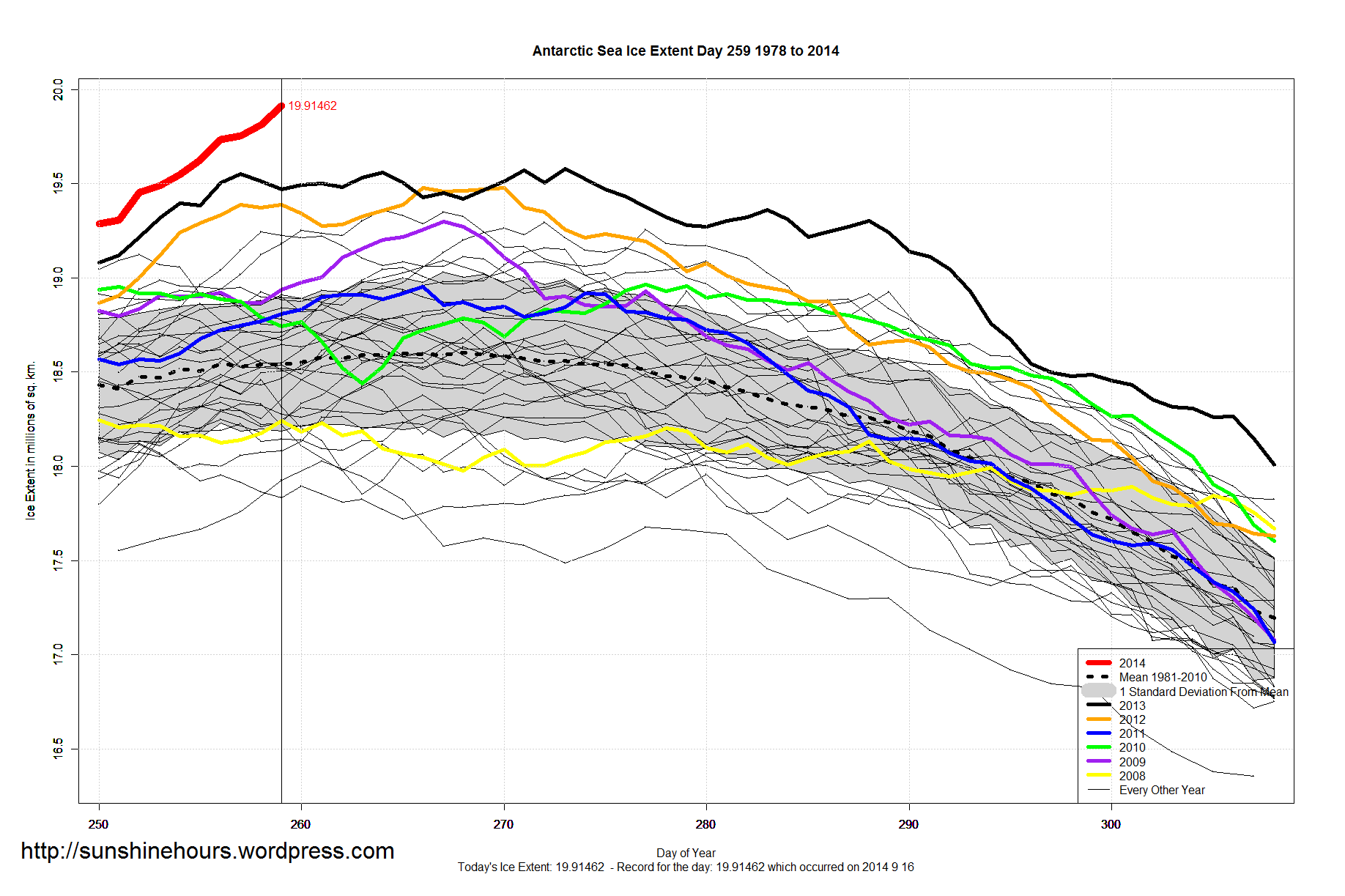
Antarctic Sea Ice Extent Sep 17 2014 – Amazing – Another 100,000 sq km – Only 85,000 sq km From 20 Million

Antarctic Sea Ice Extent Sep 17 2014 – 1,372,000 sq km above the 1981-2010 mean. Data for Day 259. Data here.

5th All-Time Record in 5 days. Skyrocketing toward 20,000,000.

Wow.


antarctic_Sea_Ice_Extent_Zoomed_2014_Day_259_1981-2010


antarctic_Sea_Ice_Extent_2014_Day_259_1981-2010

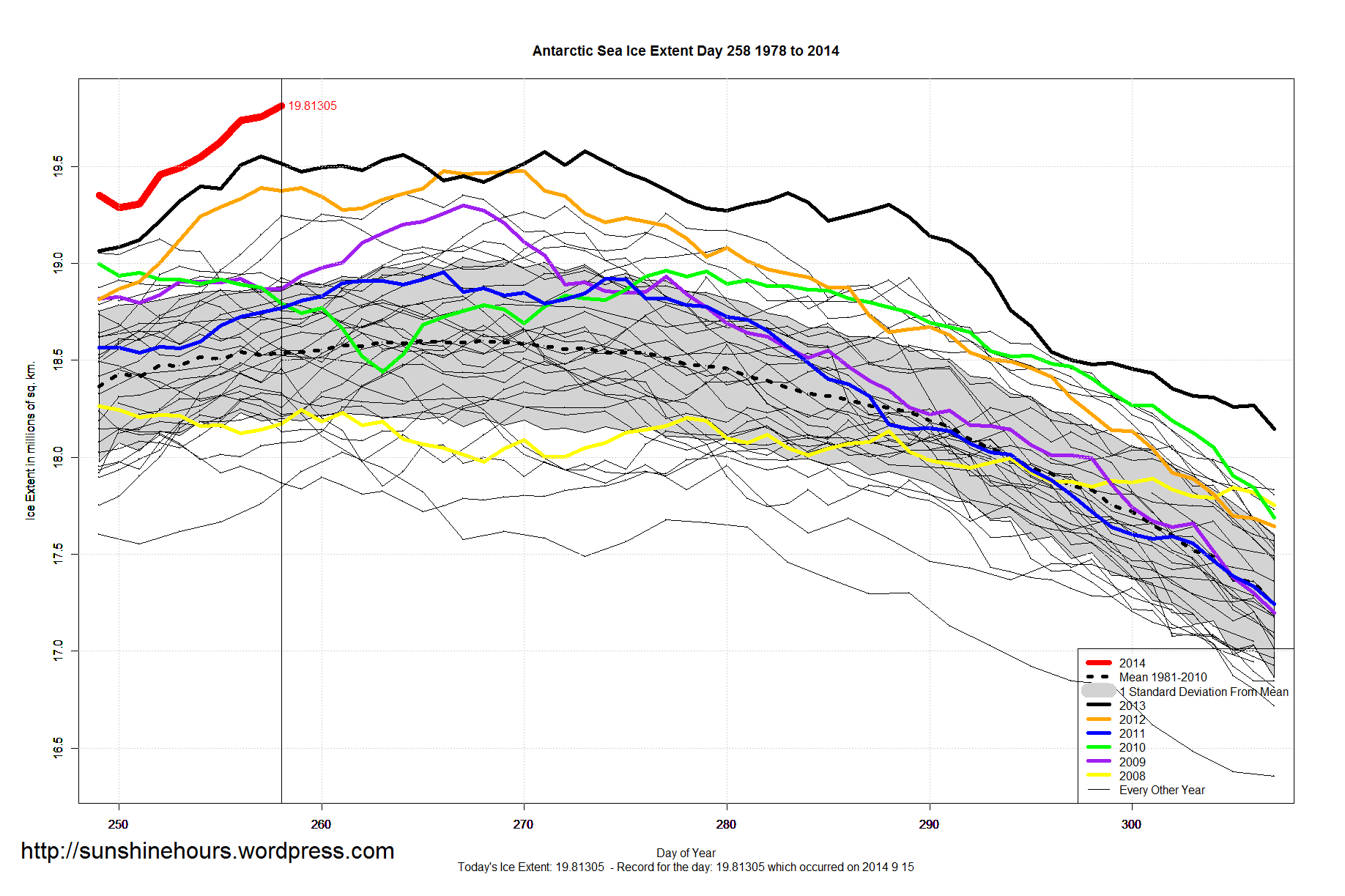
Antarctic Sea Ice Extent Sept 16 2014 – Holy Crap – Another All-Time Record – 4th In A Row

Antarctic Sea Ice Extent Sept 16 2014 – 1,273,000 sq km above the 1981-2010 mean. Data for Day 258. Data here.

4th All-Time Record in a row. 240,000 sq km higher than 2013’s record.

Holy Crap … there is a chance of hitting 20,000,000 sq km.


antarctic_Sea_Ice_Extent_Zoomed_2014_Day_258_1981-2010


antarctic_Sea_Ice_Extent_2014_Day_258_1981-2010

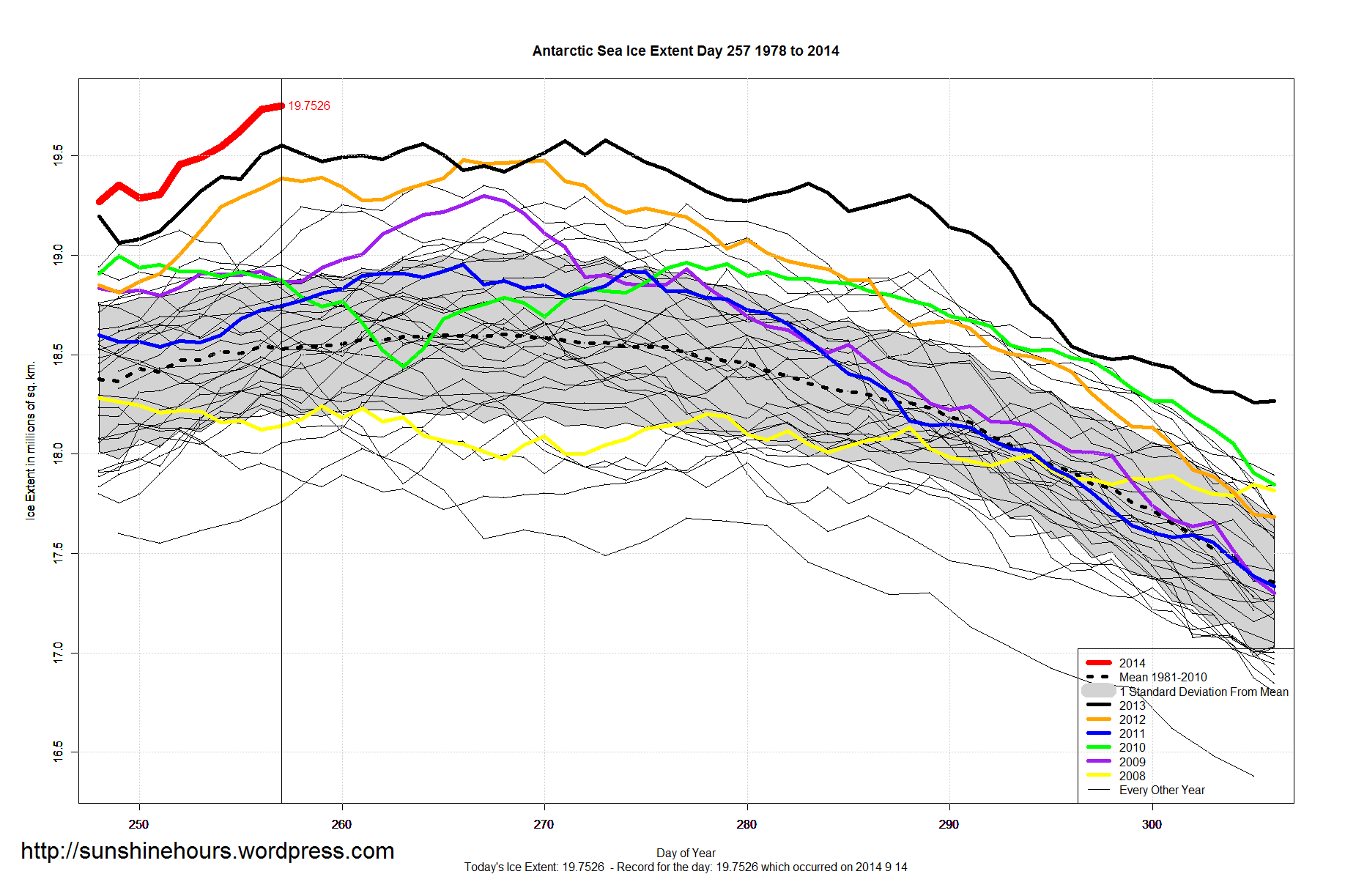
Antarctic Sea Ice Extent Sep 14 2014 – Amazing – Another All-Time Record

Update: And another record

Antarctic Sea Ice Extent Sept 14 2014 – 1,191,000 sq km above the 1981-2010 mean. Data for Day 256. Data here.

Amazing. Day 256 has broken the day 255 all-time record by 110,000 sq km. And the daily record from 2013 was broken by 230,000 sq km.

History making.

antarctic_Sea_Ice_Extent_Zoomed_2014_Day_256_1981-2010


antarctic_Sea_Ice_Extent_2014_Day_256_1981-2010

Will Britain Enjoy Fewer Cold Days Thanks To Global Warming? No.

A new “study” is out.

“Britain will have fewer days of ‘extreme cold’ and will enjoy milder winters as a direct result of climate change, according to a new study.

The new research is set to cool growing fears that the Northern Hemisphere could be gripped by more severe winters throughout the next century due to the Arctic warming up.”

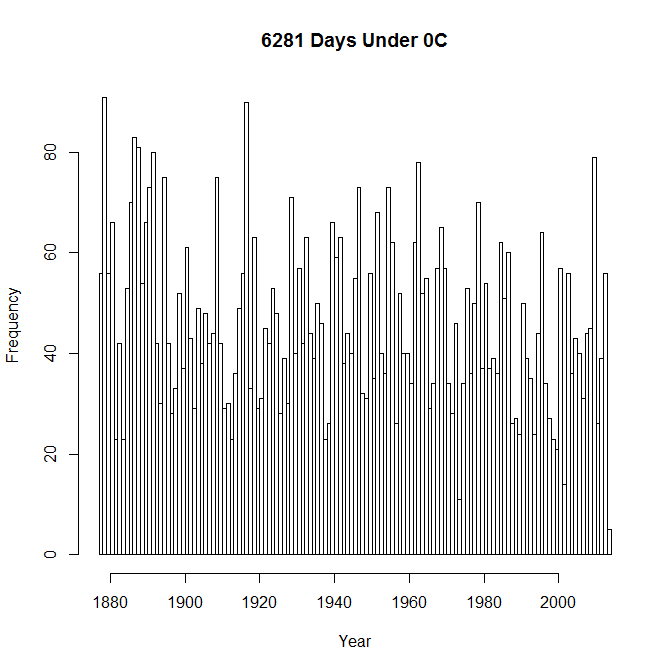
In these cases I like to turn to HADCET Daily Minimum data which is available from 1878 on. And I thought I would look at the number of days that the minimum was lower or equal to 0C for each year.

 Wow. 2010 had the 6th highest number of days that were 0C or colder. So much for “Global Warming”.

Year Days Longest Coldwave
1879 91 18
1917 90 28
1887 83 11
1888 81 23
1892 80 14
2010 79 16
1963 78 27
1895 75 32
1909 75 23
1891 73 13

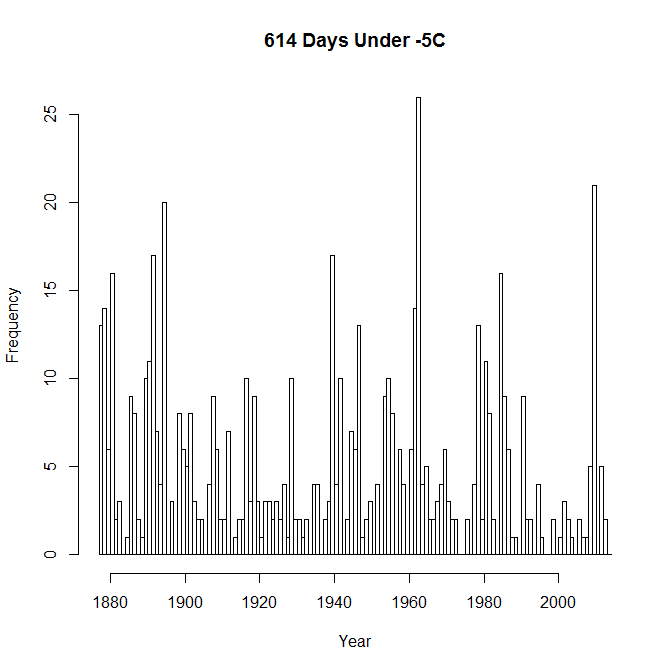
What about equal to or less than -5C? Wow! 2010 was 2nd highest with 21 days.

Year Days Longest Coldwave
1963 26 5
2010 21 5
1895 20 11
1892 17 7
1940 17 14
1881 16 8
1985 16 6
1879 14 7
1962 14 3
1878 13 6

614 Days Under -5C 6281 Days Under 0C

USA NOAA First 5 Months (Jan-May) Were Only Ranked 56 out of 120

According to the NOAA the first 5 months (Jan-May) 2014 was ranked 56th out of 120 (120 = warmest) .

The cooling trend for Jan-May dates back to 1990. 2012 was the hot aberration.

NOAA_Jan_May_2014_Temperature_TREND_1990


These are the anomalies from the Jan-May average. It has been a cold start to the year for the East while warmer in the south west.


cag_[ Statewide Avg Temp Anomalies (average between Jan 2014 and May 2014) ]