USHCN 2.5 Adjustments (Final – Raw)

Over at Nick Stokes blog they are trying to tear down a graph used by WUWT and Steven Goddard. They have made a valid point that the last few skyrocketing points may be because of late data.

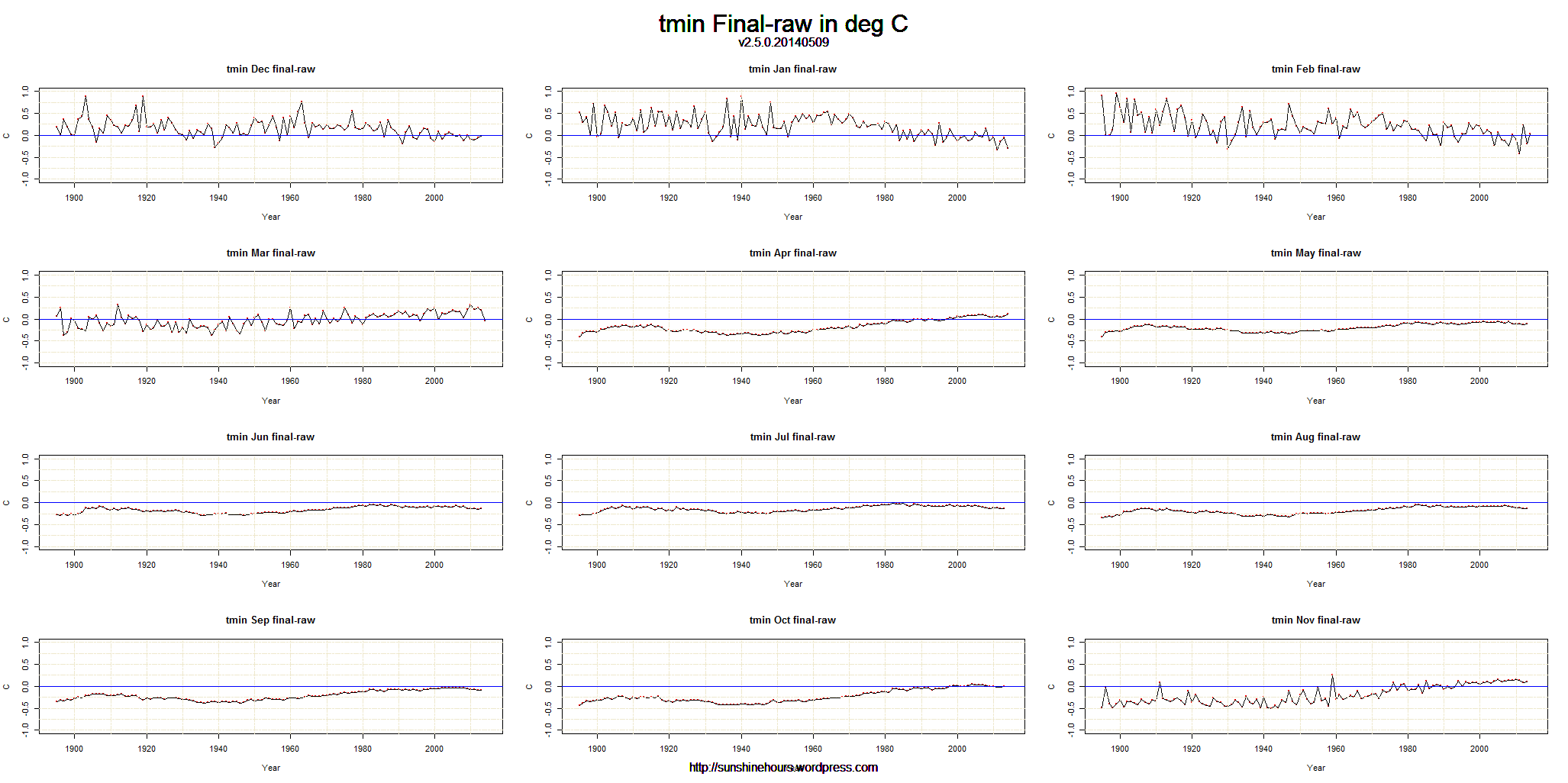
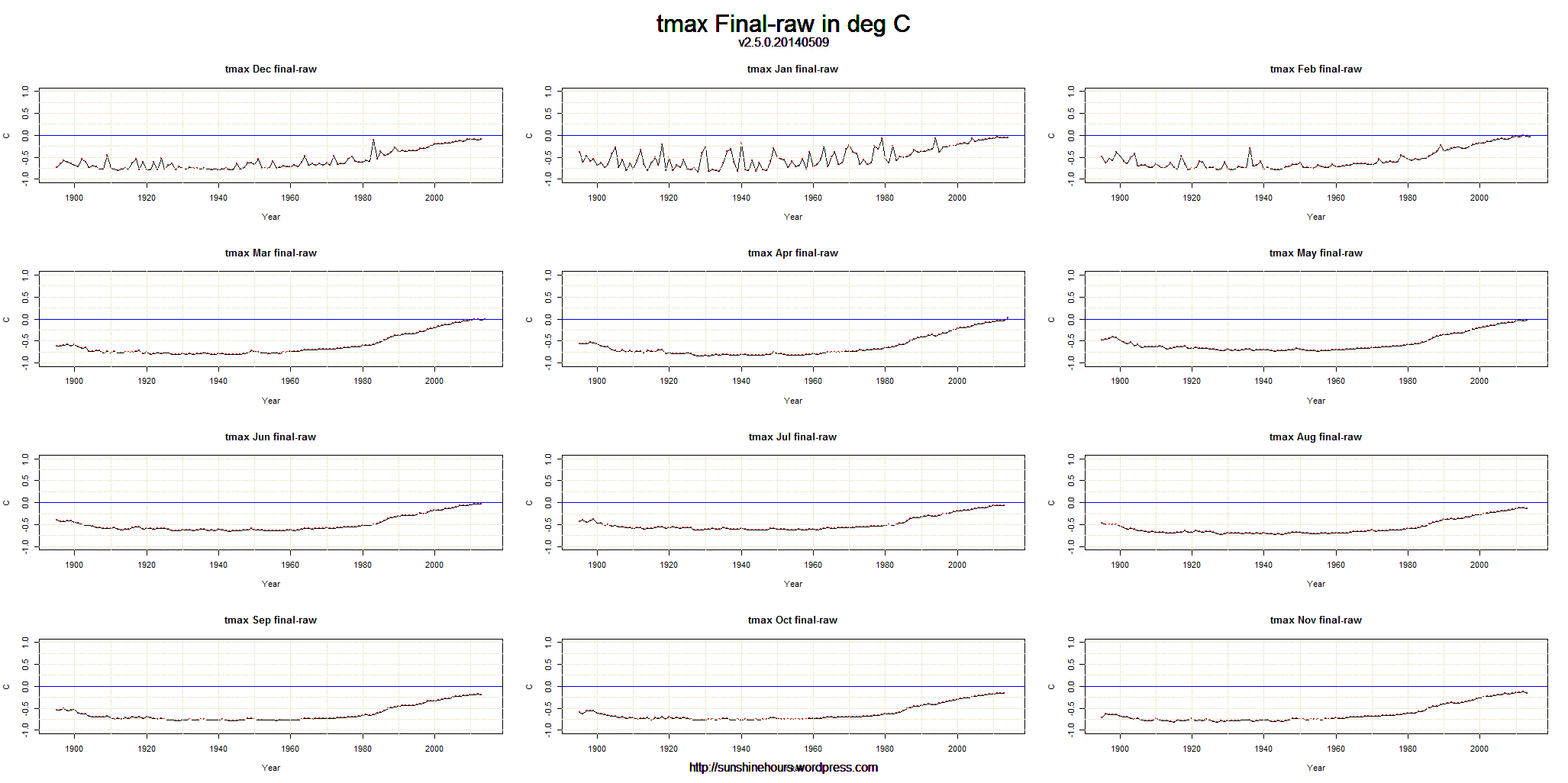
But I thought I would take a look at monthly adjustments to tavg, tmin and tmax. Each of these 3 graph sets show the Final Temperature  minus the  Raw Temperature.

1) As you can see the USHN adjustments cool the past (especially the warm 20s/30s/40s).

2) I don’t know why they adjust tmax so much.

3) I really, really want to know why Dec/Jan/Feb (and to a lesser degree Nov and Mar) are so heavily manipulated. The adjustments can change by .5C from year to year. Bizarre.

Click for bigger.


v2.5.0.20140509_tavg_final-raw_ushcn v2.5.0.20140509_tmin_final-raw_ushcn v2.5.0.20140509_tmax_final-raw_ushcn


The Streak – 1933/1934 and 2011/2012

The Hockey Schtick blog brought a recent paper to my attention.

The abstract says:

A recent observation in NOAA’s National Climatic Data Center’s monthly assessment of the state of the climate was that contiguous US average monthly temperatures were in the top third of monthly ranked historical temperatures for thirteen straight months from June 2011 — June 2012. The chance of such a streak occurring randomly was quoted as (1/3)13, or about one in 1.6 million.”

I’m not going to discuss the “chances”. But I am going to simply note the following.

The NOAA ranks months temperature and precipitation based on the number of months from 1895. So 2012 was the 118th year. If a month is ranked 118 (as of 2012) then it was the warmest month from 1895 to 2012.

Using the same 12 month June to June time frame and using data from October 2012 ( before NOAA’s recent update) it took me about 10 minutes to find out a similar streak.

From June 1933 to to June 1934 8 months were ranked 100 and above. 2 of them were ranked 118.

From June 2011 to June 2012 8 months were ranked 100 and above. 1 of them was ranked 118.


year Month Rank
1933 6 118
1933 7 104
1933 9 116
1933 12 115
1934 1 114
1934 4 107
1934 5 118
1934 6 108


year Month Rank
2011 7 114
2011 8 117
2012 1 115
2012 2 104
2012 3 118
2012 4 116
2012 5 117
2012 6 107

What are the odds of that occurring 80 years apart!


Could Climate Change Have Caused the Polar Vortex?

According to Time Magazine: “Climate change skeptics are pointing to the record cold weather as evidence that the globe isn’t warming. But it could be that melting Arctic ice is making sudden cold snaps more likely—not less

Do you want to see what a cold snap really looks like according to the NOAA?

February 1936 – Coldest Month in USA History (click on the image for the full effect)

cag_[ Statewide Temperature Anomalies (Feb 1936) ]


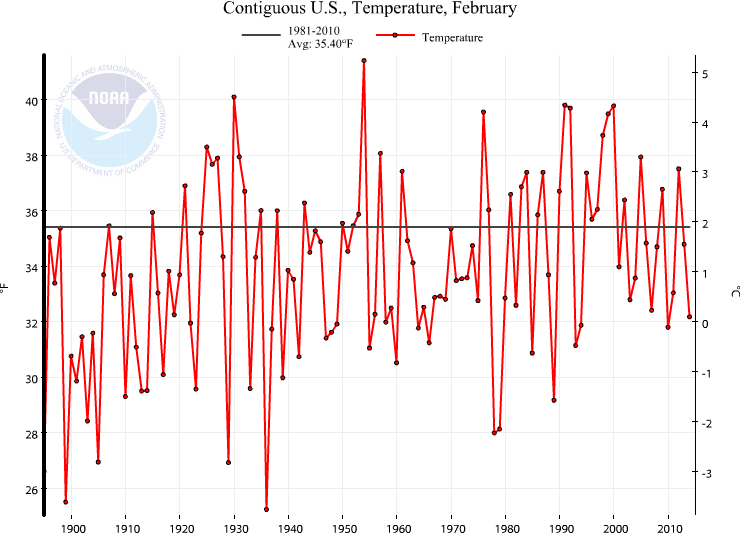
In 2014, Feb was -1.69°F below the 1901-2000 average. In February 1936 the USA was -8.59°F below average. Big difference.

NOAA_Feb_1936_Lower_48


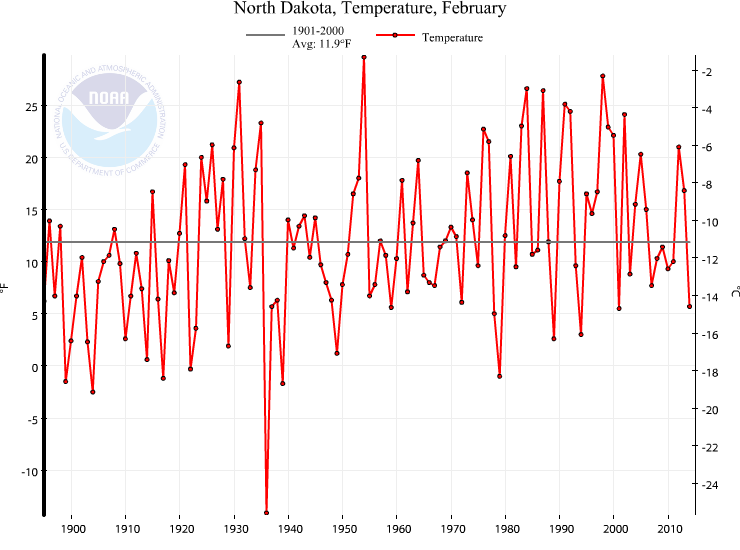
In North Dakota, February 1936 was 26.0°F below the 1901-2000 average. The whole month averaged -14.1°F below 0.

NOAA_Feb_1936_North_Dakota

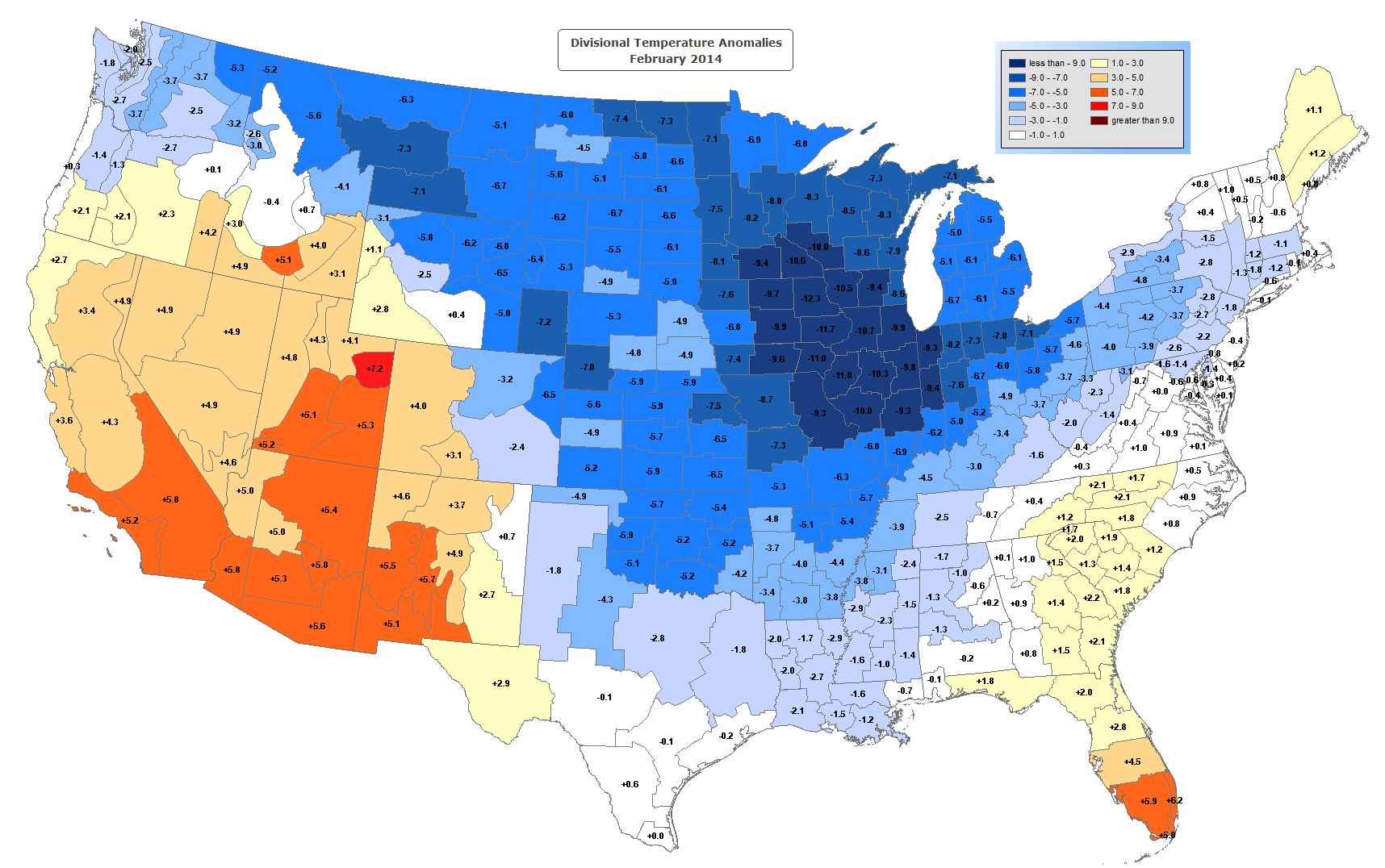
In comparison, lets take a look at Feb 2014:

cag_[ Statewide Temperature Anomalies (Feb 2014) ]

USA March 1910 versus March 2014 (according to the NOAA)

March 1910 (Before Global Warming) 7.94°F Above the 1901-2000 Average

cag_[ Divisional Temperature Anomalies (Mar 1910) ]


Some of those divisions are 16F above normal.

March 2014 (After Global Warming)  -0.99°F Below the 1901-2000 Average

cag_[ Divisional Temperature Anomalies (Mar 2014) ]

http://gis.ncdc.noaa.gov/map/cag/#app=cdo

PS I just randomly picked 1934 without checking. And then I noticed 1910 … but I’ll post the 1934 map so it doesn’t go to waste.

March 1934 (Before Global Warming) 1.28°F Above the 1901-2000 Average

cag_[ Divisional Temperature Anomalies (Mar 1934) ]


USA NOAA March 2014 – 43rd Coldest – Colder Than 1898,1900,1901,1902,1903,1904,1905,1907 …

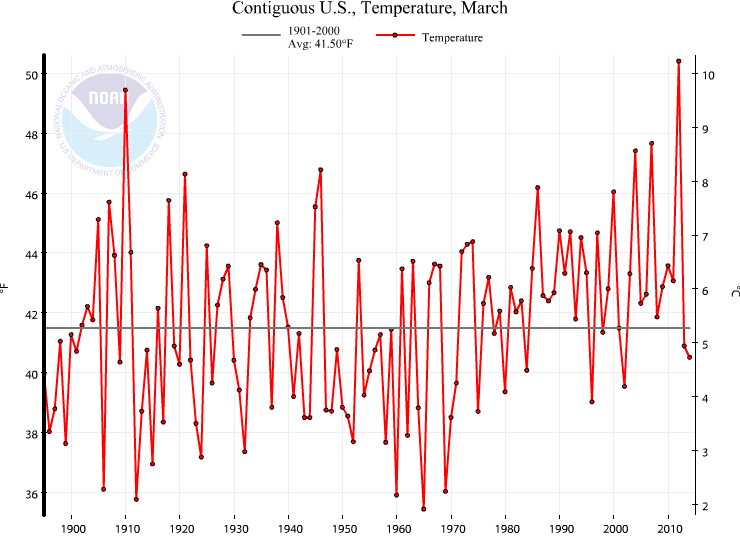
According to the NOAA March 2014 was 43rd coldest out of 120 March’s.

That is the 2nd March in a row colder than the 1901-2000 average.

This is a partial list of the March’s warmer than 2014: 1898,1900,1901,1902,1903,1904,1905,1907,1908,1910,1911,1914,1916,1918,1919,1921,1925,1927,1928,1929,1933,1934,1935,1936,1938,1939 … 

NOAA_Mar_2014


NOAA Precipitation Update as of Feb 2014 – Last 12 Months Were Normal

I missed this when it came out last month, but according to the NOAA Precipitation for the 12 month period ending February 2014 was normal.

It was .19 inches above the 1901-2000 mean.

Wasn’t there supposed to be a permanent “Climate Change” drought?


NOAA_Feb_2014_Precipitation_12 Months


Addendum: If you split the NOAA Climate History in two (March – February), these are the averages:

1895 – 1955 = 29.45 inches

http://www.ncdc.noaa.gov/cag/time-series/us/110/00/pcp/12/02/1895-2014?base_prd=true&firstbaseyear=1896&lastbaseyear=1955

1956 – 2014 = 30.44

http://www.ncdc.noaa.gov/cag/time-series/us/110/00/pcp/12/02/1895-2014?base_prd=true&firstbaseyear=1956&lastbaseyear=2014


One last one:

1980 – 2014 = 30.75 inches

http://www.ncdc.noaa.gov/cag/time-series/us/110/00/pcp/12/02/1895-2014?base_prd=true&firstbaseyear=1980&lastbaseyear=2014


Climate Change … bringer of slightly more precipitation.

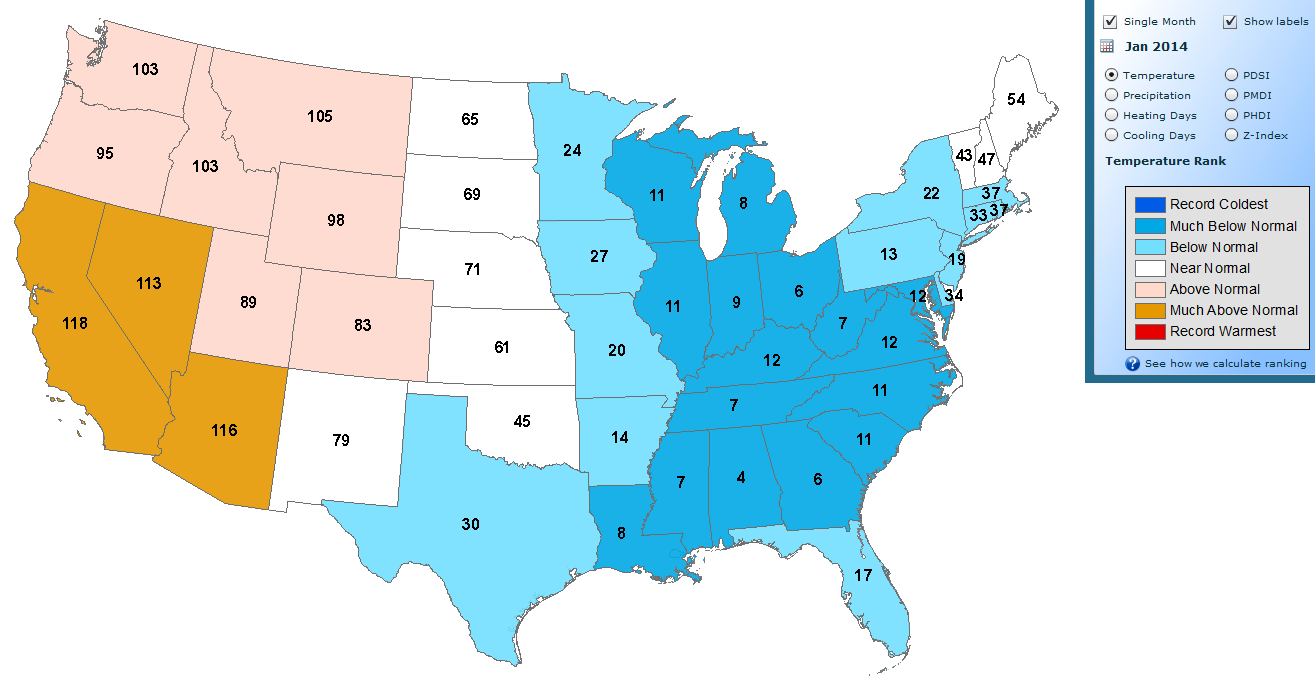
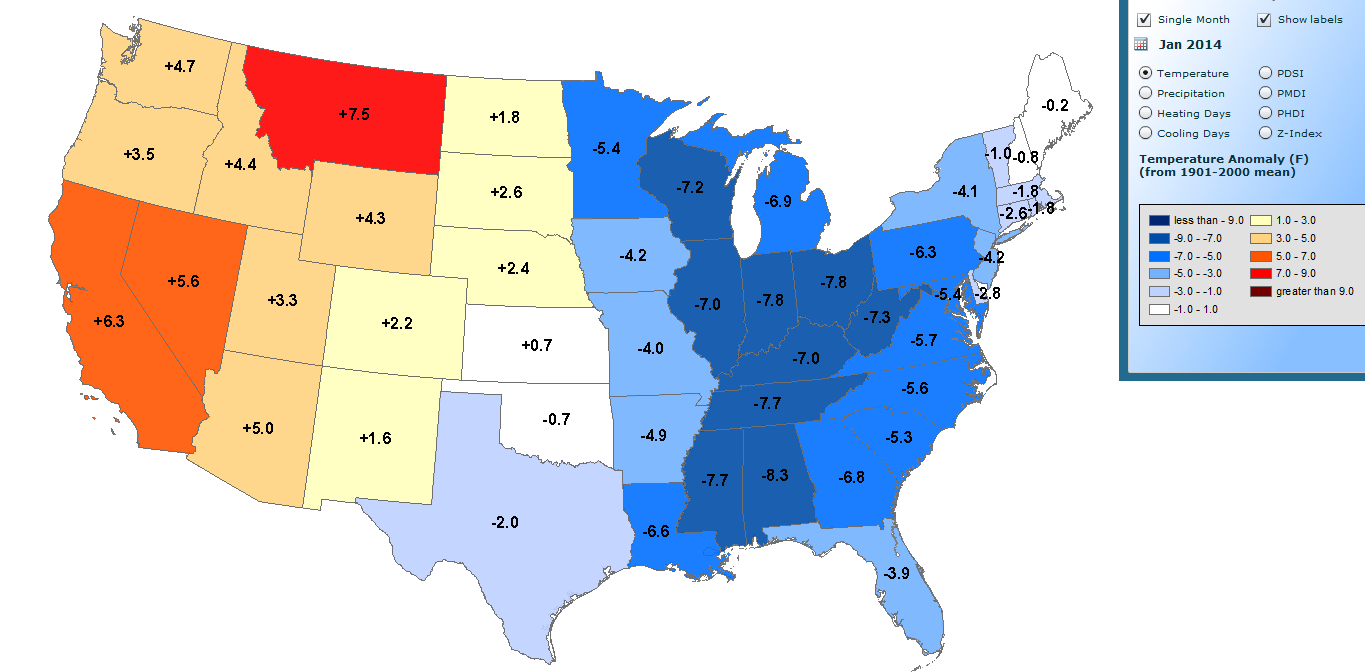
NOAA USA January – 67 January’s Were Warmer

According to the NOAA, January was only the 53rd warmest out of 120. That means 67 January’s (out of 120) were warmer.

The lower 48 states were pretty much divided right down the middle. Very cold in the east, warm in the west and normal in the states directly above Texas.

Alabama had its 4th coldest January in 120 years. It was -8.3F colder than normal. Minnesota was the coldest state, averaging 2.3F. Brrr. Only 52.3F colder than Florida.

Here are the maps of average temperature, rank out of 120 (120 = warmest) and temperature anomaly from 1901-2000

Average Temperature in F

NOAA_JAN_2014_Map_Average_Temperature

Rank out of 120 (120 = warmest and 1 = coldest)

NOAA_JAN_2014_Map_Rank

Anomaly in F from 1901 – 2000 average.

NOAA_JAN_2014_Map_Anomaly

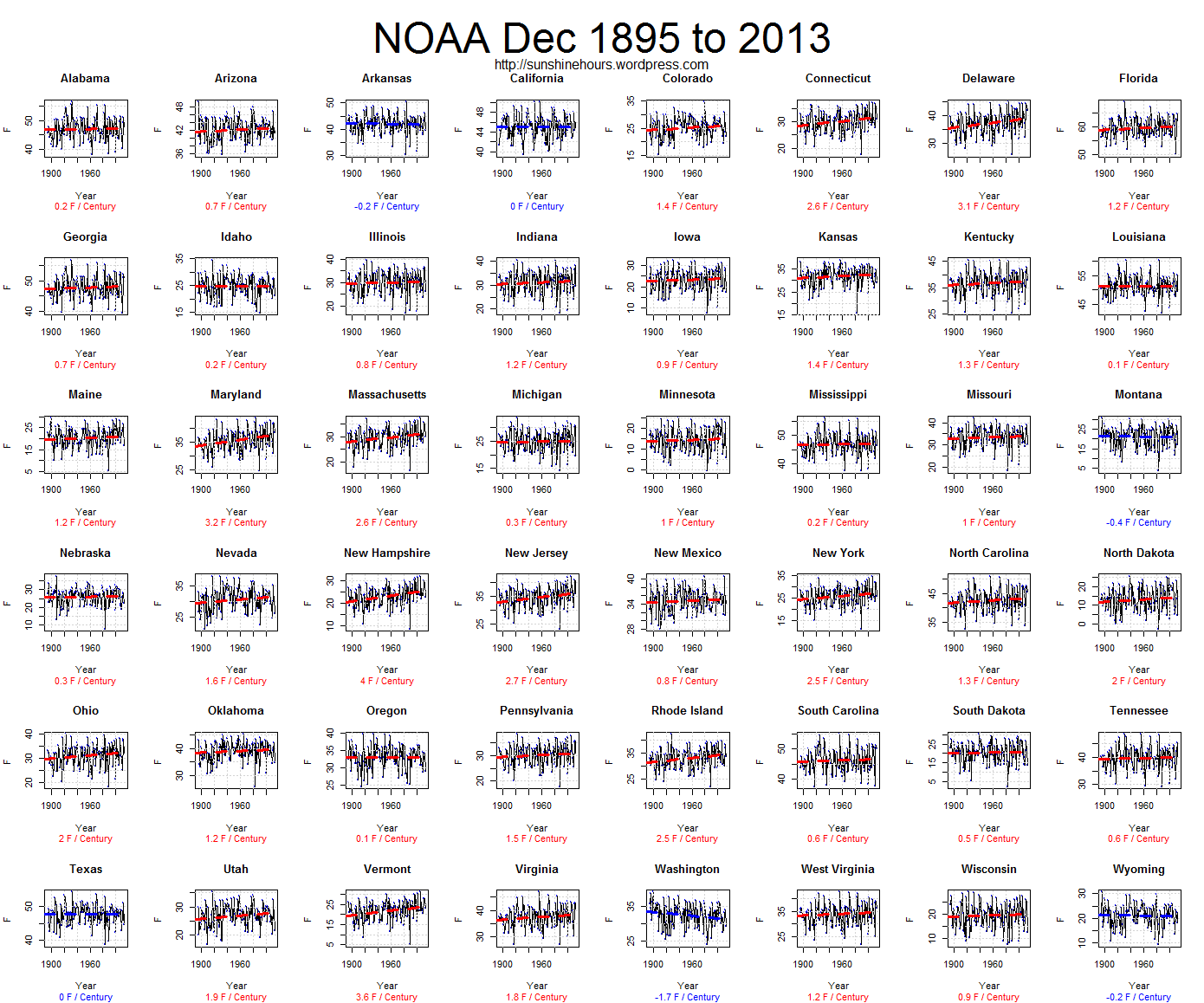
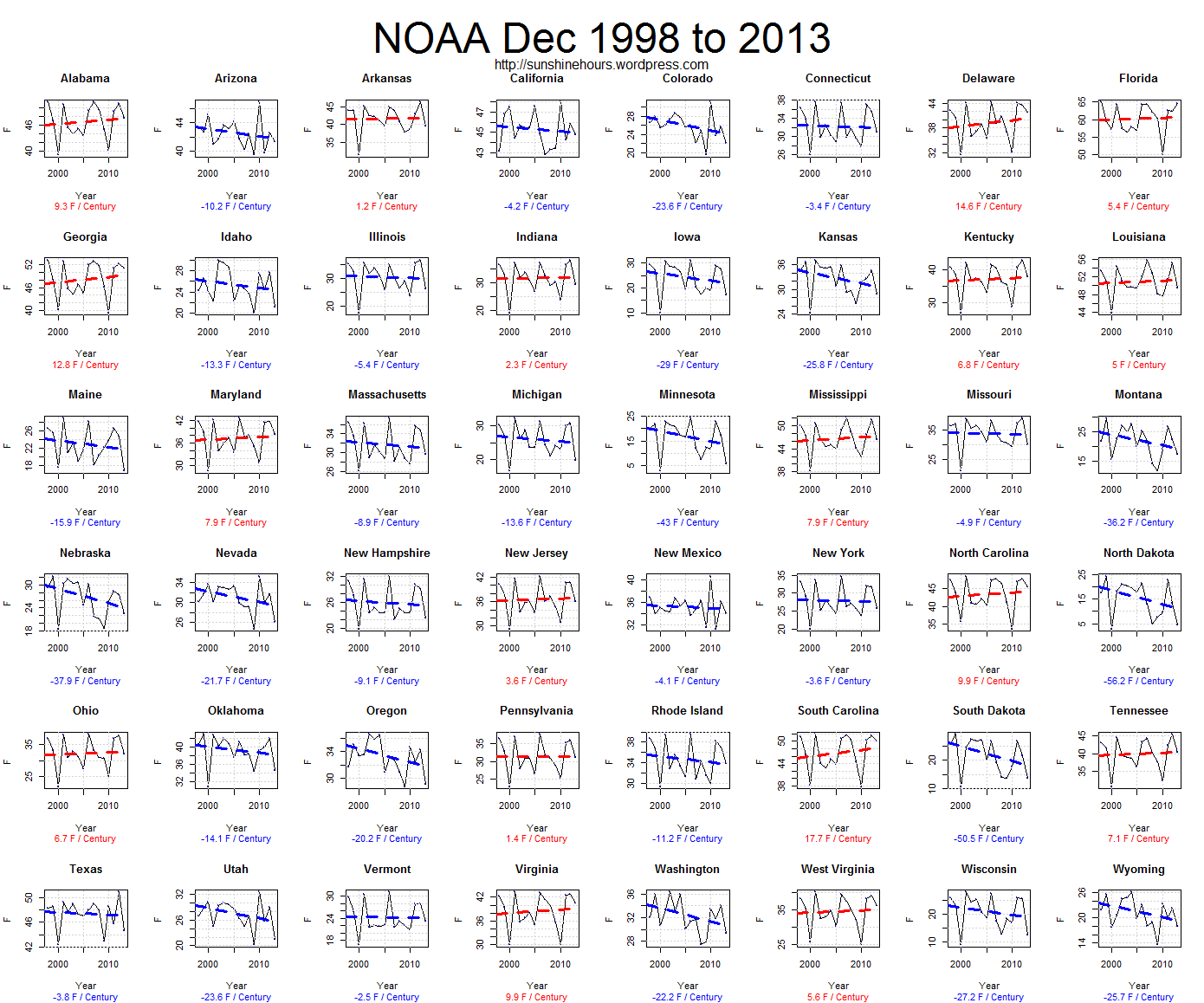
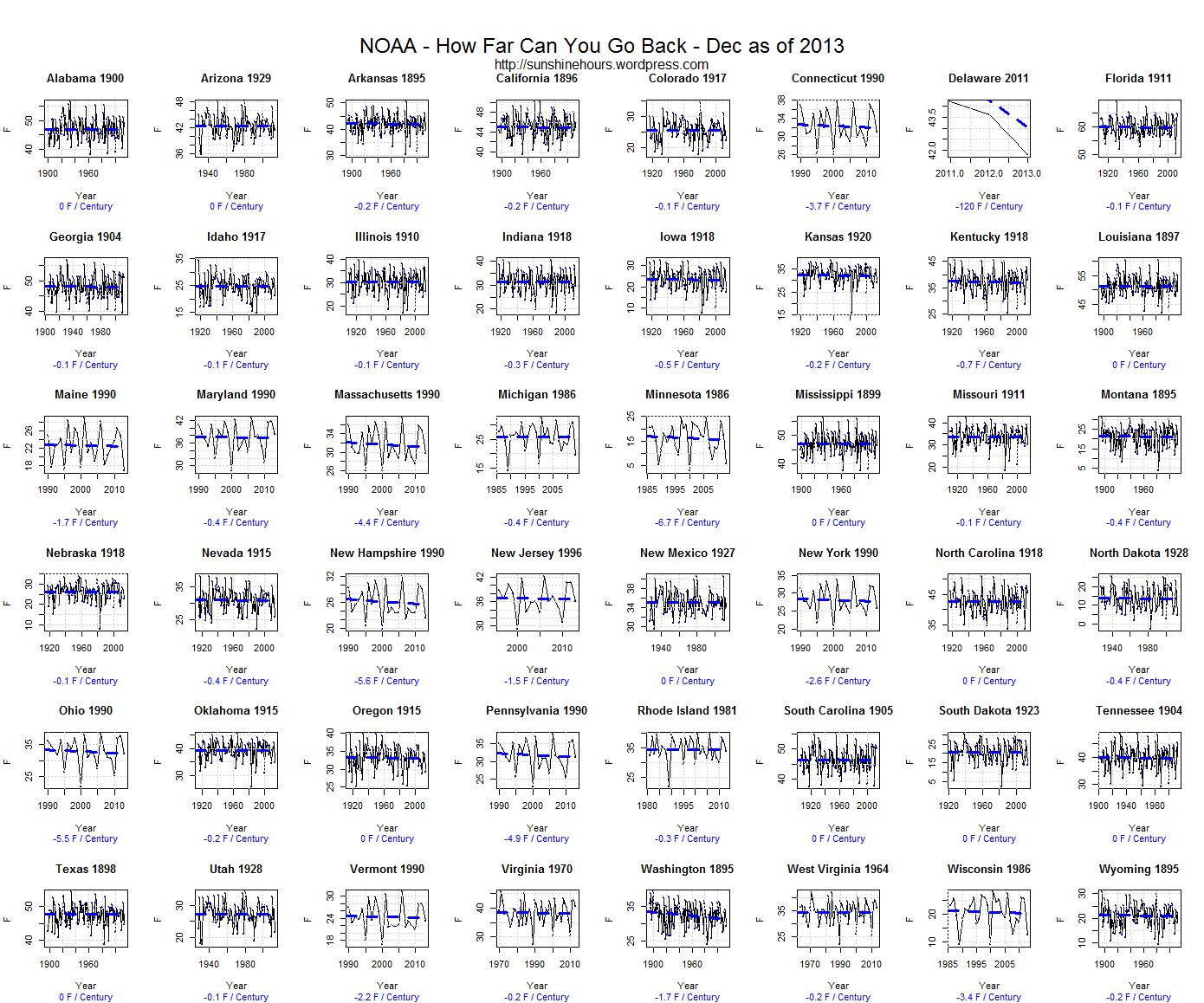
NOAA USA December 2013 – 6 States Cooling From 1895

A few interesting (to me) graphs concerning the NOAA December 2013 temperate data.

Did you know six states (the ones in blue) have been cooling since 1895?

NOAA Dec 1895 to 2013

Did you know 30 states (of the lower 48) are cooling from 1998. North Dakota is cooling at at -56F per century in December since 1998.

NOAA Dec 1998 to 2013

Did you know that if you checked to see how far back you have to go to find the longest negative trend for December, many states go back a long, long way? Only Delaware is weird. NOAA - How Far Can You Go Back - Dec as of 2013